
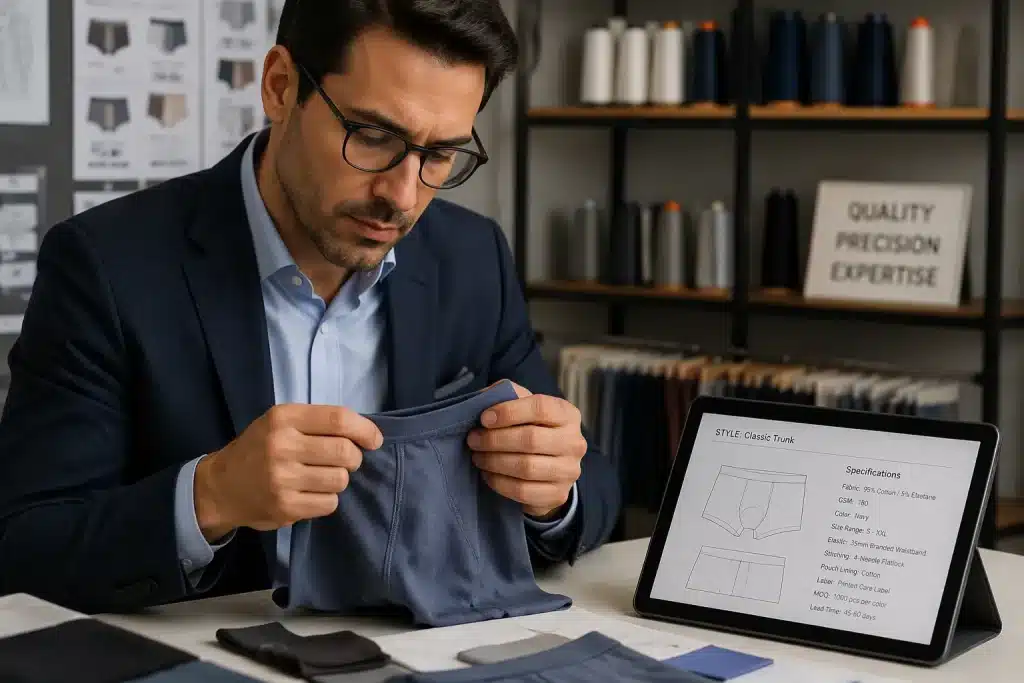
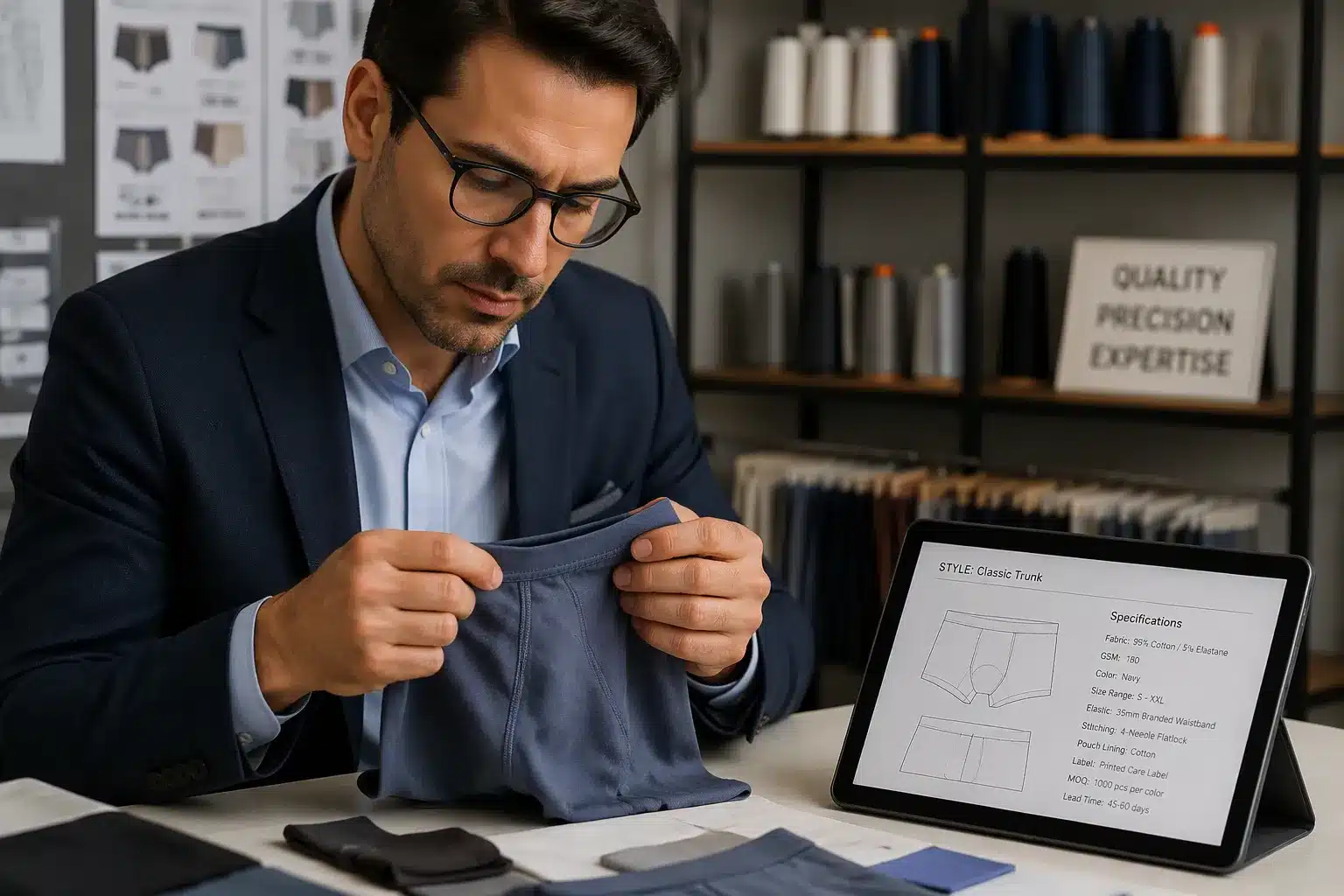
Begin your search for a supplier by checking fabric quality and the certifications that support it. Ask any mens underwear manufacturers on your shortlist for proof of GOTS or STANDARD 100 by OEKO-TEX®. GOTS covers organic cotton and the whole manufacturing process, so it matters a lot for men’s underwear. OEKO-TEX tests every part, including dye and elastic, for harmful substances.
Buyers in 2026 see performance fabrics, traceable sourcing, and flexible MOQs as basic standards, not extras. You need a quick way to compare custom underwear suppliers without losing weeks.
This checklist guides you through fabric, customization, MOQs, ethics, pricing, lead times, and communication in the order you should check them. Use it to review each underwear manufacturer before you commit.
Key Takeaways
Check the quality of the fabric and its certifications, such as GOTS and OEKO-TEX, to make sure it is safe and comfortable.
Find manufacturers that let you order small amounts and test samples to check fit and how it’s made.
Pick suppliers that treat workers fairly and use materials that are good for the environment, so production can be sustainable.
Ask for clear pricing and reliable lead times to avoid hidden costs and delays.
Try a small order first to check communication and support before you commit to large production.
Fabric Quality in Mens Underwear Manufacturers
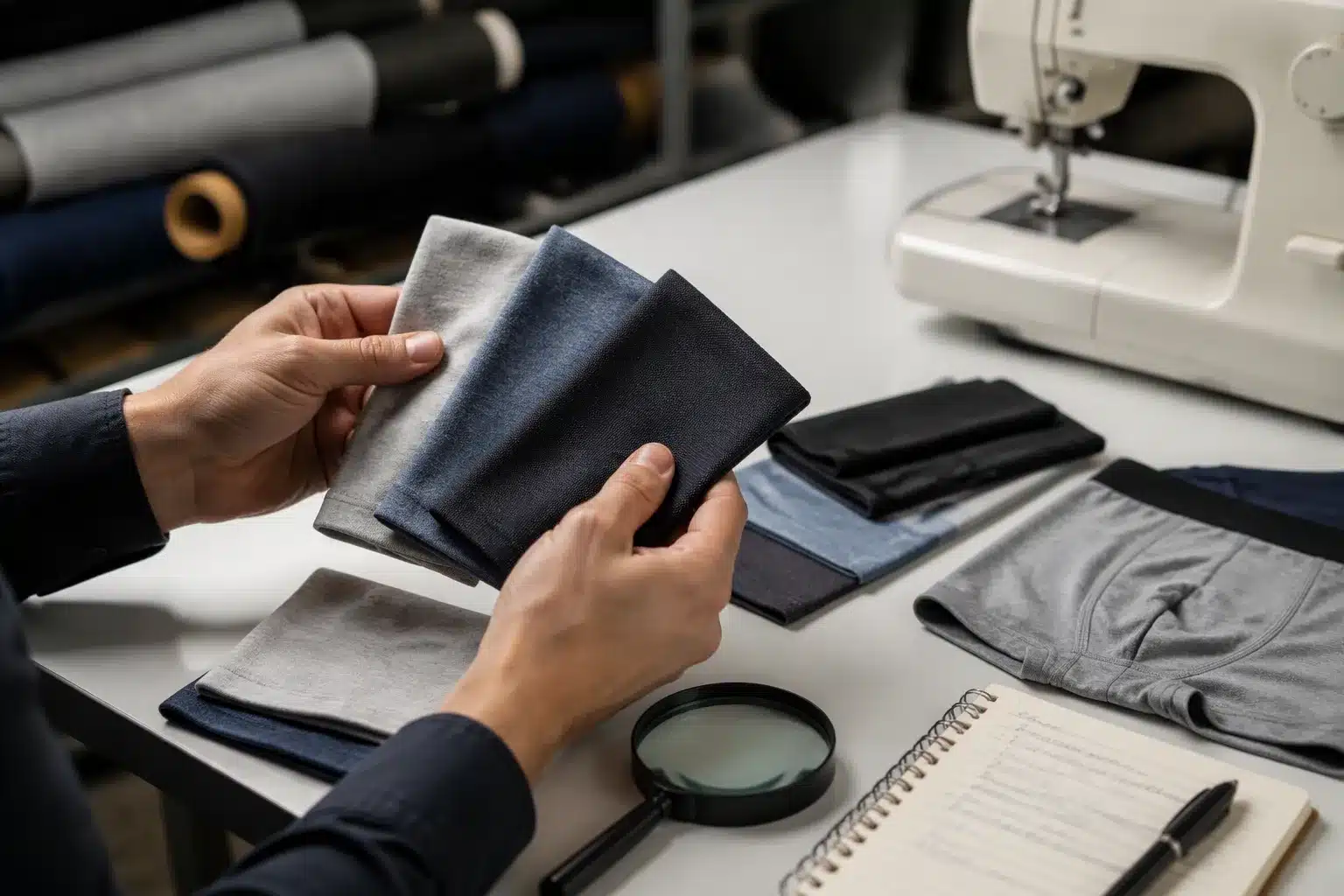
A good manufacturer should make men’s underwear based on your designs, size charts, and fabric needs—not just from a stock list. This takes real skill in choosing fabric and building the garment. Making intimate clothes is technically hard. The best men’s underwear makers focus on details like how seams are finished and how strong the waistband is. These details stop chafing and keep the shape. The right underwear starts with the right partner who knows what the product needs to do.
To find a trustworthy underwear maker, start by checking their fabric skills. Your brand’s name depends on the quality of materials and how the garment is made.
Core Fabrics and Performance Blends
The right fabric pulls sweat away and lets air move to stop discomfort. Bad fabrics trap heat. Air flow directly affects comfort all day, especially for active people or those in warm places. Fit is not talked about enough but is very important—underwear should move with your body, not bunch or pinch. Details like seam finishing and waistband strength also matter. Your lifestyle decides which features matter most. Active men need different things than office workers.
Here are the common fabric performance factors you should evaluate:
Breathability: ensures air flow and temperature control.
Moisture-wicking: draws sweat away to keep skin dry.
Fit: tailored cuts prevent bunching and support movement.
Durability: fabrics resist wear, pilling, and stretching.
Skin-friendliness: hypoallergenic and gentle on sensitive skin.
Top brands use specific blends to reach these goals for men. The table below shows popular options for underwear.
Fabric Blend | Example Product | Key Performance Benefit |
|---|---|---|
TENCEL™ Lyocell + cotton | Konquer Wear AirGlide | Ultra-soft, breathable, tailored fit, moisture-wicking |
Modal + elastane | Lululemon Always In Motion Boxers | Buttery-soft, ergonomic pouch, moisture-wicking |
Polyester + elastane (88%/12%) | Calvin Klein Micro Stretch | Quick-drying, shape-retaining, moisture-wicking |
Modal blend | Hanes Originals Premium | Ultra-gentle, tagless, keeps skin fresh, moisture-wicking |
Learning about fabric numbers helps you compare options for comfortable men’s underwear. MicroModal takes in water 50% faster than cotton and dries quickly. Its fiber thickness is under 1.0 denier, while cotton is 1.5–2.5 denier. It lets air through better, per GOTS 2025 rules. Synthetic blends dry fast but do not hold water like natural fibers. Wool and synthetic blends work well at moving moisture. ExOfficio Give-N-Go 2.0 dried the fastest in tests. These numbers help you pick which fabric is best for your target customer.
Certifications and Material Innovation
Certifications check the quality of materials and how things are made. OEKO-TEX STANDARD 100 tests every piece of the garment for over 100 harmful substances. This directly deals with worries about skin irritation and hormone problems. GOTS goes further by checking organic fibers and making sure the making process is good for the environment. GOTS bans toxic bleaches and dyes. GOTS is very strict because it certifies the whole production chain. Brands like NADS and Subset use clear certifications to show quality and safety for skin. This openness builds trust with buyers.
New materials are coming fast in 2026. Going green drives the trend, with eco-friendly materials like bamboo, TENCEL, and organic cotton becoming normal. New fabric tech focuses on moving sweat and fighting odor for active lifestyles. New pouch designs give support and reduce rubbing. Over 80,000 Amazon reviews highlight breathability and support. Demand for these features keeps growing each year.
Makers that invest in these new ideas deliver high-quality underwear that meets modern needs. When you check a partner for custom underwear production, look at their certification records and ask about their newest material sourcing. This step makes sure your final product matches the quality your brand promises.
Custom Underwear Design and Branding
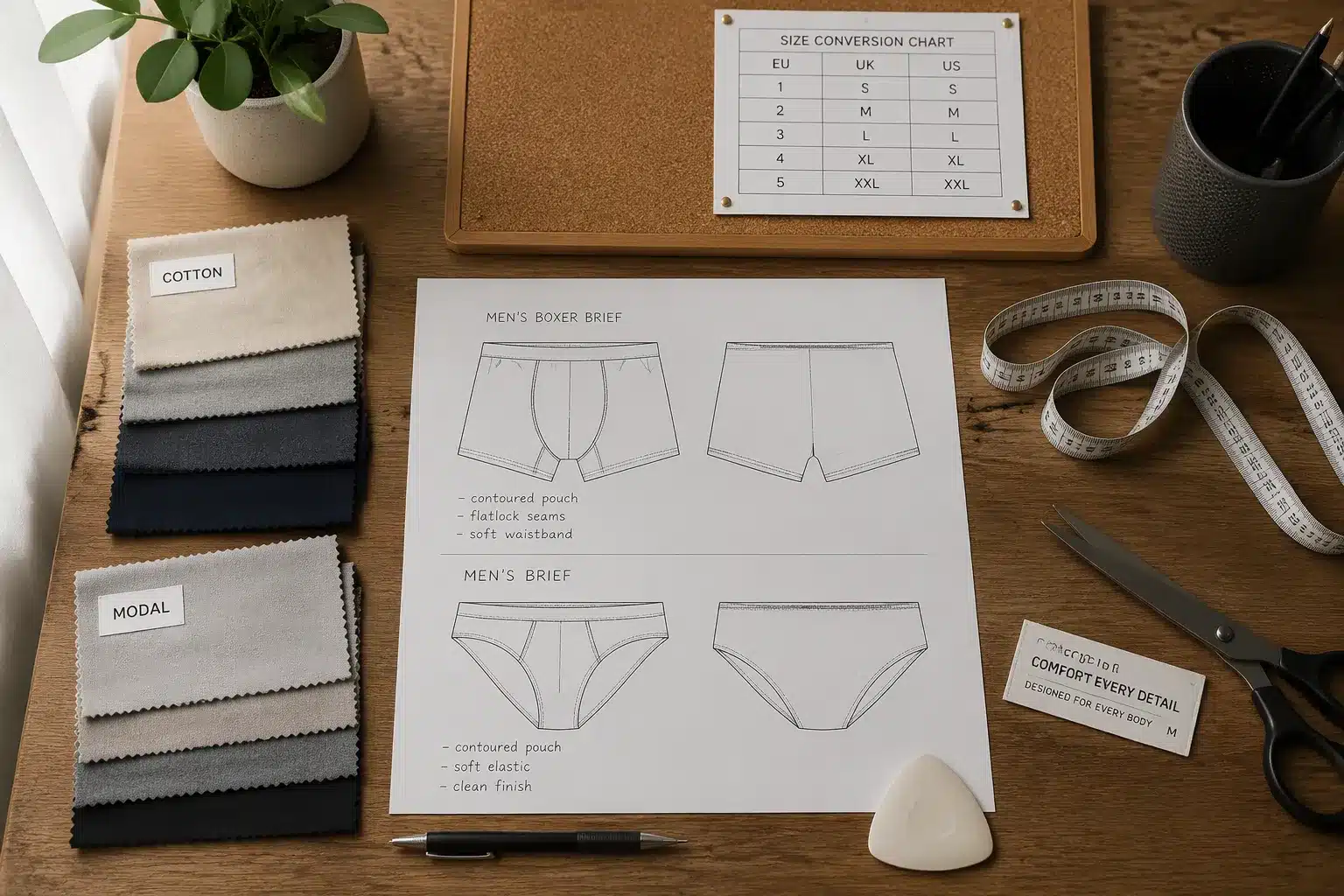
Before you talk to any custom underwear manufacturers, get three things clear. First, does customization cover only the print? Second, does the print use screen printing or a sewn-in label? Third, how many units can you buy? These answers shape your whole design and manufacturing process.
Your custom underwear design should show your brand’s style and market position. A budget label and a premium label need different construction, fabrics, and finishing. A strong partner’s development capabilities include pattern development, construction methods, and fabric selection. Ask for samples of popular styles of custom underwear to judge their work.
Pattern Development and Sizing
Pattern development turns your idea into a wearable garment. A skilled partner builds patterns for custom boxer briefs, custom briefs, and custom boxers. Each style needs its own block. Fit changes by rise, leg opening, and pouch design. You want comfortable men’s underwear that moves with the body.
Sizing standards are different by region. The table below shows the EU to UK/US conversion.
EU | UK / US |
|---|---|
1 | S |
2 | M |
3 | L |
4 | XL |
5 | XXL |
Central European countries use a different scale. The table below maps those codes.
Standard Size Codes (AT/DE/NL/DK/SE/FI) | Underwear | International |
|---|---|---|
44 | 4 | XXS |
46 | 5 | XS |
48 | 6 | S |
50 | 7 | M |
52 | 8 | L |
The European Standards Organisation (CEN) made the EN 13402 series to replace national standards across 33 member states. It is common for children’s clothing but not yet for adults. EN 13402-3 deals with vanity sizing using an SI-unit-based labelling system. The US has no mandatory size standard. ASTM International released recommended charts in the 1990s, but brands still size to their own preferences.
Custom pattern development usually needs around 1,000 pieces per style. Lower trials depend on specification feasibility. Standard programs run 500–1,000 pieces per style and color. Private label projects need 1,000–3,000 pieces depending on fabric, construction, and packaging.
Print, Label, and Packaging Options
Screen printing uses water-based inks put directly on fabric. The result is a soft hand feel that sits comfortably against the skin. For men’s underwear, prints stay minimal to avoid irritation. Heat-transfer tagless labels print onto the garment interior. They remove the sewn label and reduce discomfort.
Sewn-in woven labels use thread and give a durable, premium feel. They reinforce brand identity. Placement options include neck, hem, sleeve, and inseam care labels. These labels may cause irritation if you do not position them carefully.
Packaging shapes the unboxing moment. The table below compares common options.
Packaging Type | Best Use Case | Key Advantages |
|---|---|---|
Sustainable Kraft Drawer Box | Eco-conscious premium brands | 100% recyclable, reusable as organizer |
EVA Frosted Ziplock | E-commerce / Multi-packs | Moisture-resistant, premium feel, cost-effective |
Rigid Gift Sets | High-end / Gift markets | High perceived value, maximum protection |
Fabric Pouches | Boutique / Zero-waste | Multi-functional, adds “gift” value |
Many suppliers now use recycled materials and soy-based inks to cut carbon emissions. Brown kraft boxes offer a natural, earthy feel. Recyclable coatings and soy-based inks support eco-friendly branding. These options are recyclable, compostable, and reusable.
A full range of customization options lets you build personalized underwear that matches your vision. Whether you choose private labeling services or private label manufacturing, your partner’s quality and flexibility decide your success.
MOQs and Sourcing for Underwear Manufacturing Companies
Minimum order quantities often decide if a new brand can start at all. Many underwear manufacturing companies now offer low MOQs of about 100 pieces. This works well for new brands that need to test the market before growing.
Low MOQs and Sampling Programs
Sampling programs let you check construction and fit before you order in bulk. DIYASI offers custom-made samples in about 7 days with MOQs of 100-120 pieces. The sample stage carries the decision load here. You can test how a customized waistband feels or how a custom pouch works.
Xiaotex provides first samples in 3-7 days and changes in 2-4 days. They focus on low MOQs and keep a stock fabric library with over 50 options. You can send tech packs, photos, or physical samples. They also give technical support to help develop your specifications.
Manufacturer | Sampling Lead Time | Minimum Order Quantity | Additional Features |
|---|---|---|---|
DIYASI | ~7 days for custom-made samples | 100-120 pieces | Sample stage carries decision load; useful for testing construction before committing |
Xiaotex | Initial samples: 3-7 days; revisions: 2-4 days | Low MOQ emphasized (exact number not specified) | Stock fabric library with 50+ options; can work from tech packs, photos, or physical samples; technical support for developing specs |
Industrial Clusters and Supplier Reliability
The Asia-Pacific region leads men’s underwear production. It holds 24% of the global men’s underwear market, worth USD 4,447.92 million, with a yearly growth rate of 9.3%. Xiaolan in China makes 70% of China’s men’s underwear, so it is a key sourcing area.
This ecosystem includes 3,800 business districts and 180 regional technology institutes. These institutes support certified standardization rules, seamless knitting features, and advanced cooling fabric tools. The region serves over 9,000 retail clients.
Main cluster: Asia-Pacific, 24% of global men’s underwear market (USD 4,447.92 million), 9.3% CAGR
Infrastructure: 3,800 business districts, 180 regional technology institutes
Capabilities: certified standardization, seamless knitting, advanced cooling fabrics
Client base: over 9,000 retail clients
A reliable underwear factory shows steady production and on-time delivery history. Ask for references and check their track record before you commit.
Sustainability, Pricing, and Lead Times
Ethical Labor and Eco-Materials
Buyers in 2026 want proof that products are made ethically. You should look for eco-material options like organic cotton, bamboo, hemp, and Tencel. These materials cause less harm to the environment and attract shoppers who care. Fair-labor verification is just as important. Certifications like GOTS and Fair Trade Certified prove that workers get fair pay and safe conditions. Brands like Pact use GOTS-certified organic cotton and make their men’s underwear in Fair Trade Certified factories. This proves that ethical sourcing and quality production can go hand in hand.
You can check a supplier’s claims through third-party certifications. The table below lists the main ones to look for.
Certification | Purpose |
|---|---|
OEKO-TEX STANDARD 100 | Tests for harmful substances and ensures skin safety |
GOTS | Prohibits PFAS and requires eco-friendly processing |
Bluesign | Ensures responsible chemical use and bans PFAS |
Fair Trade Certified | Confirms fair wages and working conditions |
PETA-approved vegan | Confirms vegan and cruelty-free standards |
Ask your supplier for current certificates. A trustworthy factory will share them right away. This step protects your brand and your customers.
Pricing Transparency and Logistics
Pricing for underwear production usually follows a tiered structure. You pay less per unit as your order quantity goes up. Ask for a full breakdown that covers fabric, labor, printing, packaging, and shipping. This helps you compare quotes without hidden costs. Payment terms are different for each supplier. Common arrangements include a deposit before production and the rest before shipment. Some factories offer more flexible terms for repeat custom orders.
Lead times and shipping reliability deserve a real test. Place a sample order first. This shows how fast the factory responds, how they handle changes, and whether they meet deadlines. A sample order also lets you check the quality of stitching, waistbands, and fabric feel. Do not commit to a large custom production run until you finish this step. Reliable shipping matters too. Ask about their record for on-time delivery and how they deal with delays. A supplier who communicates clearly during a small order will likely do the same on a larger one.
Communication and Support
Responsiveness and the Sample Process
How well a supplier responds can make or break your underwear brand launch. When supply chains work together, materials arrive on time for making underwear. Delivering on time stops you from running out of stock when you launch. Suppliers who stay flexible can change their production plans fast. Good risk management finds dependable backup choices. Checking quality during manufacturing makes sure products meet safety and comfort rules.
Responsiveness Factor | Impact on Launch |
|---|---|
Supply Chain Collaboration | On-time materials stop shortages |
Timely Delivery | Meets demand without running out |
Flexibility & Responsiveness | Changes production for trending styles |
Risk Management | Backup suppliers keep things going |
Quality Assurance | Products meet safety standards |
Emergency Handling | Makes 1,000 units in 7 days |
The customer experience relies on how well your underwear supplier responds. Fast delivery and real human support build loyalty for your brand. Updating content and engaging your community keep momentum going after launch. A supplier who responds well communicates clearly during small orders and keeps that same honesty for bigger ones.
How fast samples come back shows how responsive a manufacturer is. Ready-made underwear samples take about 5-7 days. Custom underwear samples take 7-15 days based on how complex they are. Once you confirm your order, the manufacturer makes a pre-production sample in 3-5 working days. They send photos or ship the sample for your approval. The sample stage lets you test construction, fit, and how the fabric feels before you commit to bulk production. This step saves time and money while building trust.
Post-Sale Support and Quality Guarantees
Product guarantees keep your underwear brand safe. Manufacturers check products using AQL 2.5 standards. This means they look at a statistical sample and only accept a small number of defects. More than 25 QC staff inspect every piece of underwear before it leaves the factory. The whole workflow includes mass production and inspection at every stage.
Beyson Apparel works with a fully certified supply chain. Certifications include OEKO-TEX, GOTS, BSCI, and FSC. The company follows global standards for textile safety, organic sourcing, and ethical auditing.
After-sales support goes beyond inspection. A 24/7 expert team answers your questions. Professional sales, order, QC, and transportation teams respond fast. ODM and OEM services give solutions usually within a week. Packing details and a QC report arrive when production ends. After you confirm the QC report and pay the final amount, goods ship out.
A complete in-house facility handles every step. This covers fabric selection, cutting, sewing, prototyping, sampling, bulk production, packaging, and shipment. The manufacturer keeps customers updated with regular messages through a clear process. Delivering on time creates a smooth working approach. These support systems keep your men’s underwear brand running well after launch.
Here is a quick recap of the underwear selection criteria:
Fabric certifications (OEKO-TEX, GOTS)
Custom underwear design and branding options
MOQ size and sampling programs
Ethical labor and eco-material sourcing
Pricing transparency and lead time reliability
No single factor decides a good partnership. Balance quality, MOQ flexibility, ethics, price, and communication for your underwear line. The best mens underwear manufacturers deliver across all areas.
Start your evaluation now. Request samples from your shortlisted suppliers. Ask for current certifications. Test responsiveness with a small order before you commit to large production. This approach protects your brand and your men’s underwear line.
FAQ
What certifications should I request from mens underwear manufacturers?
Ask for OEKO-TEX STANDARD 100 and GOTS certificates. OEKO-TEX checks every part for harmful substances. GOTS makes sure fibers are organic and processing is eco-friendly. These papers prove your supplier meets safety and sustainability rules. A factory you can trust shares current certificates right away.
How low can minimum order quantities go for custom underwear?
Some manufacturers take orders as low as 100 pieces. This helps new brands test the market before they grow. Sampling programs let you check construction and fit first. You can judge waistband strength and pouch design before you commit to bulk production.
How long does sampling take for men’s underwear?
Ready-made samples ship in about 5-7 days. Custom samples take 7-15 days based on how complex they are. After you confirm your order, pre-production samples arrive in 3-5 working days. This step lets you check quality and fabric feel before mass production starts.
Which region leads underwear manufacturing?
The Asia-Pacific region holds 24% of the global men’s underwear market. Xiaolan in China makes 70% of China’s men’s underwear. This cluster offers certified standardization, seamless knitting, and advanced cooling fabrics. Over 9,000 retail clients source from this ecosystem.
What quality checks should I expect before shipment?
Reputable factories inspect products using AQL 2.5 standards. This means they look at a statistical sample and accept only a small defect rate. Ask for a QC report before you pay your final balance. More than 25 QC staff often inspect every piece before goods leave the factory.