
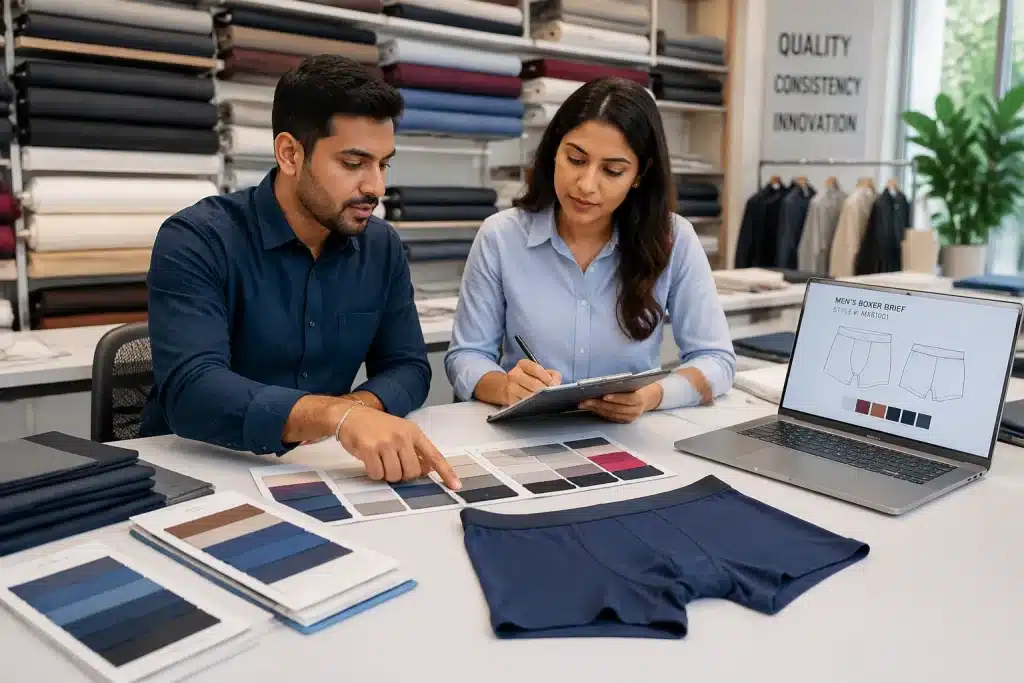
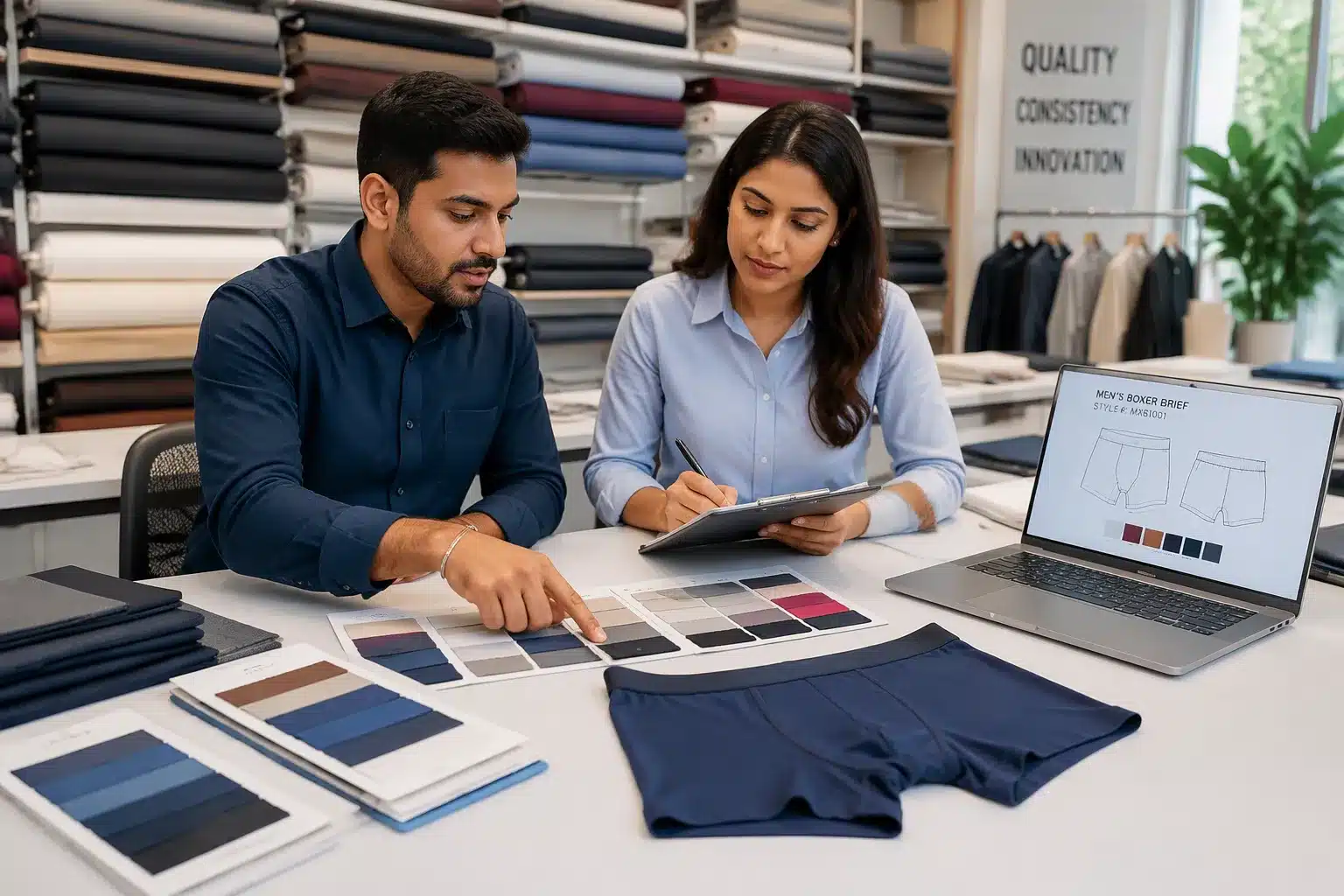
Picking among custom boxer briefs manufacturers really comes down to five things: product specs, technical capability and quality standards, material suitability, regulatory compliance, and total cost. Clear communication runs through every one of them.
Boxer briefs sell again and again. That makes your choice of custom underwear manufacturers a long-term business decision, not a one-off purchase. A weak pouch seam, a pouch that rides up, or a waistband that rolls shows up in repeat orders fast.
The five tips below give you a step-by-step framework. Apply it to any shortlist of custom boxer briefs manufacturers. Each tip includes practical checks — pouch construction, fabric hand-feel, fit testing — you can run before requesting samples or quotes.
Key Takeaways
Write a detailed spec sheet first. It lists fit, fabric, sizes, and all custom details.
Check the factory’s machines and quality control. Ask where they inspect during production.
Match fabric to your customer. Choose blends for everyday, active, or premium lines.
Confirm test reports and labels for your market. Get current certificates in writing.
Compare total cost, not just unit price. Include setup fees, minimums, and shipping.
Test communication early. Send a detailed question and time the reply.
Run a small trial order. It tests timing, quality, and support before you commit big.
Watch for red flags like vague answers or pressure to skip samples. Ask for clarity in writing.
Tip 1: Define Your Specs
Lock In Fit, Fabric, and Size Range
Every quote you collect should answer to one document: your written spec sheet. Without it, you’re comparing prices on products that may not even be the same thing. Start with fit. Decide how the waistband should sit, how long the leg should run, and how snug the pouch should feel. A custom-fit boxer brief lives or dies on pouch construction, so describe the pouch in plain words: roomy or close, seamed or seamless, with or without a fly.
Fabric comes next. Note the fiber blend, the weight, and the hand-feel you want. Don’t copy numbers from another brand’s label — pick weights that suit your climate and customer, then confirm them with the factory. Size range matters just as much. Map out your waist sizing from smallest to largest, and decide whether you’ll offer inclusive waist sizing from day one. Proper fit across the full range is what keeps customers coming back.
List the Customization You Need
Write down every design choice before you talk to anyone. That list covers waistband branding, label placement, stitch color, and packaging. It also covers the pouch: how many pouch sizes you’ll stock, whether pouch size changes across the size run, and how custom pouch sizing should scale. If you want a custom pouch with a specific shape, sketch it.
Think about garment fit details too — leg opening tension, flatlock seams, tagless neck labels. Each design decision adds cost and tooling, so group them by priority. Must-haves go at the top. Nice-to-haves go below. This keeps negotiations honest and stops a factory from quietly dropping a detail you cared about.
Write a Spec Sheet First
Now put it all on one page. Your spec sheet should list fit notes, fabric specs, the full size range, and every customization item with a reference image where possible. Add a measurement chart for each size, taken from a garment you already know fits well.
Send this sheet with every sample request and quote inquiry. Ask each factory to confirm point by point. Vague replies tell you plenty. A manufacturer who returns your sheet with clear comments, questions, and suggested alternatives is engaged with your design. That’s the response you want before you spend money on samples.
Tip 2: Vet Capability and Quality
Check Machinery, Capacity, and Workflow
Ask what machines actually run your order. Flatlock and coverstitch machines matter most for underwear, since they build the seams that touch skin all day. A factory with the right equipment handles stretch seams cleanly. One without it will improvise, and you’ll feel that in the pouch and leg openings.
Capacity deserves a straight question too. How many units can they finish per week, and where does your order land in that queue? Then ask about workflow. In-house production gives you tighter control over timing and changes. Outsourced production can suit smaller or seasonal runs. Neither is better on its own — the right choice depends on your order size and how fast you need to scale.
Review QC Checkpoints and Defect Policies
Good quality control happens at named points, not at the end of the line. Ask where they check fabric on arrival, cut panels, sewn construction, and final packing. A factory that inspects only finished goods catches problems too late. You want checks during construction, especially around the pouch and waistband attachment.
Then get the defect policy in writing. What counts as a major defect? What’s the acceptable rate? Who pays for replacements? Ask how they handle a batch with a weak seam or a twisted waistband. Vague answers here usually mean no policy exists. A clear, written policy tells you the manufacturer has handled this conversation before.
Inspect Samples for Stitching and Finishing
A sample is the most reliable test of real quality. Brochures show perfect photos. A sample shows you the actual construction. Turn it inside out. Look at seam density, thread tension, and loose ends. Check that the pouch sits flat with no puckering. Pull the waistband and watch whether it recovers.
Wear the sample if you can, or wash it once and inspect again. Finishing problems — skipped stitches, uneven hems, scratchy labels — show up fast after one wash. Compare samples from two or three custom boxer briefs manufacturers side by side. Judge the garment construction, not the packaging. Your design only works if the construction behind it holds up.
Tip 3: Match Materials to Use Case
Compare Blends for Everyday, Active, and Premium Lines
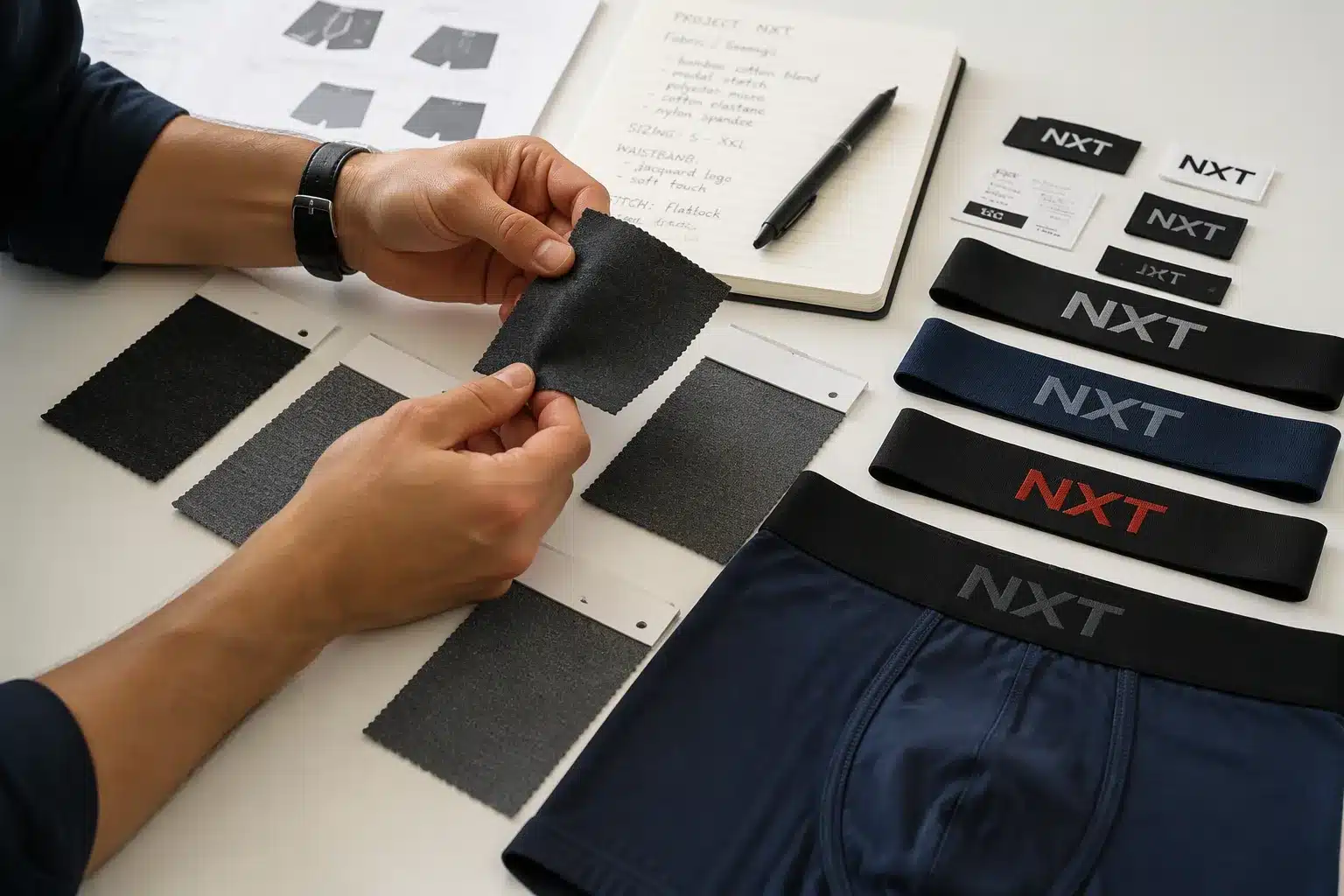
Your fabric choice should follow the customer, not the other way around. For an everyday line, look for a blend with a soft hand-feel and enough stretch to hold its shape through repeated washing. Cotton-rich blends suit this well. An active line needs a fabric that moves moisture away from skin, so compare how each option feels when damp. A premium line can justify a finer knit and a smoother finish, and that difference should be visible the moment someone opens the package.
Ask each factory for fabric swatches across all three tiers. Feel them, stretch them, and wash them before you commit. Confirm every material claim with the factory in writing, since performance language on a spec sheet means little without their confirmation. The right fabric for your line is the one that matches how your customer actually wears the garment.
Check Waistband, Pouch, and Seam Options
The waistband carries your branding, so settle its construction early. Jacquard logos, printing, heat transfer, and woven labels each carry different minimums, wash-test results, and sample costs. Ask the factory to walk you through each option item by item, including whether a jacquard waistband is realistic at your order volume. Lower-barrier branding routes exist, and a good partner will name them plainly.
Then turn to the pouch. A custom pouch changes how the whole garment fits, so decide between a sized pouch and a shaped pouch before sampling. Pouch sizing should scale with your size run, and a custom-sized front needs its own measurements on the spec sheet. Seam placement matters too — flatlock seams sit flatter against skin. A textile-integrated design, where the pouch and body fabric work as one panel, is worth discussing with the factory if you want a cleaner finish.
Plan EMS Boxer Briefs for Performance Lines
EMS boxer briefs give you a moisture-wicking performance option for active-use customers. Treat them as one piece of a broader line plan rather than the whole range. Pair EMS boxer briefs with everyday and premium styles so your catalog covers different shoppers. The construction behind EMS boxer briefs deserves close attention, since the fabric and seam choices drive how the garment performs.
Confirm all performance claims directly with the factory before you print anything on a label. Ask how the fabric behaves after washing, and request a sample you can test yourself. A custom-fit boxer brief in the EMS range should still follow your fit standards, so check the pouch and waistband against your spec sheet. Good EMS boxer briefs fit into a performance line naturally when the fabric, construction, and design all point the same direction.
Tip 4: Verify Compliance
Confirm Testing for Your Target Market
Compliance starts with one question: where will you sell? A boxer brief headed to one market may need different testing than the same garment headed to another. Ask the factory which tests they routinely run on fabric and finished goods for your destination. Common checks cover colorfastness, shrinkage after washing, and fiber content. Some markets also expect flammability or restricted-substance screening.
Get the answers in writing, and match them to your spec sheet. If your design includes a dyed waistband or a printed pouch panel, ask whether those components get tested too. A factory that tests the body fabric but skips the trim leaves a gap. Confirm who pays for testing, how long results take, and whether reports come per order or per style.
Request Current Certificates and Reports
Ask for current certificates and test reports, not last year’s file. Check the issue date, the scope, and whether the report names the exact fabric or component you plan to use. A certificate for a similar fabric is not a certificate for yours. This matters most when you compare custom boxer briefs manufacturers side by side, since paperwork quality varies widely.
Read the report rather than just filing it. Does the tested fabric weight match your order? Does the pouch construction in the report match your sample? If anything looks off, ask for clarification before you place a bulk order. A manufacturer with nothing to hide will walk you through the documents without hesitation.
Clarify Labeling and Fiber Content Rules
Labeling rules trip up more buyers than testing does. Most markets require fiber content disclosure, country of origin, and care instructions on a permanent label. Ask the factory how they handle each one, and who drafts the label text. You own the accuracy of that text, so verify the fiber percentages against the actual fabric spec.
Your design choices affect labels too. A tagless printed neck label needs different artwork approval than a woven label. If your pouch carries branding, confirm the label placement meets local rules. Ask the factory to send a labeled production sample before the full run. One look at the finished garment tells you whether the labeling is right.
Tip 5: Compare Total Cost
Break Down Unit Price, MOQ, and Setup Fees
A low unit price means little on its own. Ask each manufacturer to separate the unit price from the minimum order quantity and the one-time setup fees. Setup fees cover pattern making, screens, and machine programming. A complex pouch panel or a shaped front adds pattern work, and that cost lands in setup, not in the per-piece rate. Get every line itemized in writing.
Minimums deserve the same scrutiny. Ask whether the MOQ applies per style, per color, or per size. A factory might quote a friendly number, then apply it to each colorway. That quietly multiplies your commitment. Waistband branding drives minimums too — jacquard logos, printing, heat transfer, and woven labels each carry different thresholds, wash-test results, and sample costs. Ask the factory to walk you through each option item by item, including whether jacquard is realistic at your volume. Lower-barrier branding routes exist, and a good partner will name them plainly.
Factor In Sampling, Shipping, and Payment Terms
Sampling costs money, and the bill rarely stops at the sample itself. Ask whether sample fees are refundable against a bulk order, who pays courier charges, and how many revision rounds you get. A cheap sample that takes three rounds to get right costs more than a pricier one that lands first time. Budget for a wear test too, since a washed sample tells you more about fabric behavior than a fresh one.
Shipping changes the math fast. Fabric weight and pack size affect freight, so confirm how garments are folded and boxed. Ask about payment terms as well. Deposits, balance timing, and accepted payment methods all affect your cash flow. Compare the full landed cost, not the quote on the first page.
Weigh Communication and After-Sales Support
Responsiveness is a cost variable, even though it never appears on an invoice. A manufacturer who answers questions in a day keeps your launch on schedule. One who goes quiet for a week burns calendar time you cannot recover. Test this before you commit by sending a detailed question and timing the reply.
After-sales support matters just as much. Ask how they handle a batch with a weak pouch seam or a fabric flaw. Do they replace, credit, or repair? Who covers freight on a rework? Get the answer in writing. A slightly higher quote with clear support often beats a bargain with silence on the back end.
Shortlisting Custom Boxer Briefs Manufacturers
You’ve done the homework. Now it’s time to put two or three custom boxer briefs manufacturers side by side and let the evidence decide. This last step turns five tips into a decision you can defend to your team.
Build a Five-Tip Scorecard
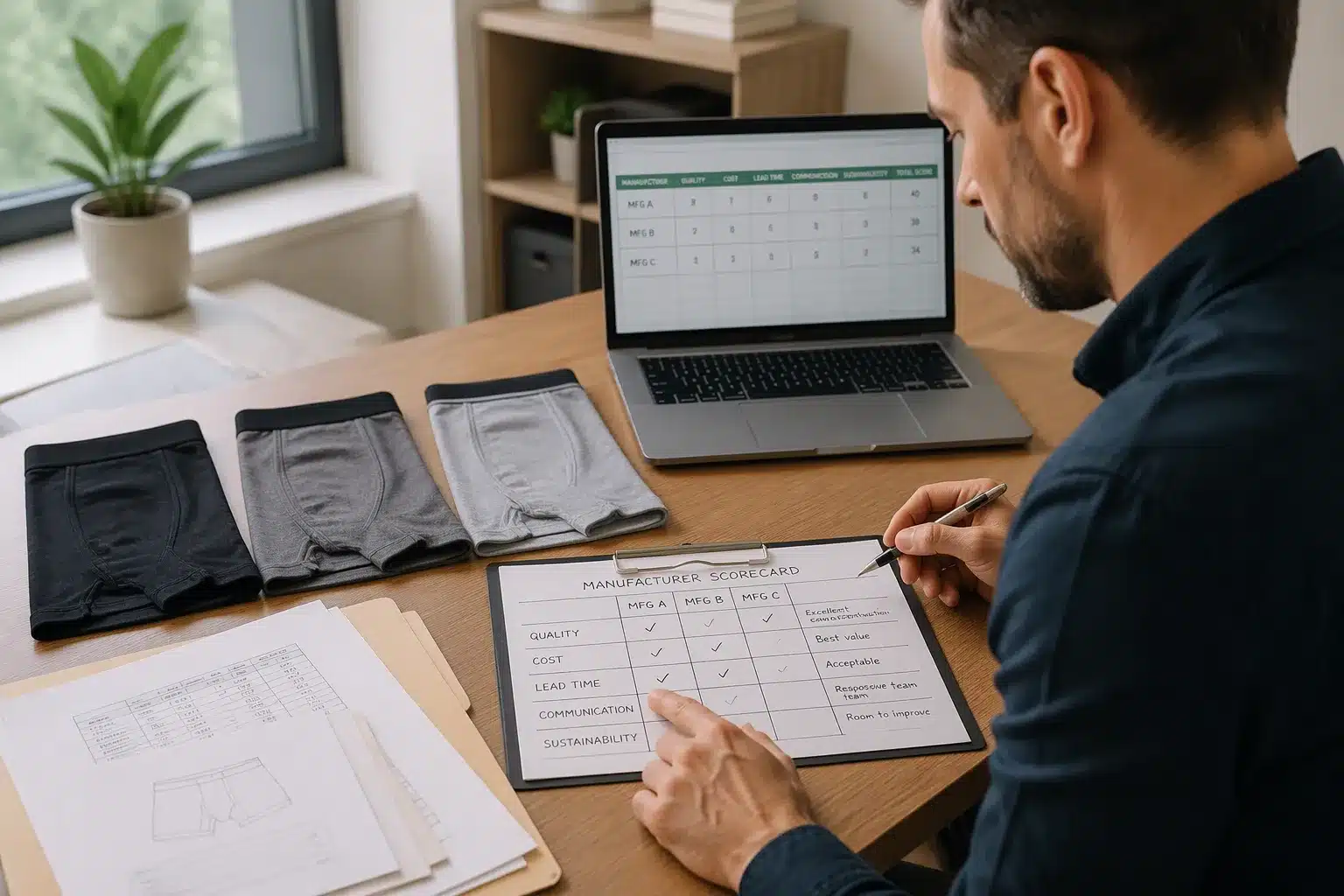
Set up a simple grid. Give each factory a column and give each tip a row: specs, capability and quality, materials, compliance, and total cost. Score each cell on a small scale, say one to five, and jot a one-line reason next to every score. The reason matters more than the number. “Confirmed pouch measurements point by point” tells you something. A bare “4” tells you nothing a month later.
Tip | Factory A | Factory B | Factory C |
|---|---|---|---|
Specs confirmed in writing | |||
Sample construction and QC policy | |||
Fabric and pouch options for your line | |||
Test reports and labeling plan | |||
Landed cost and support |
Fill the grid from documents, not memory. Pull quotes, sample notes, and report dates into one folder per factory. When two scores tie, revisit the sample. Turn it inside out again and check the pouch seam and waistband recovery. The garment usually settles the argument.
Run a Small Trial Order
A trial order is the cheapest insurance you’ll ever buy. Keep it small — enough to test the full workflow without tying up serious capital. You’re testing three things: communication, timing, and finishing.
Send your spec sheet and ask for a written confirmation of every line.
Request a production sample with your actual waistband branding and labels.
Place the trial run and track how often the factory updates you without being asked.
Inspect the delivery against your measurement chart, then wash one piece and check it again.
Watch the calendar during the trial. Did they hit the date they promised? Did questions get answered in a day or a week? A trial also reveals finishing details a sample can hide, like consistency across sizes. If the pouch sits right on one size and pulls on another, you’ve learned something a brochure never shows. A clean trial earns a bigger commitment. A messy one saves you from a costly mistake.
Spot Red Flags Early
Some warning signs show up before you ever pay a deposit. Treat them as stop signs, not speed bumps.
Vague answers to specific questions. If you ask about pouch sizing across the size run and get “we can do any design,” press once more. Silence or vagueness on a second ask is your answer.
Reluctance to share samples or current test reports. A confident factory sends both without a fight.
Quotes that don’t match your spec sheet. Missing line items, shifting minimums, or numbers that change between emails signal trouble ahead.
Pressure to skip the sample stage. Nobody who understands garment construction asks you to buy blind.
Inconsistent stories. The sales contact promises one thing, the technical contact another. Align them before you commit.
None of these flags means a factory is bad. Each one means you need clarity before money moves. Ask directly, in writing, and keep the reply. A manufacturer who clears up every concern earns trust the honest way. One who dodges has told you what the bulk order will feel like.
Run the five tips as a checklist. Define specs, vet capability, match materials, verify compliance, compare cost. Fabric and pouch choices anchor that list.
The best partner fits your order size, line, market. The lowest quote rarely wins. Ask about fabric sourcing, fabric testing, pouch sizing, pouch construction. Name fabric weight, fabric hand-feel, pouch shape, pouch seam. Strong fabric and pouch work beats a cheap guess.
Request quotes and samples from two or three factories. Score fabric and pouch side by side. Send your spec sheet. Ask for a sample plan and MOQ quote. Confirm fabric, pouch, fit details in writing. Every fabric and pouch answer belongs in writing. Fabric and pouch fit matter.
FAQ
Can a factory make jacquard logo waistbands at 300 pieces?
Often, yes — but it depends on the factory. Jacquard tooling carries its own minimums, and those minimums vary widely between suppliers. Ask directly whether 300 pieces clears their jacquard threshold. If it doesn’t, ask what volume would. Get the answer in writing before you design around it.
What lower-barrier branding options exist?
Printing, heat transfer, and woven labels usually carry lower minimums than jacquard. Each option differs in wash durability, sample cost, and setup fees. Ask the factory to walk you through all four routes item by item. A good partner will name the trade-offs plainly, then let you pick what fits your volume.
What should I ask about MOQ for each branding method?
Ask whether the minimum applies per style, per color, or per waistband design. A friendly headline number can multiply fast once colorways enter the picture. Confirm the threshold for jacquard, printing, heat transfer, and labels separately. Put every answer on your spec sheet so quotes stay comparable.
How do I compare wash testing across branding methods?
Request wash-test results for each branding option, not just one. Check how the logo holds up after repeated washing and whether the report names your exact waistband construction. Confirm the test date is current. If a factory can’t supply results, ask for a sample you can wash yourself.
What drives sample costs for branded waistbands?
Setup complexity drives most of it — jacquard tooling costs more to sample than a printed label. Ask whether sample fees are refundable against a bulk order and how many revision rounds you get. Courier charges count too. A pricier sample that lands right the first time often beats a cheap one needing three rounds.
Which cost variables change between branding methods?
Setup fees, minimums, and per-piece rates all shift by method. Jacquard spreads tooling across a larger run; printing and heat transfer lower the entry barrier. Labels add their own artwork approval step. Itemize every line, then compare landed cost — not the first-page quote.
How does waistband branding affect the rest of the garment?
A branded waistband changes how the pouch and body sit, so sample the full garment, not just the band. Check that the pouch seam stays flat under the new waistband tension. Confirm the fabric still recovers after washing. One labeled production sample settles more questions than any spec sheet.
What if a factory dodges my branding questions?
Press once more, in writing. Vague answers about jacquard minimums or wash results usually mean the factory hasn’t handled your volume before. Keep the reply on file. A manufacturer who clears up every concern earns trust the honest way — one who dodges has shown you what bulk production will feel like.
See Also
How to Choose a Modal Boxer Briefs Manufacturer for Your Brand
Seven Best Low MOQ Boxer Briefs Manufacturers for Small Businesses
Choosing an Anti-Chafing Boxer Briefs Manufacturer for Your Brand with Hongku
How to Pick the Best Private Label Men’s Underwear Manufacturer in the UK
Low MOQ Underwear Manufacturing for Small Batch Boxer Briefs Production