
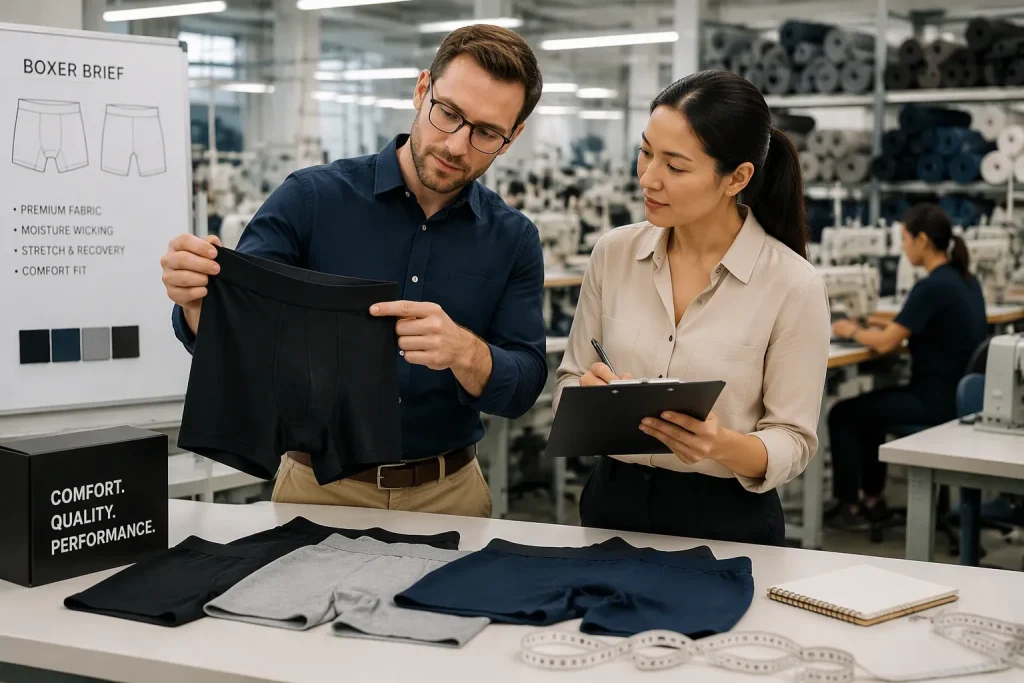
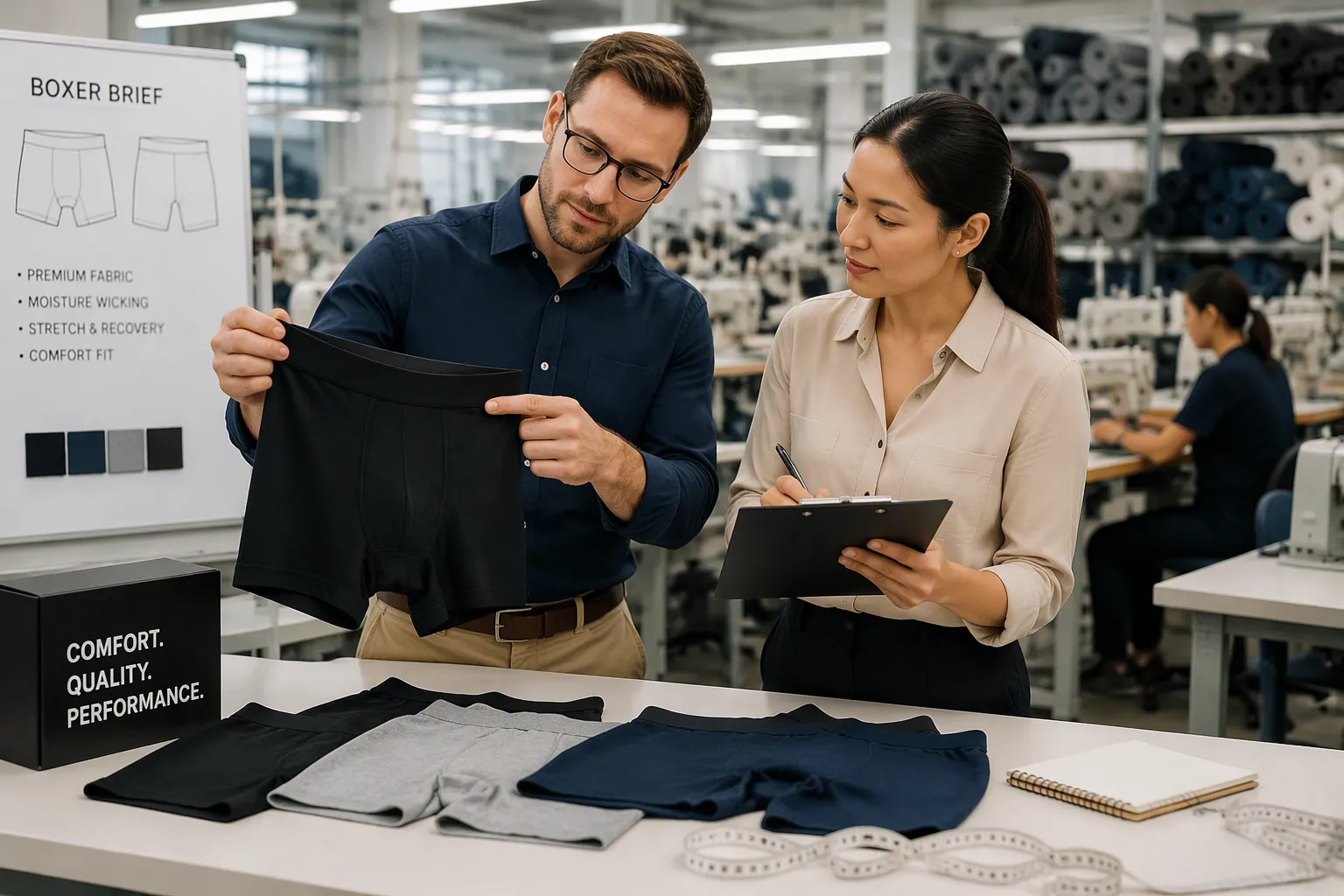
Choose a partner that treats anti-chafing as an engineering problem, not a fabric softness issue. Chafing happens because of friction, moisture, and garment geometry — not simply rough fabric. Two variables matter most: friction coefficient under moisture and seam profile height.
This post gives you a technical checklist and sample testing protocol to vet any anti chafing boxer briefs manufacturer. Hongku Underwear is a working example that meets these criteria. Fabric softness alone fails; a plush material can still cause chafing when wet. The right anti chafing boxer briefs manufacturer controls wet friction and seam profile height precisely. If you are sourcing through a performance underwear OEM, agree inseam length, seam construction, and pouch support before accepting anti chafing claims without wear-test evidence.
Key Takeaways
Chafing is an engineering problem: control friction and seam height.
Test anti-chafing performance wet, not dry, because sweat increases friction.
Choose a manufacturer who specifies seam type by position, not by default.
Verify five construction fixes: inseam, leg grip, seam profile, fiber behavior, pouch.
Run wet, wash, and wear tests on every sample before production.
Request wash data and wear-test evidence before making anti-chafing claims.
Check certifications like OEKO-TEX, GOTS, WRAP, and BSCI for quality and compliance.
Avoid manufacturers who give vague answers or refuse to share audit reports.
Anti-Chafing as an Engineering Problem
Friction, Moisture, and Movement
Two variables decide whether a boxer brief actually prevents chafing: friction coefficient under moisture and seam profile height. Friction coefficient under moisture measures how much drag the fabric creates once you sweat. Sweat raises friction in both skin-on-skin and skin-on-fabric contact. Damp skin grips, and wet fibers swell out of their dry-state behavior. Seam profile height measures how far a seam ridge rises above the fabric surface. Under compression, those ridges act as friction generators in high-load zones like the gusset, leg opening, and crotch crossing.
You cannot judge either variable with a dry hand feel. Test anti-chafing performance wet, because that is when chafing actually starts. A fabric that glides across your palm in the showroom may grab and rub once moisture builds up.
Why Soft Fabric Alone Fails
A boxer brief can feel measurably softer yet chafe worse. Softness describes surface hand feel. It says nothing about how the material behaves when saturated or how prominent the seams sit against skin. When you sweat, your skin becomes softer and more vulnerable to abrasion. Standard cotton or a poorly fitted garment then behaves like sandpaper against sensitive areas such as the thighs.
Construction details close that gap. Flatlock stitching removes raised fabric edges and creates a smoother contact surface. Four-way stretch and abrasion-resistant fabric move with the body. Rapid moisture-wicking keeps skin dry and stops damp fabric from clinging, which is the root cause of friction build-up. Seamless builds and technical fabrics reduce chafing for the same reason: fewer ridges, drier skin. That is why friction reduction and moisture management are construction outcomes, not marketing words.
What This Means for Manufacturer Selection
A capable manufacturer specifies seam type by position, not by default. A ridge you can feel is likely to cause chafing during wear, so ask which seam goes where. Before you accept any anti-chafing or moisture-management claim, agree on three things: inseam length, seam construction, and pouch support. Then request wear-test evidence.
Ask your manufacturer these questions:
Which seam type do you use at the gusset, leg opening, and crotch crossing?
What is the measured friction coefficient under moisture for this fabric?
Can you provide wash data and wear-test reports?
A supplier who answers vaguely on seam profile height or wet friction is guessing. A supplier who welcomes these questions treats anti-chafing boxer briefs as an engineered product. That distinction should drive your shortlist.
Five Construction Fixes for Anti-Chafing Boxer Briefs
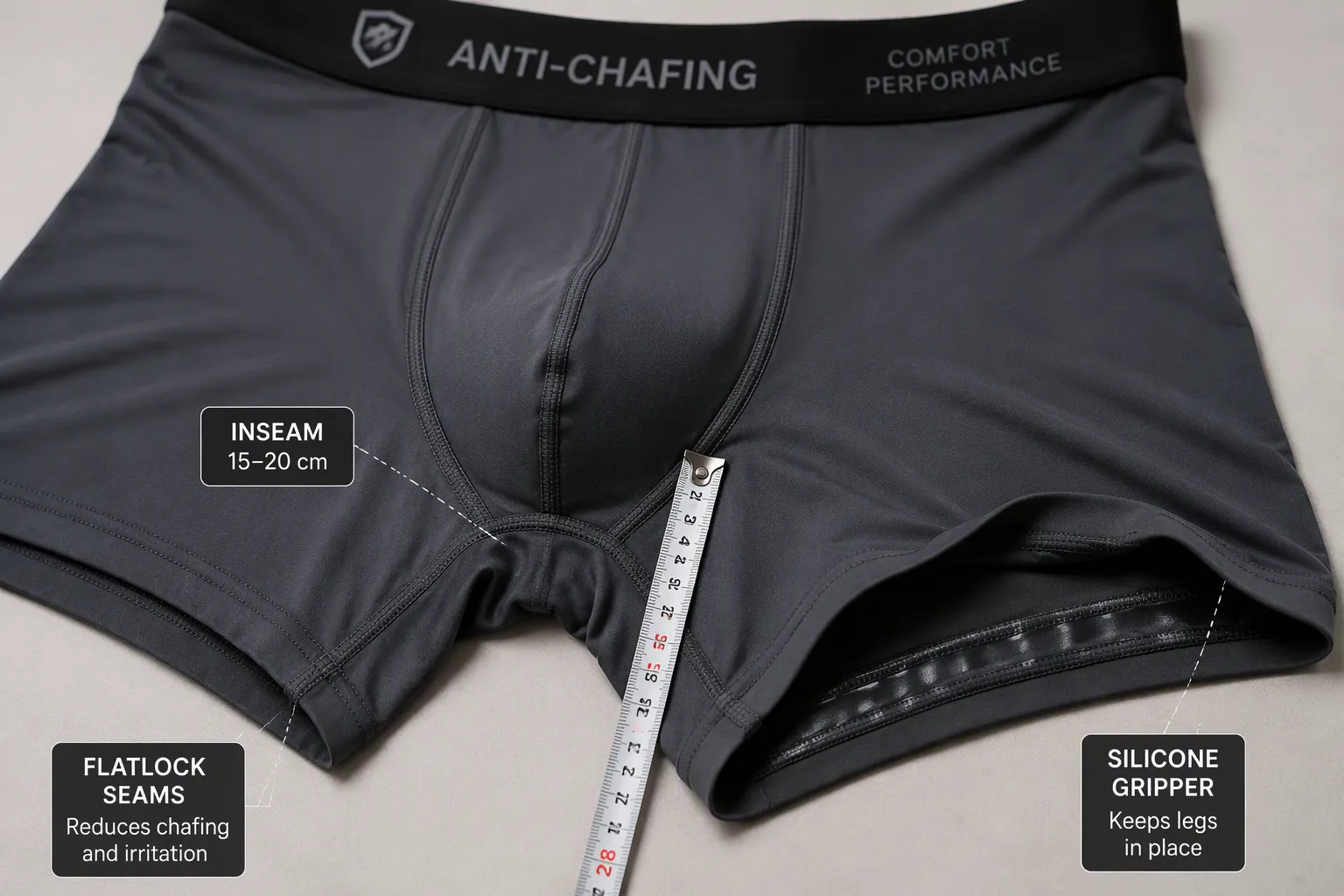
Anti-chafing panels exist for one job: keep your thighs moving smoothly without sticking or riding up. Five construction features do that work. You should see all five in any sample you approve.
Leg length and inseam: a 15–20 cm inseam keeps fabric inside the inner-thigh contact zone through your stride. That turns skin-on-skin friction into fabric-on-fabric friction.
Leg opening grip: the hem must stretch and recover after washing. A migrated hem folds into a lump in the contact zone and makes chafing worse.
Seam profile: flat or low-profile seams at the gusset, leg opening, and crotch crossing cut raised ridges under compression. Any ridge your fingertip can feel will irritate after repeated movement.
Wet-state fiber behavior: modal and lyocell stay soft and low-stiffness when damp. Engineered synthetics wick sweat fast. Cotton-rich blends turn weak when wet. Judge anti-chafing performance wet, never dry.
Pouch and 3D shaping: a contoured pouch removes flat-panel folds that migrate into the highest-friction zone. That reduces shear between fabric layers as you move.
Inseam Length and Leg Opening Grip
6-Inch vs. 8-Inch Inseams
Inseam length decides how much fabric sits between your thighs. A 6-inch inseam suits everyday wear and warmer climates. An 8-inch inseam covers more of the inner thigh and gives longer boxer briefs great protection for guys with skinnier legs. Skinnier legs leave a wider gap at the inner thigh, so skin meets skin more often. Extra length fills that gap with fabric. Match the inseam to your customer’s build and climate, then lock the spec before production.
Silicone Grippers vs. Elastic Bands
A leg opening must stretch and recover after washing. Silicone grippers hold the hem in place with light tack. Elastic bands rely on tension alone. Both work when the spec is right. Both fail when the hem migrates upward. A migrated hem creates a folded lump in the contact zone, and that lump increases chafing. Test recovery after repeated wash cycles, not just on the first wear.
Seam Selection and Profile Height
Flatlock, Coverstitch, and Bonded Seams
Flatlock seams produce a smoother surface against the skin than traditional seams, which leave a raised ridge. That flat construction minimizes bulk and reduces friction during movement or exercise, so you find it in premium underwear, compression garments, and athletic apparel. Bonded seams remove stitching entirely, but they demand compatible fabrics and an adhesive system. Review edge bulk, bond strength, skin-contact feel, and wash behavior on an approved sample before you commit.
Criterion | Flatlock | Bonded |
|---|---|---|
Material compatibility | Requires sewable fabrics | Requires compatible fabrics and adhesive system |
Edge bulk | Reduces bulk vs. traditional seams | Edge bulk must be reviewed on sample |
Bond strength | Stitched, generally durable | Must be verified on proposed sample |
Skin-contact feel | Smooth, low friction | Skin-contact feel must be reviewed on sample |
Wash behavior | Standard wash durability | Wash behavior must be reviewed on sample |
Selection guidance | Choose based on edge bulk, friction, and pressure | Choose based on edge bulk, friction, and pressure on approved sample |
How Hongku Underwear Specifies Seam Types
Hongku Underwear specifies seam type by position rather than by default. The factory combines flatlock, coverstitch, and overlock seams in one product to balance comfort, durability, appearance, and cost. Low-profile flatlock seams sit at the gusset and crotch crossing, where pressure runs highest. That approach keeps seam profile height low in the zones that matter most.
Fiber Behavior When Wet
Cotton, Bamboo, and TENCEL™ Compared
Cotton feels soft dry and turns weak when wet. Bamboo and TENCEL™ lyocell stay soft and low-stiffness when damp, which keeps friction low as sweat builds. Engineered synthetics move sweat away fast and dry quickly. Each fiber changes character once moisture enters the fabric. That is why moisture management belongs in your spec sheet, not in your marketing copy.
Testing Wicking Speed and Dry Time
Test wicking speed and dry time on every fabric you consider. Wet a swatch, time how fast moisture spreads, then time how fast the fabric dries. Compare results across cotton, bamboo, TENCEL™, and synthetic blends. A moisture-wicking fabric that dries slowly still leaves damp skin, and damp skin grips. Before you make any anti-chafing or moisture-management claim, agree on inseam length, seam construction, and pouch support with your manufacturer. Then request wear-test evidence.
Hongku Underwear applies these fixes in production. The factory builds anti-chafing boxer briefs with 3D pouch shaping, low-profile flatlock seams, and tested performance fabrics. Construction quality shows up in the details you can measure. Agree on inseam length, seam construction, and pouch support before you sign off. That single step protects your brand and your customers.
How to Test Samples from an Anti Chafing Boxer Briefs Manufacturer
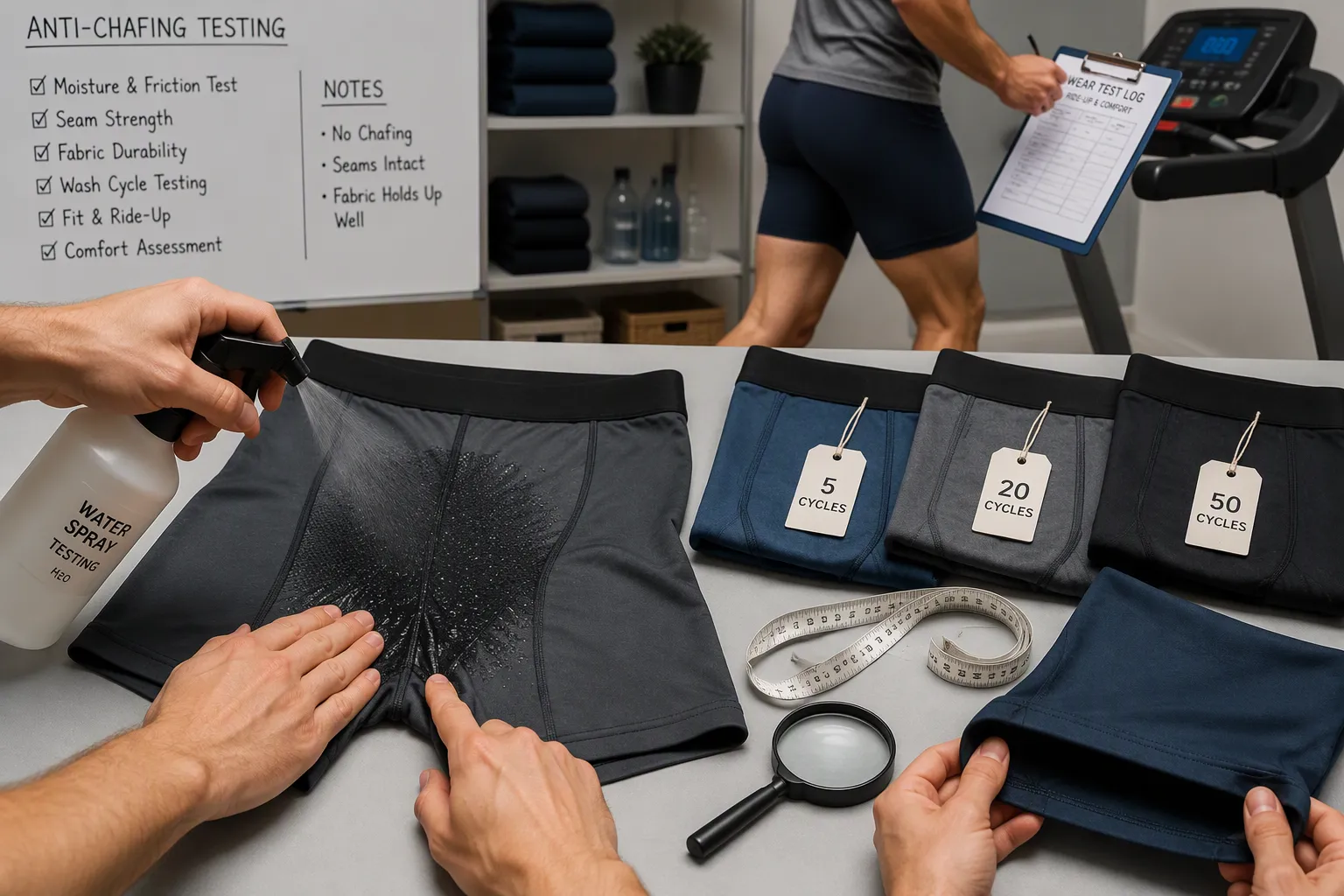
You cannot judge anti-chafing performance from a catalog photo or a dry hand feel. You need an acceptance protocol. Run every pre-production sample through three tests: the wet test, the wash test, and the wear test. This manufacturer evaluation framework separates real anti-chafing construction from marketing claims.
The Wet Test
Spray the gusset, inner thigh panels, and leg openings until the fabric is damp. Now rub the fabric against itself and against your forearm. Feel for drag. A fabric with a low friction coefficient under moisture glides. A fabric that grabs will chafe once your customer sweats. Check the seam profile height at the gusset and crotch crossing while wet. Run your fingertip along each seam. Any ridge you can feel will irritate skin under repeated movement. This test takes two minutes and tells you more than any spec sheet.
The Wash Test
Wash the sample through 5, 20, and 50 cycles. Check the sample after each checkpoint. You want to catch hem migration, seam failure, and fabric degradation before your customers do.
Checkpoint | What to Inspect |
|---|---|
5 cycles | Hem recovery, leg opening grip, color bleed |
20 cycles | Seam integrity, flatlock seams holding flat, pilling |
50 cycles | Fabric thinning, elastic fatigue, ride-up frequency |
Measure ride-up frequency by counting how many times the leg opening migrates upward during a timed walk or jog. Compare that count across wash checkpoints. A hem that migrates more after 20 washes has a recovery problem. Check seam integrity by pulling each seam gently and looking for skipped stitches, loose threads, or bond separation. Document every result. This data protects your brand when you scale.
The Wear Test
Recruit real testers who match your target customer’s build and activity level. Give each tester a fresh sample and a log sheet. Ask them to record chafe reports, ride-up events, and comfort ratings after each wear. Run the test for at least one week per tester. A single wear session hides problems that appear after repeated use.
What to Measure: Chafe Reports and Seam Integrity
Track two numbers: chafe incidents per wear session and seam integrity after washing. Ask testers to rate chafing on a simple scale — none, mild, moderate, severe. Then map those ratings to specific zones: inner thigh, gusset, waistband, and leg opening. A cluster of mild reports at the leg opening points to a grip problem. Moderate reports at the gusset point to seam profile height. Pair these reports with your wash test data. If flatlock seams stay flat through 50 washes and testers report no chafing, you have a passing sample.
How Hongku Underwear Supports Sample Testing
Hongku Underwear provides wash data and sample testing support for brand clients. The factory documents fabric behavior through repeated wash cycles and shares those results before you commit to a production run. That transparency shortens your manufacturer evaluation and reduces reorder risk. You get real numbers, not guesses.
Before you approve any sample, confirm that the manufacturer agrees on inseam length, seam construction, and pouch support. Request wear-test evidence before making any anti-chafing or moisture-management claims. A capable anti-chafing boxer briefs manufacturer welcomes this step. A weak one avoids it.
Hongku Underwear also builds moisture-wicking fabrics and low-profile flatlock seams into every anti-chafing boxer briefs sample. The factory treats construction quality as a measurable outcome. That approach gives you confidence when you compare this boxer briefs manufacturer against others on your shortlist. Use the wet, wash, and wear tests as your scorecard. The partner who passes all three earns your business.
Order Minimums and Customization with Hongku Underwear
Low MOQs for New Brands
You do not need to gamble your launch budget on thousands of units. Hongku Underwear keeps minimum order quantities low enough for new brands to test the market without drowning in inventory. That flexibility matters when you are still learning which inseam length and pouch design your customers prefer.
Sampling moves fast, too. You request a sample, the factory builds it, and you get it in your hands quickly. Communication stays responsive throughout. Ask a question about seam construction, and you get a real answer, not a runaround. That speed lets you validate your specs before you commit to a full production run.
Customization: Fabric, Fit, Labels, Packaging
Hongku Underwear offers full custom oem/odm across every part of the garment. Pick your fabric: GOTS-certified organic cotton, bamboo, or TENCEL™ lyocell. Each fiber behaves differently when wet, so match the material to your customer’s climate and activity level. Then dial in the fit — 6-inch or 8-inch inseam, silicone grippers or elastic bands, flatlock or bonded seams.
Labels and packaging are yours to design. Woven labels, printed tags, custom poly bags, and retail-ready boxes all fall under private label and custom oem/odm services. Before you approve any sample, agree on inseam length, seam construction, and pouch support with the manufacturer. Request wear-test evidence before making anti-chafing or moisture-management claims. That step protects your brand from promising performance the garment cannot deliver.
Lead Times and Reorder Consistency
Production lead times depend on fabric availability and order volume. Hongku Underwear communicates timelines upfront, so you can plan your launch without guessing. Once production starts, the factory tracks your order through each stage.
Reorder consistency is where a reliable underwear manufacturer proves its worth. Your second run should match your first — same seam profile height, same leg opening recovery, same fabric hand feel. Hongku Underwear maintains that consistency by locking specs after sample approval. Nothing shifts unless you request a change. That predictability lets you scale with confidence, knowing your anti chafing boxer briefs manufacturer will deliver the same product every time.
Quality Standards for a Specialized Anti-Chafing Boxer Briefs Manufacturer
Fabric Testing: Shrinkage, Colorfastness, Pilling
You need fabric test data before you approve any production run. Ask for shrinkage rates after repeated washing, colorfastness ratings against sweat and friction, and pilling scores after abrasion cycles. These three tests tell you how the fabric behaves over the life of the garment, not just on day one.
GOTS-certified organic cotton is a key indicator of organic men’s underwear. That certification confirms organic fiber origin and eco-friendly processing. Pair it with fabric testing to confirm the material holds its shape and color after your customer wears it fifty times.
Construction Audits: Stitch Density and Seam Strength
Construction quality shows up in measurable details. Stitch density determines how well seams hold under repeated stress. Seam strength testing pulls each seam to failure and records the load. Low-profile flatlock seams at the gusset and crotch crossing must stay flat through wash cycles. If they pucker or separate, your anti-chafing claims fall apart.
Ask your manufacturer for construction audit reports. These documents record stitch density per inch, seam type by position, and seam strength results. A capable anti-chafing boxer briefs manufacturer tracks these numbers batch by batch. That data protects your brand when you scale.
Compliance: OEKO-TEX, GOTS, WRAP, and BSCI
Certifications separate serious manufacturers from order-takers. OEKO-TEX STANDARD 100 confirms fabrics are tested for harmful substances. GOTS covers organic materials and eco-friendly processing. WRAP verifies lawful, humane, and ethical production. BSCI addresses labor rights and workplace safety. Together, these certifications cover product safety, material claims, and social compliance.
Standard / Certification | Details | Scope / Notes |
|---|---|---|
OEKO-TEX® STANDARD 100 | Product Class I, Certificate No. 26.HCN.12213, held by Shenzhen Ljvogues Sports Fashion Ltd (parent entity), issued by Hohenstein Laboratories, valid through 31 July 2027 | Applies only to named Product Class I articles; must match each material and component before making an order claim |
ISO 9001 | Quality management system certification | Manufacturer produces under ISO 9001 certified systems |
ISO 14001 | Environmental management system certification | Manufacturer produces under ISO 14001 certified systems |
REACH / SVHC Compliance | Regulatory compliance with EU chemical safety standards | Products comply with REACH/SVHC standards |
GOTS Scope Certificate | Global Organic Textile Standard | Relevant for organic fiber origin claims |
SGS Test Reports | Third-party testing documentation | Provides independent verification of product quality and safety |
A certificate does not by itself prove absorbency, leak resistance, fit, wash durability, PFAS status, organic fiber origin, or the performance of a finished custom product. Those questions require their own applicable specifications and evidence.
How Hongku Underwear Documents Quality and Compliance
Hongku Underwear documents fabric testing, construction audits, and compliance reports for every order. The factory provides wash data and sample testing support. You get real numbers, not guesses.
Verify certificates properly. Request the current certificate PDF. Use the official OEKO-TEX Label Check. Match the article list to your tech pack. Record evidence for each component. Recheck every material change. Before you approve production, agree on inseam length, seam construction, and pouch support. Request wear-test evidence before making anti-chafing and moisture-wicking claims. That step separates a reliable underwear manufacturer from one that just ships product.
Red Flags When Vetting an Anti-Chafing Boxer Briefs Manufacturer
Vague Answers on Seam Types and Inseam Specs
Ask a potential partner one direct question: which seam type do you use at the gusset, leg opening, and crotch crossing? A capable anti-chafing boxer briefs manufacturer answers with specifics. A weak one talks about comfort and quality instead. When a supplier cannot name the friction coefficient under moisture for a fabric or describe seam profile height by position, that supplier is guessing. You cannot build anti-chafing boxer briefs on guesses.
Watch for the same vagueness on inseam specs. A real manufacturer knows whether your sample uses a 6-inch or 8-inch inseam and why. If the answer shifts between emails, your construction quality will shift between production runs. That inconsistency creates chafing your customers will feel.
No Sample Testing Protocol or Wash Data
Durability is a safety metric, not a nice-to-have. A manufacturer without wash data cannot tell you how the garment performs after 20 or 50 cycles.
Compliance obligations also exist before the first production run. Under EU BPR (Article 58), antibacterial underwear is a treated article requiring approved active substances and labeling. In the US, silver-based antimicrobials on textiles are regulated as pesticides under FIFRA. A responsible spec includes a third-party report from a lab like SGS or Intertek on the production lot. Without a sample testing protocol, you face uncontrolled release, unverified claims, and costly retrofits.
Unwillingness to Share Factory Audit Reports
A partner who dodges audit requests is hiding something. Factory audit reports document stitch density, seam strength, and working conditions. They prove your manufacturer evaluation rests on evidence, not promises. Refusal to share them signals risk you cannot absorb.
A capable performance underwear oem partner welcomes technical questions. Ask about flatlock seams, wet-state fiber behavior, and pouch support. Ask for wear-test evidence before you make anti-chafing and moisture-wicking claims. Before you approve any sample, agree on inseam length, seam construction, and pouch support. A reliable underwear manufacturer treats these requests as normal business. A boxer briefs manufacturer that avoids them is not ready for your brand.
Why Hongku Underwear Fits the Performance Underwear OEM Model
You have a technical checklist in hand. Hongku Underwear passes it on every line. The company builds anti-chafing boxer briefs as engineered products, not softness experiments. This makes Hongku a specialized anti-chafing boxer briefs manufacturer you can hold accountable from sample to reorder.
Technical Expertise in Anti-Chafing Construction
Hongku Underwear tracks the same variables you should watch. Low-profile flatlock seams sit at the gusset and crotch crossing, where pressure runs highest. A 3D pouch removes flat-panel folds that migrate into the inner-thigh zone. Special panels keep thighs moving without riding up. Each choice targets friction coefficient under moisture or seam profile height.
Nothing is guesswork. Ask where seam placement changes and why. Ask how fabric behaves when wet. Hongku answers with specifics. The factory agrees on inseam length, seam construction, and pouch support before production starts. That clarity means construction quality follows your spec, not a default. That discipline makes the anti chafing construction repeatable.
Flexible MOQs and Fast Sampling
New brands do not need to sink cash into bulk inventory. Hongku keeps minimums low so you can test the market. Sampling moves quickly. You request a sample, the factory builds it, and you hold it in days, not weeks. That speed lets you run the wet, wash, and wear tests before placing a production order.
Communication stays direct. Lead times stay clear before you commit. You ask about seam placement, and you get a real answer. This responsiveness makes a small order feel like a partnership. If you need a custom design, full custom oem/odm covers fabric, fit, labels, and packaging. You choose the options; the factory locks them into a spec. A small order still gets full attention because an anti chafing boxer briefs manufacturer knows each detail matters. Construction quality stays locked after sample approval. Reorders match the first run because this boxer briefs manufacturer does not change what already passed.
Documented Quality and Certifications
Hongku documents everything. You receive wash data, construction audit reports, and compliance documents with each order. The factory provides OEKO-TEX, GOTS, and other certifications. You do not need to guess whether fabric shrinks or seams stay flat. You see the numbers.
This documentation earns your trust. Ask for wear-test evidence before you approve any sample. It also protects your brand when you make chafing or moisture-management claims. A performance underwear specialist shares evidence willingly. That transparent approach is exactly what the performance underwear oem model demands. It also shows how custom oem/odm services should work: the supplier proves the product, not just promises it. You request samples, run your tests, and choose the partner that passes.
Pick a manufacturer who can execute real specs: inseam length, leg opening grip, seam profile height, wet fiber behavior, and pouch design. Then verify those specs through wet, wash, and wear testing. Hongku Underwear proves these capabilities with documented quality standards, flexible MOQs, and sample testing support.
Use this checklist as your scorecard when you compare anti-chafing boxer briefs manufacturer options. Agree on inseam length, seam construction, and pouch support before you approve any sample. Request wear-test evidence before making anti-chafing or moisture-management claims.
Don’t settle for vague promises about chafing prevention. Request samples from each boxer briefs manufacturer on your list. Run the tests yourself. Choose the anti chafing partner who passes every check. That manufacturer earns your trust, and your customers feel the difference.
FAQ
What is the single most important spec for anti-chafing boxer briefs?
Seam profile height. A raised seam ridge creates friction in high-load zones like the gusset and crotch crossing. Low-profile flatlock seams sit flatter against skin. Ask your manufacturer which seam type goes at each position, not just whether they use “comfort seams.”
How do I know if a fabric will chafe when wet?
Run the wet test. Spray the gusset, inner thigh panels, and leg openings until damp. Rub the fabric against itself and your forearm. A low friction coefficient under moisture means it glides. If it grabs, it will chafe once your customer sweats.
Should I choose a 6-inch or 8-inch inseam?
It depends on your customer’s build and climate. A 6-inch inseam suits everyday wear and warmer weather. An 8-inch inseam covers more inner thigh and protects guys with skinnier legs, who leave a wider gap between thighs. Lock the spec before production.
Do silicone grippers work better than elastic bands?
Both work when the spec is right. Silicone grippers hold the hem with light tack. Elastic bands rely on tension alone. The real test is recovery after repeated washing. A migrated hem folds into a lump and makes chafing worse, so check wash data.
How many wash cycles should I test before approving a sample?
Check at 5, 20, and 50 cycles. At 5 cycles, inspect hem recovery and color bleed. At 20, check seam integrity and pilling. At 50, look for fabric thinning, elastic fatigue, and ride-up frequency. Document every result to protect your brand at scale.
What certifications should an anti-chafing manufacturer hold?
Look for OEKO-TEX STANDARD 100 for harmful substance testing, GOTS for organic fiber claims, WRAP for ethical production, and BSCI for labor rights. Also ask for ISO 9001 and ISO 14001. Verify each certificate PDF against your tech pack before you claim compliance.
When can I make anti-chafing claims in my marketing?
Only after you agree on inseam length, seam construction, and pouch support with your manufacturer, and only after you request and review wear-test evidence. Claims without that evidence put your brand at risk. A capable partner welcomes the request instead of dodging it.
What is the biggest red flag when vetting a manufacturer?
Vague answers. If a supplier cannot name the seam type at the gusset, leg opening, and crotch crossing, or describe seam profile height by position, they are guessing. A capable performance underwear OEM partner answers technical questions with specifics and shares audit reports willingly.
See Also
Your Brand Needs A Dedicated Anti-Chafe Boxer Briefs Producer
Choosing A Modal Boxer Briefs Producer For Your Brand
Selecting A Private Label Men’s Underwear Maker In 2026
Top Seven Low MOQ Boxer Briefs Makers For Small Brands
How To Locate The Ideal Custom Waistband Underwear Manufacturer