
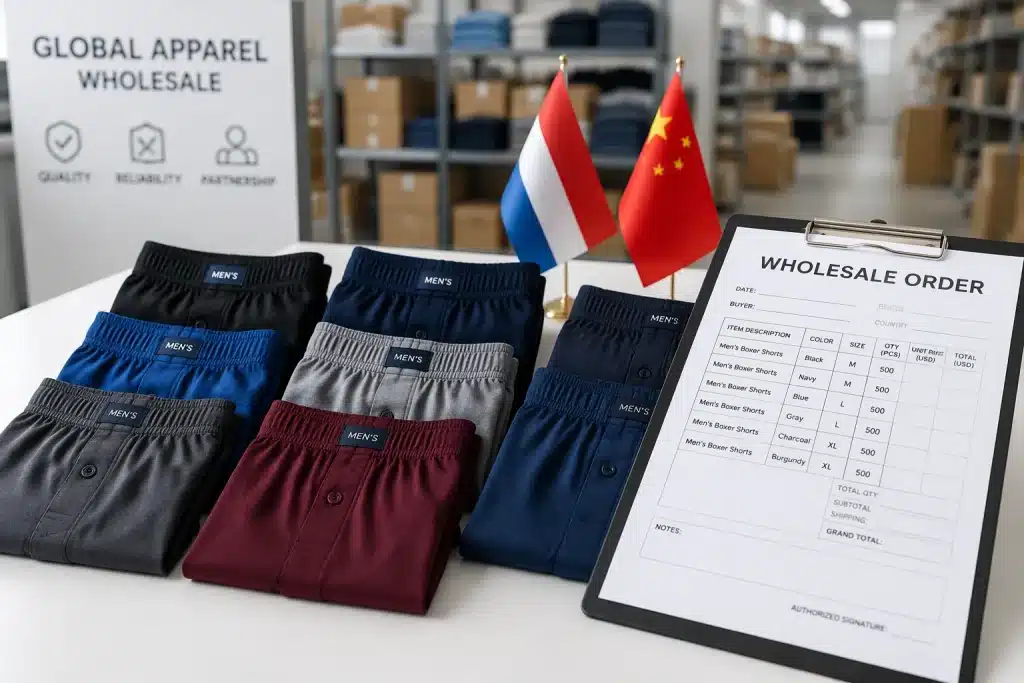
Dutch brand owners ask me this question every week. My quick answer: top Chinese suppliers quote about €1.50–€4.50 per pair of men’s boxer shorts, factory-direct. Fabric, GSM, and order volume drive that range. Mid-size factories offer the best value for most Dutch labels. They balance price, flexibility, and quality better than trading companies or giant OEM plants.
I compare unit prices, MOQs, shipping, EU import duties, quality checks, and payment terms here. One point upfront: I hold no local Dutch stock. Every order ships directly from China. That fact shapes the total cost of any underwear wholesale deal. I also cover how factories handle underwear for women, so you can bundle ranges. When buyers ask about wholesale in underwear, I point them to the same plain numbers, not sales talk.
Key Takeaways
Buying straight from China works best when you order more than 300–500 units per style.
Mid-size factories give most Dutch brands the best value for their money.
The unit price is only one part of the total cost. You also need to add freight, duties, VAT, and fees.
Light customization balances price and brand identity for starting brands.
Full OEM production gives the lowest price per unit, but it requires higher volume and longer lead times.
Always ask for paid samples and check the quality before production and shipment.
EU labels and papers such as test reports and REACH declarations are required.
Never pay the full amount up front. Use 30/70 payment terms instead, and confirm production slots in writing.
Quick answer: when direct sourcing fits
Direct sourcing from China pays off above roughly 300–500 units per style. That is my decision rule after years of quoting Dutch labels. Below that threshold, shipping and duties eat the price gap. Local stock or EU-based wholesale usually wins on total cost. Above it, factory-direct pricing starts to work in your favor. The gap widens with every extra unit you order.
For which Dutch brands it pays off
Direct sourcing suits Dutch brands with a clear size run and steady demand. You need enough volume to fill a container or at least a solid pallet. A label selling 3-packs through its own webshop fits well. So does a brand that already moves 1,000 pieces per season across a few colors. These buyers absorb the lead time and turn inventory fast.
Smaller labels can still test the model. Start with one style and one fabric. Order the minimum and treat it as a paid trial. I see many Dutch starters begin this way. They learn the process without locking up capital in underwear they cannot sell.
When local sourcing is better
Local sourcing wins when speed matters more than unit price. A Dutch brand that needs stock within days cannot wait for sea freight. EU-based wholesale suppliers hold inventory and ship fast. You pay more per piece, but you avoid import paperwork and long transit times.
I hold no local Dutch stock myself. Every order I place ships directly from China. That is a deliberate choice, and it shapes my advice. If you need 100 pieces next week, I will tell you to buy locally. If you can plan 60 days ahead, direct sourcing becomes the smarter path. Match the model to your cash flow and your sales calendar.
The main costs at a glance
The unit price is only the first line. I always build a full cost stack before I compare suppliers. Here is the structure I use for every underwear order:
Cost line | What it covers |
|---|---|
Unit price | Goods cost per piece, ex-works |
Freight | Sea, air, or express to the Netherlands |
EU import duty | Rate set by the CN code for the garment |
VAT | 21% Dutch VAT on import |
Inspection fees | Pre-shipment checks and lab tests |
Add bank fees, currency conversion, and inland transport from Rotterdam. These lines look small on their own. Together they can add a meaningful share to your landed cost per unit. I never sign a purchase order before I see the full picture.
Price Comparison of Top Chinese Suppliers
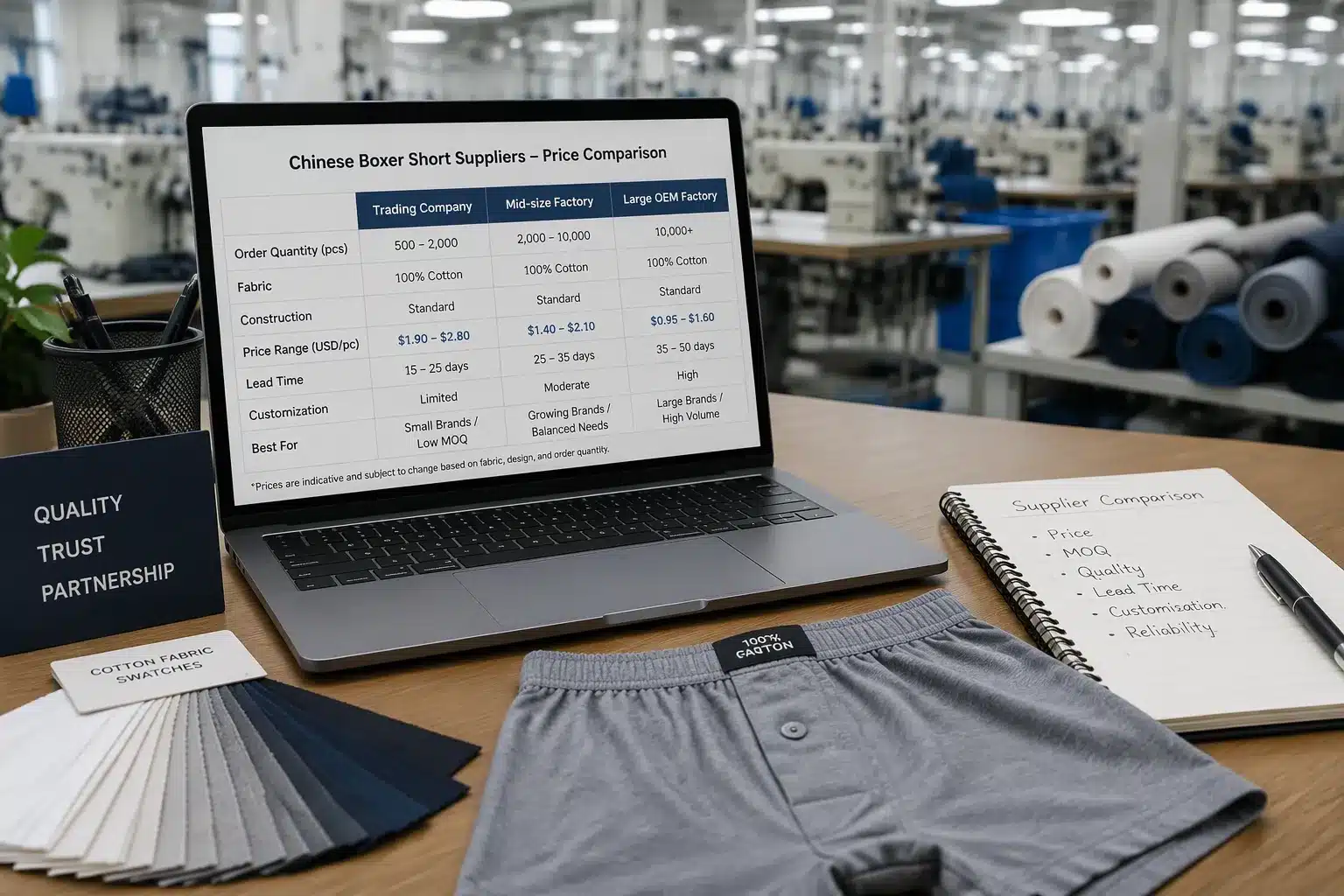
Three kinds of suppliers lead the Chinese factory market for men’s boxer shorts. Each one gives a different price range. I compare them side by side, because the first number you see hides big differences in service, flexibility, and risk.
Price Ranges by Supplier Type
Supplier type | Indicative unit price | Typical profile |
|---|---|---|
Trading company | €2.50–€4.50 | Sourcing agent, wide catalog, small runs |
Mid-size factory | €2.00–€3.50 | Own production lines, moderate MOQs |
Large OEM factory | €1.50–€2.80 at volume | High MOQs, full certification, export focus |
Trading companies charge the highest prices. They handle many product lines and seldom run their own sewing floor. You pay for ease and English-language help. Mid-size makers remove the middle layer. They run their own lines and quote lower prices for the same fabric. Large OEM plants give the lowest average unit price, but only at serious volume. Their pricing rewards buyers who commit to thousands of pieces per style.
The supplier market also covers women’s underwear. Many factories run both product lines on the same floor. Dutch brands that expand their range can bundle orders with the same factory. That move spreads freight and inspection costs across more SKUs. It also makes your negotiating position on pricing stronger.
MOQ and Volume Discounts Compared
Minimum order quantities follow the price bands closely. Trading companies often take the smallest runs, sometimes a few hundred pieces per color. Mid-size factories usually ask for more, and large OEM plants set the highest limits. Volume discounts follow the same logic. Every step up in quantity pulls the average unit price down.
Small price gaps matter at volume. A difference of €0.10 per unit becomes €1,000 on a 10,000-unit order. I have seen buyers accept a quote because it looked close to the cheapest offer. At scale, that gap pays for a full inspection round. Always compare suppliers at your real order quantity, not at a sample size.
A supplier’s quoted price is not always the best deal you can get. Some manufacturers pad the first quote and expect negotiation. Others hide tooling or sampling fees in a separate line. I ask every supplier for a full breakdown before I judge the offer. The lowest first number can lose once the extras appear.
Best Value for Dutch Brands
Mid-size factories give the best value for most Dutch labels. They combine competitive pricing with workable MOQs and direct communication. A brand ordering 500 to 2,000 pieces per style rarely gains from the giant OEM plants. Those plants reward volume that most Dutch starters do not have yet.
I hold no local Dutch stock. Every order ships directly from China, and that fact shapes this comparison. A wholesaler with EU stock charges more per piece but ships in days. Factory-direct buying trades speed for price. My advice reflects that trade-off, not a warehouse I own.
The women’s underwear market shows how much price spread exists across suppliers. European women’s underwear market buyers compare quotes the same way I do for men’s boxers. They normalize every offer to a landed cost per unit. I recommend the same discipline here. Collect three quotes, convert each to a delivered cost, and compare like for like. The supplier with the best structure usually wins, not the one with the loudest sales pitch.
Local stock vs. OEM production
Dutch labels face one core trade-off here. Local stock ships in days at a higher unit price. OEM production cuts the unit cost but adds 30–60 days of lead time plus tooling and sample costs. I walk every client through this choice before we talk about fabric. The right answer depends on your sales calendar and your cash position, not on the headline price alone.
Local stock: fast but more expensive
Local stock means someone already holds the goods in Europe. You order today and receive boxes within days. That speed carries a price. The holder of the stock adds a margin for storage, risk, and capital tied up in inventory. You pay for convenience, and you pay well.
I hold no local Dutch stock myself. Every order I place ships directly from China. That is a deliberate model, and it shapes my advice. A brand with an empty webshop and a launch date next week should buy local stock. A brand that can plan two months ahead should look at factory-direct options instead. Speed has a real value, but so does margin.
Light customization: balance in price
Light customization sits between the two extremes. You take a stock fabric and add your own label, your own care tags, and custom 3-pack packaging. The factory runs a short production batch on existing material. Setup costs stay low, and the unit price lands well below local stock.
This path suits starting Dutch brands. You get a real brand identity without paying for custom dyeing or new patterns. Many manufacturers in China offer this service as a standard option. The same factories often run women’s underwear lines, so a starter range can cover both men and women in one order. I recommend this route for a first production run. It tests the market without locking up capital.
OEM production: lowest unit price
Full OEM production gives the lowest unit price. You specify the fabric, the GSM, the fit, and the packaging. The factory builds the run from scratch. Unit costs drop to the factory-direct ranges I quoted earlier, roughly €1.50–€4.50 depending on fabric and volume.
The catch is time and setup. Lead times run 30–60 days, and you pay for samples and tooling before production starts. Suppliers in the women’s underwear market quote the same way. Buyers there compare landed cost, not headline price. I apply that discipline to men’s underwear orders too. The women’s underwear market rewards planning, and so does this one. Wholesale buyers who plan ahead win on margin. Wholesale buyers who rush pay for speed. Choose your path with both numbers in front of you.
Total Costs and EU Import Duties
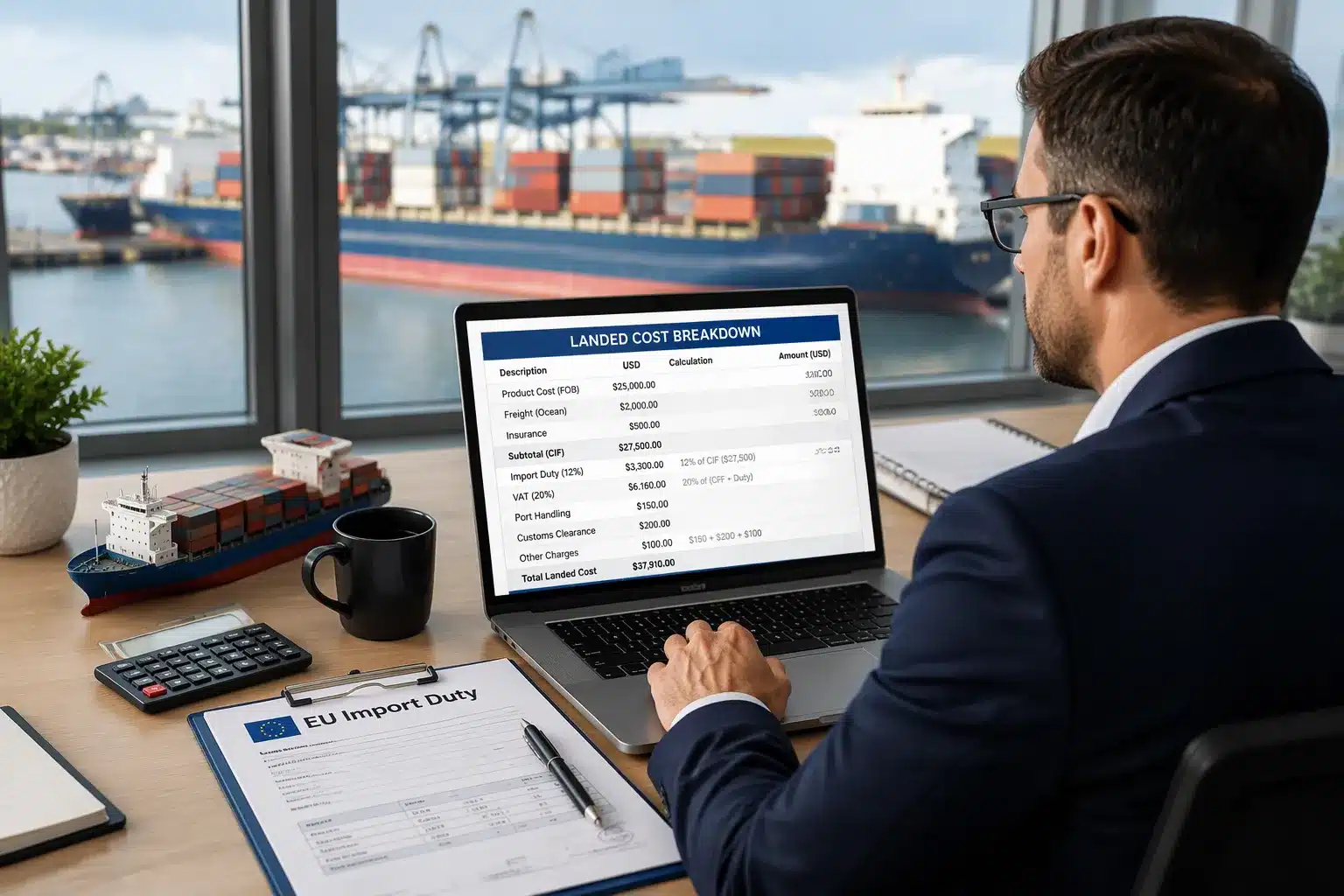
The unit price only tells you part of the story. The landed cost shows you the real picture. I build a full cost model for every order before I sign anything. Here is how I do it, using real numbers from a recent quote.
Shipping Costs and Transport Methods
Sea freight gives the lowest cost per unit on large orders. A full container of boxers moves slowly but cheaply. Air freight cuts transit time to days and makes the freight bill much higher. Express couriers only work for samples and small top-up runs.
I match the shipping method to the order size. A 5,000-piece run travels well by sea. A 300-piece trial goes by air or express. Freight per unit drops fast as volume goes up. That drop is one reason the average unit price gets better at scale.
Calculating EU Import Duties and VAT
Duty depends on the CN code for the garment. Cotton and elastane men’s underwear has its own code and its own rate. I check the current rate in the EU TARIC database before every order. I never quote a duty figure from memory.
Here is my worked example. 5,000 boxers at €2.00 each gives €10,000 in goods value. Freight by sea adds a few hundred euros. Duty applies to the goods value plus freight. Dutch VAT of 21% then applies on top of goods, freight, and duty. A pre-shipment inspection adds a fixed fee. The final landed cost per unit lands clearly above €2.00.
The same math governs women’s underwear. Buyers who track the average import unit price for women’s underwear see the pattern clearly. The import unit price for women’s underwear imports rarely matches the factory quote. The average import unit price for women’s underwear imports includes freight and duty. That gap explains why the average unit price for women’s underwear looks higher than the ex-works figure. I apply the identical method to men’s boxers.
Hidden Costs That Push Up the Unit Price
Small lines add up. Bank transfer fees, currency conversion spreads, retail packaging, and inland transport from Rotterdam all land on your invoice. None of them appear in the factory quote.
I hold no local Dutch stock. Every order ships directly from China, so these lines hit every shipment I place. I budget them upfront. A brand that ignores them sees its margin shrink after arrival.
The women’s underwear side shows the same effect. The European women’s underwear market runs on thin margins. Smart buyers compare the average import unit price across suppliers, not just the quote. The import unit price for women’s underwear imports tells the real story. The average import unit price for women’s underwear imports reveals the true cost base. The average unit price for women’s underwear means little without freight and duty included. The import unit price for women’s underwear imports is the number I trust.
I also watch the average import unit price on women’s underwear imports when I benchmark a new factory. The import unit price for women’s underwear imports sets a fair reference point. The average unit price for women’s underwear imports helps me spot padded quotes. The average import unit price for women’s underwear imports stays stable across reliable suppliers. The import unit price for women’s underwear imports drops sharply at volume. The average unit price for women’s underwear imports reflects that curve.
Dutch brands expanding into women’s ranges should study EU women’s underwear imports before they commit. The EU women’s underwear imports data shows duty and freight patterns clearly. I pull EU women’s underwear imports figures whenever I price a mixed order. The women’s underwear imports numbers guide my wholesale planning. I treat women’s underwear imports as a benchmark for total import costs. My pricing model starts with women’s underwear imports data and adjusts for men’s boxers. The women’s underwear imports trend also shapes my wholesale negotiations. I review women’s underwear imports reports each quarter. The women’s underwear imports figures keep my costs honest. Women’s underwear imports data beats any sales pitch. I trust women’s underwear imports data over a supplier’s word.
MOQ, size mix, 3-packs and fabrics
MOQ and size mix per supplier
I set MOQ expectations before I discuss anything else with a factory. Stock fabrics usually start at 300–500 units per color. Custom dyeing pushes the minimum order quantity past 1,000 units. Those two numbers explain most of the gap between a cheap quote and a workable one.
Size-mix flexibility varies a lot across suppliers. Some manufacturers let you split a run freely across S, M, L, and XL. Others cap each size at a fixed share of the order. I always ask for the size breakdown in writing. A flexible mix keeps your inventory balanced. A rigid one leaves you with dead stock in odd sizes.
Low MOQs exist, but they come with a price. Small runs from trading companies carry a higher unit cost. I accept that trade-off for a first test order. For repeat business, I move to a mid-size factory and scale up.
3-packs and retail packaging
Retail packaging changes the quote more than most buyers expect. A plain polybag costs almost nothing. A printed 3-pack box with your brand on it adds a real line to the invoice. I price both options side by side before I commit.
Most factories handle private label packaging as a standard service. You supply the artwork, and they print and pack on the line. This step suits Dutch brands selling through their own webshop. It also works for wholesale buyers who resell to boutiques.
I hold no local Dutch stock. Every order ships directly from China, packaging included. That fact matters here. You cannot top up boxes from a Dutch warehouse, so I order packaging in the same run as the goods.
Fabric choice and price impact
Fabric choice moves the unit price by roughly €0.30–€1.00. Plain cotton sits at the low end. Modal and elastane blends push toward the top. GSM matters too. A heavier knit costs more per piece and feels more premium in the hand.
I compare fabric options across suppliers before I decide. The same cotton weave can carry different prices at two factories. Buyers in the women’s underwear market already know this. They benchmark women’s underwear quotes the same way. I apply that habit to men’s boxers.
The women’s underwear side also shows how fabric drives cost. Women’s underwear buyers compare women’s underwear specs line by line. A women’s underwear order in modal costs more than one in cotton. Women’s underwear factories quote the same way as men’s boxer plants. I read women’s underwear quotes with the same eye. Women’s underwear pricing rewards a careful fabric choice. Women’s underwear ranges often share fabric with men’s lines. Women’s underwear orders can bundle with boxer runs. Women’s underwear suppliers rarely hide fabric costs. Women’s underwear buyers who check GSM save money. Women’s underwear and boxer shorts follow one pricing logic.
EU labeling and supplier documents
Mandatory labeling in the Netherlands
Every pair of boxer shorts I import must have a label that shows what it is made of. The label has to list the exact percentage of each fiber. A cotton-elastane blend needs both numbers, not a vague “cotton blend” claim. Dutch and EU consumer rules treat this as a legal requirement, not a nice extra.
A care label comes next. It tells the buyer how to wash and dry the garment. I also require the country of origin on every item. The label must name the EU importer too. That means your Dutch company name and address, printed on the product or its packaging. REACH compliance covers chemical safety, and I treat it as a hard gate. No REACH statement, no order.
Documents per supplier
I ask every supplier for three documents before I pay a deposit. First, test reports from an accredited lab. These cover fiber content, color fastness, and restricted substances. Second, a signed compliance declaration. The factory puts its name on paper and accepts responsibility for REACH and labeling rules. Third, a valid business license. That license proves the company legally exists and can export.
I hold no local Dutch stock. Every order ships directly from China, so these documents travel with the shipment. I keep digital copies in a folder per order. Dutch customs can ask for them, and so can your retail buyers. Suppliers who hesitate on paperwork rarely pass a quality audit later.
Compliance checklist for the quote
I attach a short checklist to every quote request. It keeps the comparison fair and forces weak suppliers to show their hand early. My list covers fiber composition, care instructions, country of origin, EU importer details, and a REACH declaration. I add test report dates and the lab name.
The same checklist works for a mixed range. Many factories run men’s underwear and women’s underwear on one floor. A Dutch brand that adds women’s underwear to its catalog can reuse the same documents. The women’s underwear labels follow identical EU rules. I check women’s underwear test reports with the same eye. Women’s underwear fiber labels need the same precision. Women’s underwear care labels must match the actual fabric. Women’s underwear origin marks belong on every piece. Women’s underwear importer details go on the packaging. Women’s underwear REACH statements carry equal weight. Women’s underwear suppliers who skip paperwork fail my checklist. Women’s underwear orders ship from China just like boxer runs. Women’s underwear compliance protects your wholesale accounts. Women’s underwear buyers deserve the same proof as men’s buyers.
Samples, quality control and quote
Requesting and evaluating samples
Before I agree to any production run, I order two to three paid samples per style. Free samples almost never happen in this trade, and I don’t chase them. A paid sample shows me the factory takes small orders seriously. I hold no local Dutch stock, so every sample ships directly from China. That first parcel also tests how well the supplier packs and how fast they ship.
My sample check covers three things. I pull the seams and look at how tight the stitching is. I wash the sample twice and measure shrinkage against the original size. I rub a damp white cloth on the fabric to judge color fastness. A sample that fails any of these checks never reaches a purchase order. The same routine works for underwear ranges beyond boxers. Factories that run women’s underwear lines often share fabric and machines with the men’s floor. A women’s underwear sample from the same plant shows me the real production standard. I compare women’s underwear stitching with the boxer sample side by side. Women’s underwear shrinkage behaves the same way after washing. Women’s underwear color fastness gets the identical rub test. Women’s underwear samples cost the same as boxer samples. I keep every women’s underwear sample in a reference box. Women’s underwear buyers deserve the same proof I demand for men’s lines.
Quality control before and after production
For orders above 1,000 units, I book two inspections. The first happens before production starts. The inspector checks the fabric rolls, the trims, and the labels against my approved sample. The second happens before shipment. I use the AQL 2.5 standard for both checks.
AQL 2.5 sets the acceptable defect level per batch. I apply it to stitching, sizing, and labeling on every pre-shipment check.
The pre-production check catches problems while fixing them is still cheap. The pre-shipment check protects the money I have already paid. Suppliers who resist an inspection rarely survive the second one. I also ask for the women’s underwear portion of a mixed order to pass the same AQL 2.5 gate. Women’s underwear defects cost the same to fix as boxer defects. Women’s underwear labels get checked line by line. Women’s underwear sizing runs get measured against the spec sheet. Women’s underwear orders ship with the boxer cartons, so one inspection covers both.
A complete quote request
I send every supplier the same written request. It lists the style, the fabric, the GSM, the full size run, the colors, the packaging, the target quantity, the Incoterm, and the delivery window. A complete request gets a complete quote. A vague request gets a padded price.
I normalize every quote to a landed cost per unit before I compare. Headline wholesale prices mislead, and small gaps grow at volume. Two suppliers can quote the same boxer and land far apart once freight and duty join the bill. I line up the quotes in one sheet and mark the cheapest landed figure. That number decides the order, not the first price on the page.
Payment Terms, Delivery Times, and Communication
Common Payment Terms
I never agree to pay 100% upfront. A supplier who asks for that may have money problems or no export history. Most factories I work with want 30% down and 70% before shipping. This 30/70 T/T split protects both sides. The factory pays for materials, and I keep control until the goods pass inspection.
A 50/50 split shows up with newer suppliers or first orders. I accept it when the factory is checked and the sample passed. Bigger orders sometimes use a letter of credit. An L/C costs bank fees, but it protects both sides on large sums. I compare that fee to the order value before I agree.
Realistic Delivery Times
Stock fabrics move fast. A plain cotton boxer run ships in about 30 days after deposit. Custom dyeing and full OEM production stretch that window to 60 days. I add sea freight time on top, so I plan two to three months from deposit to Dutch warehouse.
I hold no local Dutch stock, so every order ships directly from China. That fact sets my calendar. A brand with a fixed launch date must build extra time into the plan. Factories that also run women’s underwear lines face the same queue. A mixed order of boxers and women’s underwear ships together, and one delay hits both ranges. I confirm the production slot in writing before I pay.
Judging Reliability
I score every supplier on facts I can check, not sales talk. Buyer reviews give a first signal. Reference checks with past clients give a stronger one. I ask for two references and call them. Registries that track export licenses and audit history add a third layer. The same method works when buyers scan wholesale directories or social-media wholesale updates. A flashy post proves nothing without a paper trail.
Women’s underwear imports data helps me benchmark a new factory. Steady women’s underwear imports volumes point to a plant that ships on schedule. I compare women’s underwear imports figures across candidates. Reliable women’s underwear imports records rarely hide a weak supplier. Women’s underwear imports trends also reveal seasonal capacity gaps. I read women’s underwear imports reports before I commit. Women’s underwear imports history beats any promise. Women’s underwear imports data and reference calls together settle the choice.
Ask for MOQ and OEM quotes
What you request from a supplier
A vague request gets a padded quote. I send every factory the same written template, so each reply covers the same ground. That habit makes the comparison honest from the first email.
Field | What to specify |
|---|---|
Style | Boxer brief, trunk, or loose fit, with a reference image |
Fabric | Fiber blend and GSM |
Sizes | Full size run and the split per size |
Colors | Pantone codes or lab dips |
Packaging | Polybag, printed 3-pack box, or hangtag |
Quantity | Target units per style and per color |
Incoterm | FOB, CIF, or EXW |
Delivery | Deposit date and required ship window |
I add one line at the bottom: please confirm your MOQ per color and your lead time in days. Factories that answer every field in one reply usually run a tight operation. Suppliers who reply with a single price and nothing else rarely improve later.
Putting quotes side by side
Headline prices mislead. I turn every quote into a landed cost per unit before I judge it. That figure carries the goods, freight, duty, VAT, and inspection fees. Two factories can quote the same boxer and land far apart once those lines join the bill.
I build one sheet per order and place each offer in its own column. The average unit price on the page means nothing until freight and duty sit beside it. I also check the average unit price against my own benchmark from past orders. A quote far below that benchmark deserves a second look, not a celebration.
The same discipline applies to a mixed range. Many factories run men’s underwear and women’s underwear on one floor. A bundled order spreads freight and inspection costs across more pieces. I price the women’s underwear line in the same sheet and compare the combined landed figure. One wholesaler quote can look cheap alone and expensive next to a bundled offer.
Choosing the right supplier
The cheapest quote rarely wins my order. I weigh four things: landed cost, MOQ fit, documentation, and communication speed. A factory that answers within a day and ships on schedule beats a slightly cheaper plant that goes quiet for a week.
I start small with any new partner. One style, one fabric, a paid sample round, then a first production run. That path limits risk while I test reliability. Competitive pricing matters, but it never outweighs a supplier who cannot produce test reports or hold a delivery date.
Dutch brands that add a women’s range should ask about capacity first. Women’s underwear orders share machines with boxer lines, so a busy floor delays both. I confirm the production slot in writing. My rule stays simple: no local Dutch stock, every order shipped directly from China, and every quote normalized before I compare. That routine keeps pricing decisions clean and protects the margin on each run.
Local stock wins below 300–500 units per style. Light customization gives starting Dutch brands the best balance. Full OEM production pays off at volume, where factory-direct pricing reaches €1.50–€4.50 per pair. I hold no local Dutch stock, so every order ships directly from China.
My decision path stays fixed. Order paid samples first. Verify EU labels, test reports, and the REACH declaration next. Then scale with the supplier who balances unit price, MOQ, and reliability. A factory running men’s underwear and women’s underwear on one floor lets you bundle both lines and spread freight. That bundling logic applies to any wholesale range you plan.
Send your MOQ and OEM request today, using the checklist above.
FAQ
Do you hold stock in the Netherlands?
No. I hold no local Dutch stock. Every order ships directly from China to your door. That model keeps unit prices low and gives you factory-direct pricing. Plan for freight time and import paperwork, because nothing ships from a Dutch warehouse.
What is the minimum order for boxer shorts?
Stock fabrics usually start at 300–500 units per color. Custom dyeing pushes the minimum past 1,000 units. I confirm the exact figure in writing before any deposit. Size-mix flexibility varies, so always ask for the size breakdown per order.
Which supplier type gives the best value?
Mid-size factories give most Dutch labels the best value. They combine competitive pricing with workable MOQs and direct communication. Trading companies charge more for convenience. Large OEM plants reward volume that most starting brands do not have yet.
How much does fabric change the price?
Fabric choice moves the unit price by roughly €0.30–€1.00. Plain cotton sits at the low end. Modal and elastane blends push toward the top. Heavier GSM costs more per piece and feels more premium. I compare fabric options across suppliers before I decide.
What payment terms should I accept?
I never pay 100% upfront. Most factories want 30% down and 70% before shipping. A 50/50 split appears with newer suppliers. Larger orders sometimes use a letter of credit. I compare the bank fee to the order value first.
How long does production take?
Stock fabric runs ship in about 30 days after deposit. Custom dyeing and full OEM production stretch that to 60 days. Sea freight adds more time on top. I plan two to three months from deposit to Dutch warehouse.
Do I need inspections?
Yes, for orders above 1,000 units. I book a pre-production check and a pre-shipment check at AQL 2.5. The first catches problems while fixes stay cheap. The second protects money already paid. Suppliers who resist inspection rarely survive the second one.
Can I bundle men’s and women’s lines?
Yes. Many factories run men’s underwear and women’s underwear on one floor. A bundled order spreads freight and inspection costs across more pieces. I price both lines in one sheet and compare the combined landed figure. One wholesale quote can look cheap alone and expensive next to a bundled offer.
See Also
Where to Find Wholesale Boxer Shorts Multipacks for Retail
Need Boxer Shorts Manufactured? Locate Low MOQ Manufacturers Today
My Hunt for a Trustworthy Men’s Underwear Wholesale Supplier in UK
Small Batch Boxer Briefs Production with Low Minimum Order Quantities
A Complete Wholesale Men’s Underwear Guide for UK Purchasers