

When comparing men’s underwear wholesale offers, UK buyers needn’t look only at unit price. They should compare opening orders, replenishment lead times, and trade terms side by side. The real question is stock versus made-to-order. If a boxer shorts wholesale supplier UK holds stock, buyers can reorder quickly and test small quantities. Made-to-order production normally means longer lead times, lower unit costs, and less short-term flexibility. Both models work; they simply change cash flow and stock planning. This guide provides a practical comparison framework. It also clarifies delivery assumptions, so buyers know if a stated lead time includes dispatch, shipping, and customs. They should confirm everything in writing before committing.
Key Takeaways
Compare opening orders, replenishment lead times, and trade terms side by side.
Choose stock for speed and made-to-order for control and lower unit costs.
Confirm all delivery assumptions in writing before you commit to an order.
Ask suppliers to state stock status and delivery terms clearly in writing.
Use a supplier checklist to compare quotes fairly and spot weak offers.
Comparing Men’s Underwear Wholesale Opening Orders
Opening orders set the tone for everything that follows. Get this stage right, and buyers build a smooth supply chain. Get it wrong, and they tie up cash in stock that sits in a warehouse for months. So how should UK buyers compare opening offers from different men’s underwear wholesale suppliers? They need to look at two things first: minimum order quantities and whether the goods come from stock or from production.
Minimum Order Quantities
Every supplier sets a floor for the first order. Some ask for a few hundred pieces per style. Others want thousands. The number matters because it decides how much cash a buyer locks up before selling a single pair.
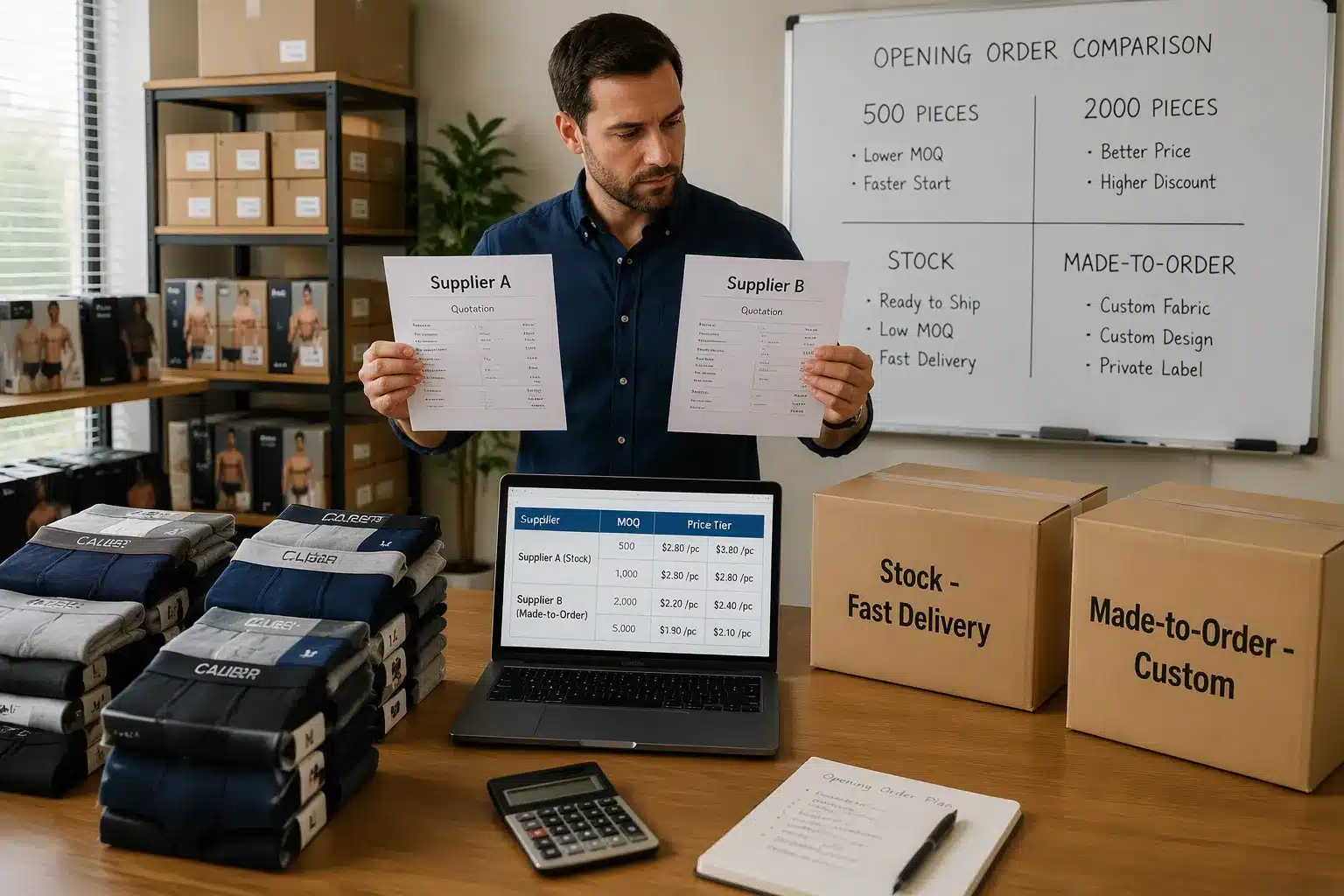
Pricing tiers usually move with volume. A supplier might quote one price for 500 pieces and a lower price for 2,000. Buyers should ask for the full tier table, not just the price at their expected volume. That way they can see whether stretching the order slightly unlocks a better rate.
A simple comparison helps. Buyers can list each supplier’s minimum, the price at that minimum, and the price at the next tier up. The gap between tiers shows how much room exists for negotiation.
Watch for mixed-style rules too. Some suppliers let buyers split the minimum across colours and sizes. Others count each style separately. That difference changes the real minimum a buyer faces.
Stock Versus Made-to-Order
This is the big fork in the road. Stock means the supplier already holds the goods. Made-to-order means production starts after the buyer confirms.
Stock offers speed. A buyer can often receive goods in days rather than weeks. It also suits testing. Someone new to a product line can order small, see what sells, and reorder what works. The trade-off is limited choice. Popular sizes and colours sell out, and the buyer takes what’s available.
Made-to-order offers control. Buyers choose fabrics, colours, labels, and packaging. Unit costs often drop at higher volumes. The catch is time. Production, quality checks, and shipping all add up. Buyers also commit to the full quantity upfront, so a wrong guess becomes dead stock.
For a first order, many UK buyers mix the two. They take stock for a quick launch and place a made-to-order run for their core line. That balances speed with margin.
One practical tip: ask the supplier to state clearly whether each item is held as stock or made to order. A boxer shorts wholesale supplier UK that answers this in writing saves everyone confusion later.
Buyers should also check whether stock levels are live or estimated. A supplier who confirms availability on the day of order gives a firmer promise than one quoting a catalogue.
Finally, compare the total cost of each route, not just the unit price. Stock may cost more per piece but arrives faster. Made-to-order may save money but ties up capital longer. The right choice depends on how quickly the buyer needs to sell.
Boxer Shorts Wholesale Supplier UK Replenishment
Repeat orders keep a business alive. A first order proves the product works. Replenishment proves the supply chain works. So how do buyers judge a boxer shorts wholesale supplier UK on this front? They compare lead times, consistency, and how stock availability shapes flexibility.
Lead Times and Consistency
Lead times vary by supply route. A supplier holding stock can often dispatch within days. A made-to-order run takes longer, because production starts only after confirmation. Buyers should ask for a realistic range, not a single figure. They should also ask what happens when demand spikes.
Consistency matters just as much as speed. A supplier who delivers in two weeks once, then six weeks the next time, creates chaos. Buyers can check consistency by asking about past order performance. How often does production run late? How does the supplier handle delays? A trading company with steady factory relationships usually gives firmer answers here.
Buyers should also confirm whether quoted lead times cover production only, or include packing and dispatch. That distinction changes planning. A stated time of “three weeks” means little if dispatch adds another week.
Stock Availability and Flexibility
Stock availability decides how flexible repeat orders become. If a supplier holds core sizes and colours, buyers can top up in small amounts. That suits fast sellers and seasonal peaks. If every item is made to order, buyers must commit to full production runs each time.
Flexibility also depends on whether stock levels are live. A supplier who checks availability on the order date gives a firmer promise than one quoting a catalogue. Buyers should ask which lines sit as stock and which run to production.
Finally, buyers should get replenishment terms in writing. That includes lead times, minimum repeat quantities, and what happens if stock runs out. A written record prevents disputes later. It also gives both sides a clear reference when planning the next order.
Comparing Trade Terms

Trade terms decide whether a good price stays good. A low unit cost means nothing if payment terms drain cash flow or delivery surprises add hidden fees. UK buyers should compare three things here: how they pay, what discounts apply, and what delivery really involves.
Payment and Discounts
Payment methods vary across suppliers. Common options include bank transfer, letters of credit, and online payment platforms. Each carries different fees and risks. Bank transfers often suit larger orders. Letters of credit add bank charges but protect both sides. Buyers should ask who covers transaction fees before they commit.
Discount structures need careful reading. Some suppliers offer tiered pricing based on order volume. Others give a flat percentage for repeat customers. A few bundle discounts with early payment. Buyers should ask for the full discount schedule in writing. That way they can compare offers fairly.
Contract terms matter too. Buyers should check cancellation policies, return conditions, and what happens if goods arrive faulty. A Chinese trading company typically handles export customs clearance on its side. The buyer handles import clearance in the UK. Both sides should agree on Incoterms, such as FOB or CIF, because these define who pays for shipping and insurance.
Get every term in writing. Verbal promises about discounts or payment flexibility mean nothing when a dispute arises.
Delivery Assumptions
Delivery assumptions trip up more buyers than any other term. A supplier might quote a lead time of three weeks. Does that cover production only? Or does it include packing, dispatch, and transit? Buyers should ask directly.
Dispatch times vary by supply route. Stock items often leave the warehouse within days. Made-to-order runs take longer because production starts after confirmation. Shipping costs depend on the Incoterms agreed. Under FOB, the buyer arranges freight. Under CIF, the supplier covers shipping and insurance to the UK port.
Customs adds another layer. UK buyers must pay import duties and VAT based on the goods’ value and classification. These charges vary by product type and trade policy at the time of import. Buyers should check current rates with HMRC or a customs broker. A Chinese supplier can provide export documentation, but the buyer remains responsible for UK import compliance.
Stated lead times and actual delivery assumptions differ. A supplier might say “four weeks” but mean production time only. Add shipping, customs clearance, and local delivery, and the real timeline stretches further. Buyers should ask for a breakdown: production days, dispatch days, transit days, and clearance days. That total gives a realistic picture.
Finally, buyers should confirm who handles delays. If customs holds a shipment, who pays storage fees? If production runs late, what compensation applies? A men’s underwear wholesale or boxer shorts wholesale supplier UK buyers trust will answer these questions clearly before the first order ships.
Practical Comparison Framework
A framework turns a pile of quotes into a clear decision. Buyers can score each supplier against the same criteria. That keeps the comparison fair and stops gut feeling from taking over.
Supplier Checklist
A side-by-side table works well here. Buyers list each supplier in a column and score them on the same rows. Here are the rows that matter most.
Check | What to confirm |
|---|---|
Minimum order | Quantity per style, and whether colours or sizes can be mixed |
Stock or made-to-order | Which lines sit as stock, which run to production |
Lead time | Production, packing, dispatch and transit stated separately |
Replenishment | Repeat minimums and how quickly stock lines can be topped up |
Payment | Method, fees, and who covers transaction charges |
Discounts | Full tier table in writing, not just the price at one volume |
Delivery | Incoterms, freight costs, and who arranges each leg |
Customs | Export documents from the supplier, UK import duties and VAT on the buyer |
Returns | Faulty goods policy and who pays return freight |
A Chinese trading company should confirm its export documentation and Incoterms clearly. The buyer still owns UK import compliance, so both sides must agree who handles each step.
Key Questions
Before committing, buyers should ask a short set of direct questions. Written answers beat verbal promises every time.
Is this item held as stock or made to order?
What is the realistic lead time, broken into production, dispatch and transit days?
Which Incoterms apply, and who pays freight and insurance?
What export documents does the supplier provide?
Who pays UK import duties and VAT, and at what point?
What happens if customs holds the shipment?
What are the repeat order minimums?
Can the supplier confirm current stock levels on the order date?
These questions suit any men’s underwear wholesale or boxer shorts wholesale supplier UK buyers shortlist. The answers reveal whether a quote is realistic or just optimistic. Buyers who compare suppliers on the same rows and ask the same questions spot weak offers fast.
Stock gives buyers speed, made-to-order gives control. The first suits quick launches; the second rewards patient planning with lower unit costs. Neither wins outright; choice depends on cash flow.
Buyers should compare opening orders, replenishment, and trade terms side by side. A cheap unit price means little if repeat shipments run late. A Chinese trading company that clarifies terms earns trust.
Always confirm delivery assumptions before ordering. Ask whether lead times include production, dispatch, transit, and clearance.
The takeaway? Treat every quote as incomplete until the supplier states stock status and delivery terms in writing. That habit saves UK buyers from costly guesses when choosing a boxer shorts wholesale supplier UK.
FAQ
How do buyers tell if an item is stock or made to order?
They ask the supplier directly and get the answer in writing. A Chinese trading company should state which lines sit in the warehouse and which start production after confirmation. That single answer shapes lead times, order minimums, and how freely a buyer can top up later.
What belongs in a realistic lead time?
Production, packing, dispatch, and transit days should each appear separately. A single figure like “three weeks” hides the truth. Buyers who ask for the breakdown see the full picture, including customs clearance, before they plan a launch or a repeat order.
Which Incoterms suit a first order?
It depends on who wants to control freight. Under FOB, the buyer arranges shipping. Under CIF, the supplier covers freight and insurance to the UK port. Both work, but buyers should confirm the choice in writing and check who pays each leg.
Who handles UK import duties and VAT?
The UK buyer does. A Chinese trading company provides export documentation and clears goods on its side. Import duties, VAT, and clearance sit with the buyer. Current rates vary, so buyers should check with HMRC or a customs broker before ordering.
Can buyers mix colours and sizes to reach the minimum?
Sometimes. Some suppliers count the minimum across colours and sizes. Others count each style separately. Buyers should ask how the minimum applies before comparing quotes, because the rule changes the real quantity they must commit to.
See Also
What To Consider When Choosing Men’s Underwear Suppliers In 2026
A Handbook For Comfort Throughout The Day With Men’s Underwear
Selecting An Own-Label Men’s Underwear Manufacturer In 2026
Short Run Boxer Brief Production With Low Minimum Order Quantity