
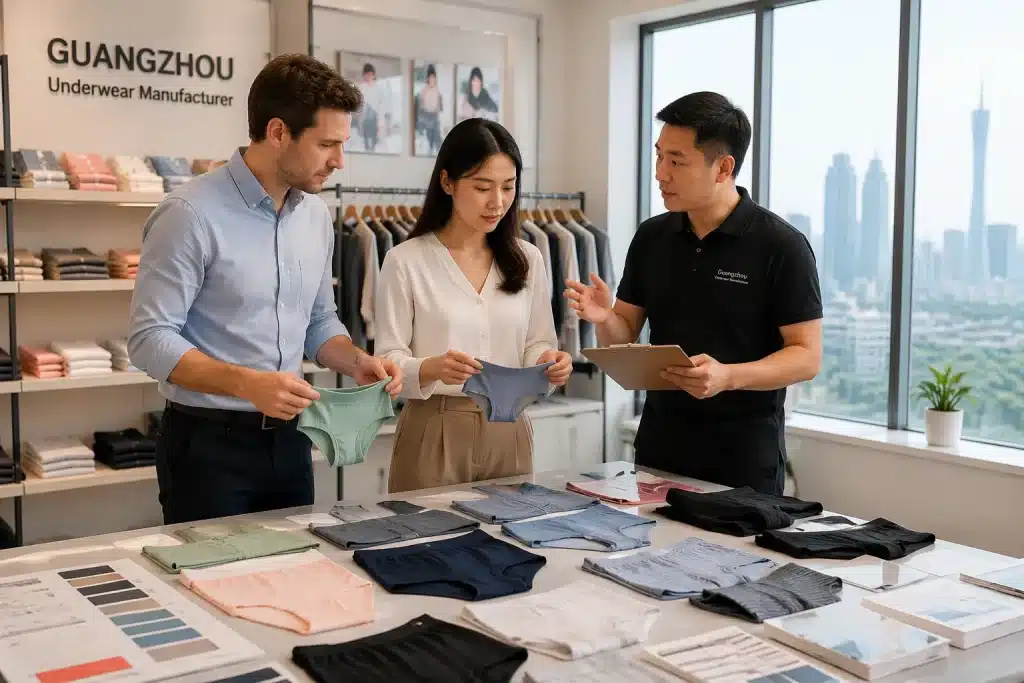
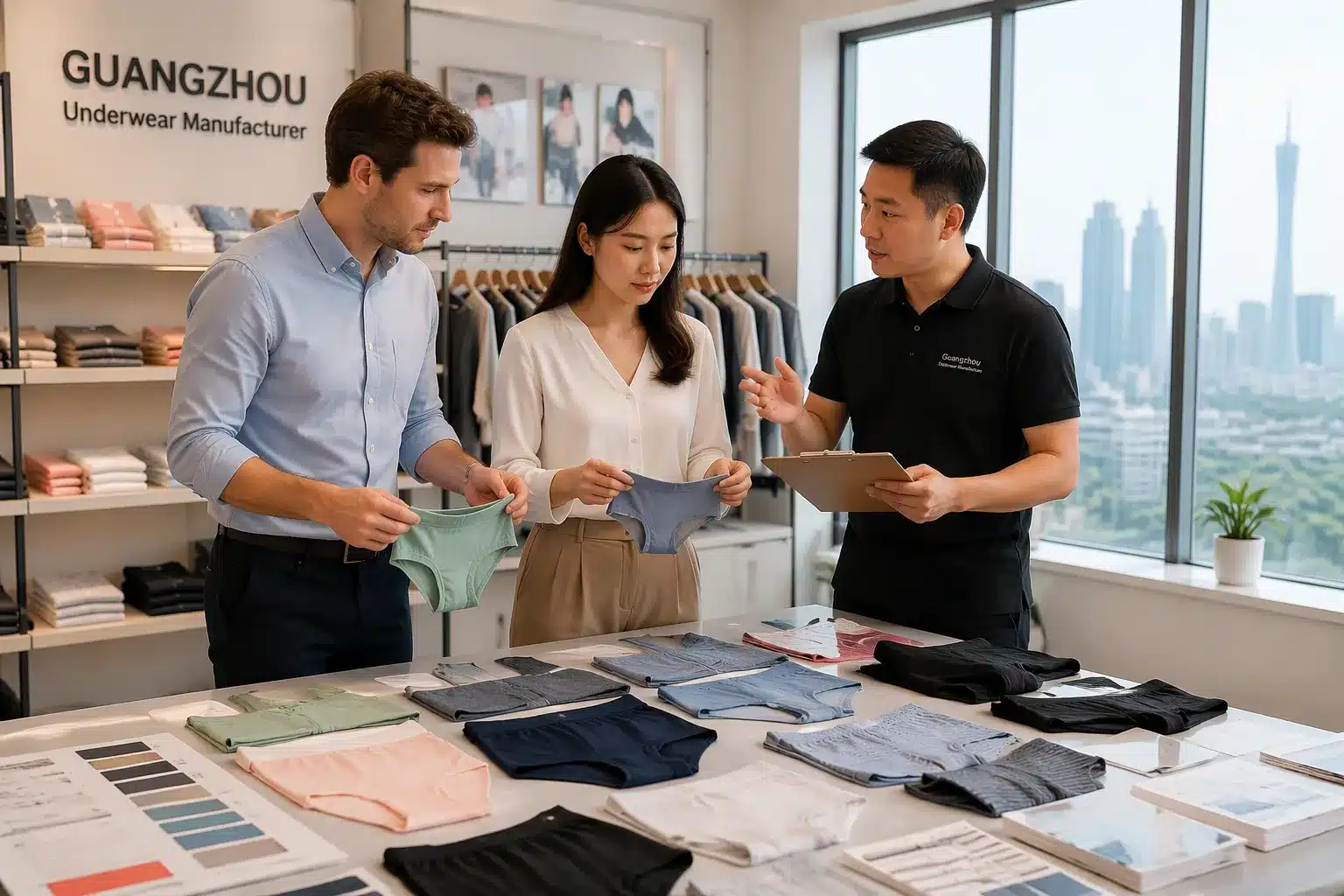
You want to buy underwear from Guangzhou. Maybe you have a brand idea, or maybe you just need a supplier you can trust. Either way, one question keeps coming up: where are the factories, and how do you reach the people who run them?
This guide gives you a clear path. You’ll learn how to find manufacturers and check business licenses and factory evidence. You’ll also learn how to get a guangzhou underwear manufacturer contact phone that reaches a real production contact. Then you’ll send a focused inquiry, ask for samples, and confirm terms with confidence. You can also contact several checked suppliers at once, which gives you more choices and more leverage.
Key Takeaways
Guangzhou has many underwear factories, so you can compare prices and split orders to test quality.
Look for suppliers on B2B platforms, at trade shows like the Canton Fair, and in local markets and industrial zones.
Look at the business license. Make sure the legal name, credit code, and address match what is on the quote and contract.
Confirm the factory location with a video that shows your product being made, and get the name of a contact person.
Send a clear request for quotation (RFQ). Include product details, quantities, target price, and timeline.
Share designs in steps: send a short summary first, then sign an NDA before sharing full tech packs.
Order a sample in the fabric you will really use. Approve it in writing before you talk about bulk orders.
Go see the factory in person, put the terms in a written agreement, and use a third-party inspection before the goods ship.
Why Guangzhou for Underwear
Apparel Cluster at a Glance
Guangzhou sits in the middle of one of the world’s most crowded clothing areas. The city and nearby towns have fabric mills, trim suppliers, dye houses, and garment factories close together. That closeness changes how sourcing works. You can go from picking fabric to sewing samples to full production without shipping materials across a continent.
The cluster also covers every skill level. Some workshops make basic cotton briefs. Others focus on bonded seams, molded cups, or performance knits. For a buyer, this means one city can serve several product lines. You don’t need a separate sourcing trip for each category.
Strength in Shapewear and Seamless
Shapewear and seamless underwear are two areas where local factories have deep experience. These products need more than sewing skill. They need bonding machines, circular knitting equipment, and operators who understand stretch recovery and fit. Factories here have built those skills over many years of serving export brands.
Seamless production is a good example. A seamless brief or bra comes off a circular knitting machine as a single tube. The factory then shapes it with heat and pressure instead of cutting and stitching. That process needs tight control over yarn tension and temperature. Guangzhou suppliers invest in this equipment because demand for seamless styles stays strong across markets.
What It Means for Buyers
A dense cluster gives you options, and options give you leverage. You can compare quotes from several factories that make the same product type. You can also split an order across two suppliers to test quality before committing to volume. Neither move works well in a region with only a handful of factories.
Here’s the catch. Easy access to suppliers makes discovery simple. Confirming who can actually meet your requirements is the harder part. Plenty of businesses in Guangzhou present themselves as factories. Some are trading companies. Others are agents. That’s not automatically a problem, since each model fits different needs. Still, you should know which one you’re talking to before you share designs or pay a deposit. Treat this section as your map of the terrain. The next step is finding candidates, then checking each one against real evidence.
Where to Find Manufacturers
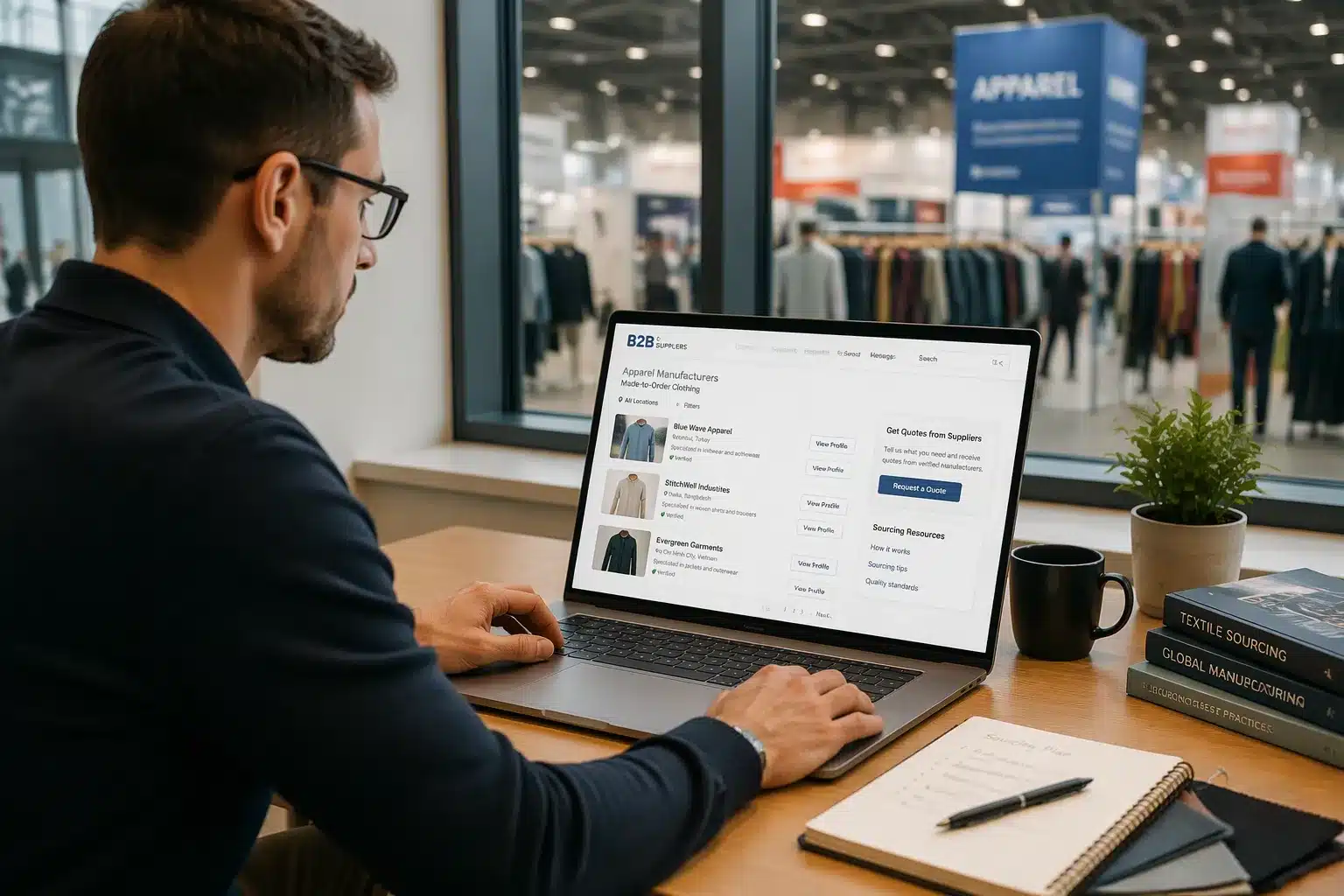
You have a map of the terrain. Now you need names, addresses, and people to talk to. Guangzhou gives you several roads into the supplier base. Each road leads to a different kind of contact. Some routes suit buyers who want to browse first. Others suit buyers who already know their spec and want to move fast. Use more than one route. A supplier you find on a platform often shows up again at a trade show, and that overlap is a useful signal.
Online B2B Platforms
B2B platforms are the fastest starting point. You can search by product type, filter by region, and shortlist suppliers without leaving your desk. Most platforms let you post a sourcing request. Suppliers then come to you with quotes and capability notes. Many listings also include instant messaging, so you can ask a quick question before you invest time in a full inquiry.
Platforms work best at the top of the funnel. They help you build a long list and spot which product categories cluster in which districts. Treat the listings as claims, not proof. A profile that says “factory” is a starting point for questions, not an answer. Save the profile links, note the stated product range, and plan to confirm the details later.
Canton Fair and Trade Shows
The Canton Fair is the best-known trade event in the region, and it covers clothing, underwear, and sports and casual wear. That breadth matters. You can walk one hall and compare a seamless shapewear maker with a cotton basics supplier in the same afternoon. Buyers can filter products online before the show, post sourcing requests, and use instant messaging to reach exhibitors ahead of a visit. That pre-show work turns a crowded hall into a short list.
Trade shows fit buyers who value face-to-face contact. You can feel fabric samples, check stitching up close, and read how a sales team answers technical questions. Smaller regional shows and industry exhibitions round out the calendar. They draw fewer exhibitors, yet the conversations often run deeper.
Sourcing agents are another option. An agent can help you find factories, develop samples, and manage production across several suppliers. This model fits buyers with a complex product line or limited time for travel. It is one option among several, not a replacement for your own checks. You still need to know who actually runs the machines.
Markets, Industrial Zones, and Associations
Local markets and industrial zones put you close to production. Wholesale garment markets let you see finished goods and ask stall holders where the items were made. Industrial zones take you to the factory gates themselves. A walk down the right street can reveal sewing workshops, knitting mills, and trim suppliers side by side.
Industry associations and chambers of commerce add a third layer. They keep member lists and can point you toward suppliers in a specific product niche. The fit is simple. Markets suit buyers who want to touch product and gather leads fast. Industrial zones suit buyers ready to visit sites and shoot line videos. Associations suit buyers who want a referral path into a niche category. None of these routes replaces document checks. Each one just gives you more candidates to check.
Checking If a Manufacturer Is Trustworthy
Finding suppliers is the easy part. The real work starts when you confirm who can actually meet your needs. A nice profile and a quick reply only show someone wants your order. They don’t tell you who runs the machines, who holds the license, or who will fix things when a shipment goes wrong. Treat this stage as lowering your risk, not just doing paperwork. Your goal is simple: find a real production contact and learn if the supplier is a factory, a trading company, or something in between.
Three-Step Factory Check
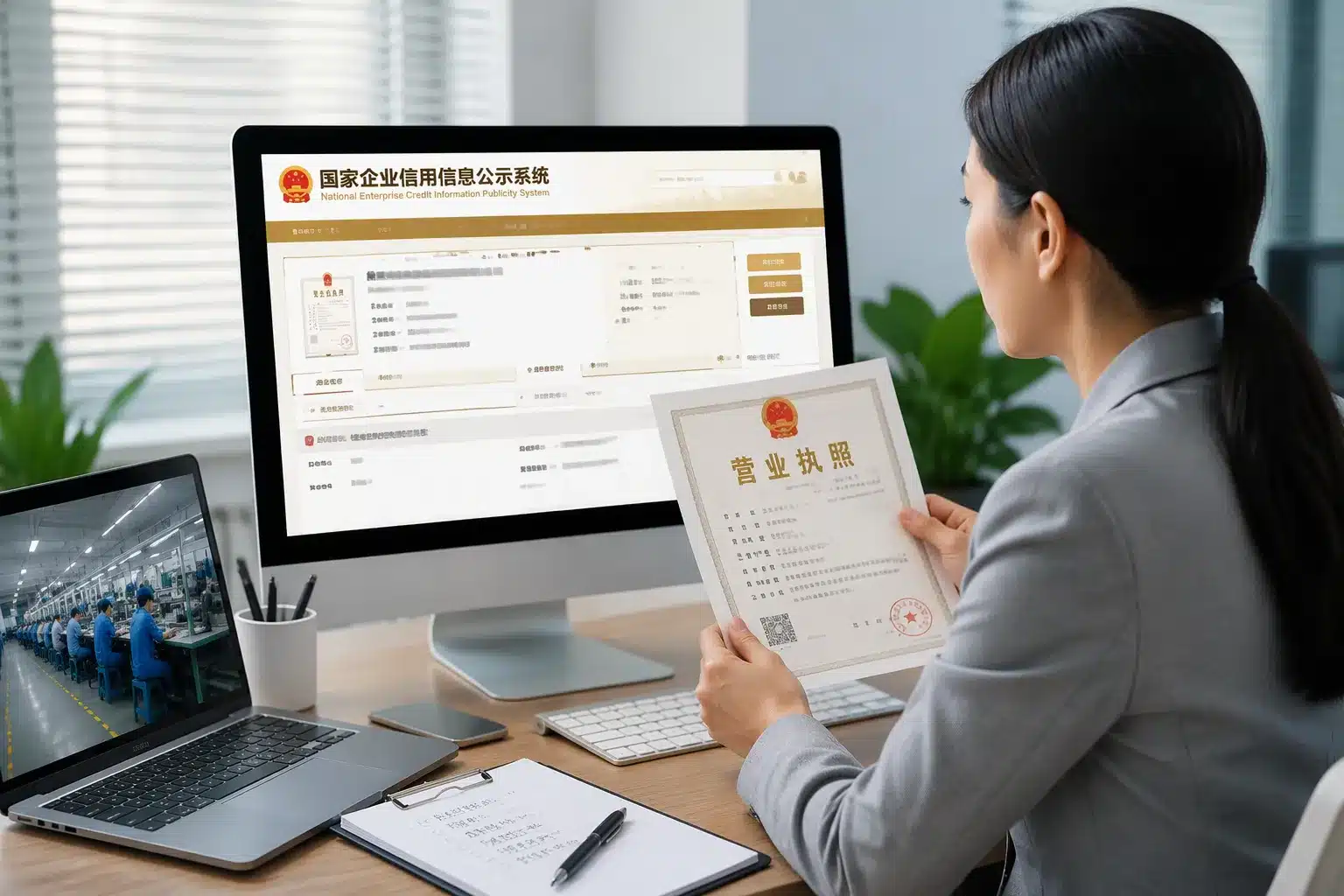
Start with the legal entity. Ask for a clear copy of the business license and match the legal name, unified social credit code, registered address, and legal representative against the quote, invoice, and contract. Then cross-check the license on China’s National Enterprise Credit Information Publicity System. That confirms the company is active and the registered address is consistent. Read the business scope closely, too. Look for manufacturing or production wording for your product category, not only wholesale, retail, import/export, or technology services.
Next, connect the entity to a physical site. Match the registered address to the actual production location. If they differ, ask why and request the factory lease or site documentation. A short production line video helps here. Ask for a clip that shows your product category being made, with the camera panning across the floor. It won’t replace a visit, but it filters out vague claims fast.
Finally, get a named contact person. You want a full name, a role, and a direct channel — not a generic sales inbox. Ask who handles production questions and who signs off on quality. A supplier who answers those questions clearly is usually a supplier you can work with.
Entity, Site, and Contact Evidence
A license check works best as a sequence. First, assess whether the submitted license image is complete, recognizable, and clear enough to read. Second, extract the key fields: the unified social credit code, Chinese company name, legal representative, and registered address. Third, review authenticity and image-risk signals such as tampering, screen recaptures, screenshots, and watermarks. Fourth, match those details to company records and flag any mismatched fields. A clean match gives you a company identifier you can carry into later research. Keep in mind that a passed check is evidence, not automatic approval — your own acceptance rules still decide the outcome.
Some red flags deserve a calm second look. A trading company may present a factory license that belongs to a subcontractor. That’s not automatically disqualifying, since trading companies fit buyers who want one point of contact across several factories. Certificates that are expired or list a different company name are a bigger concern. So is a vague MOQ that shifts every time you ask. None of these means walk away. Each one means ask a sharper question.
The core risk: the entity at the factory address should hold a manufacturing scope covering your product.
Certificates, Audits, and Quality Signals
Certificates only count when the scope matches your product and the company name matches the license. For regulated categories, request the relevant production license or permit and verify the product scope. Then move to samples. Order a sample in your actual fabric and construction, and judge stitching, stretch recovery, and finish against your spec. A sample review plus a third-party inspection before shipment reduces due diligence risk far more than any certificate alone. Together, they tell you whether the factory behind the contact can repeat what the sample promised.
Preparing Your First Inquiry
You’ve checked the license and seen the production floor. Now comes the message that starts a real conversation. A clear first inquiry saves weeks. A vague one gets you a vague quote, or no reply at all.
Building a Clear RFQ
An RFQ is your request for quotation. Think of it as a short brief, not a long letter. Give the factory enough detail to price your order without guessing. Cover these points:
Product type: briefs, boxers, bras, shapewear, seamless styles
Fabric and composition, plus any stretch or recovery needs
Size range and size breakdown
Quantities per style and per color
Target price range, stated as a range
Packaging: polybag, hangtag, carton marks
Timeline: sample date and delivery window
Keep the RFQ to one page if you can. Attach a simple sketch or reference photo. Ask two direct questions at the end: can you make this, and who will handle my order? That second question pushes the reply toward a named person, not a shared inbox.
What to Keep Confidential
Your designs are your asset. Share them in stages, not all at once. Send a capability brief first. Wait for pricing and a signed NDA before the full tech pack. Release the graded pattern only after sample approval and a confirmed bulk order.
Screen the factory before you disclose anything: verify the legal entity, business license, production site, and audit status.
A mutual NDA works well here, even when only you disclose designs. Factories share fabric sources and cost data too, so mutual terms tend to get signed faster. Name the files you’ll disclose and the purpose in a short schedule. Keep a disclosure log with the date, recipient, file name, and version. If something goes wrong later, that log is your evidence.
Choosing Email, Phone, or WeChat
Email suits detailed RFQs, attachments, and anything you may need to reference later. Phone works best for quick capability questions and for reading tone. WeChat and WhatsApp are common in Guangzhou, and many factories list direct contact details on their profiles. Treat a chat reply as a fast door-opener, then move the commercial details to email so both sides have a record.
Whichever channel you pick, ask for a full name and a role. A guangzhou underwear manufacturer contact phone that reaches a sales inbox is less useful than one that reaches the person who schedules production. Save that number once you’ve confirmed it belongs to a named contact.
Guangzhou Underwear Manufacturer Contact: Phone and More
Reaching Out by Phone and WeChat
Your first call or message should stick to a simple plan. Say who your brand is in one sentence. Name the product and the amount you want. Then ask one clear question: can you make this style in this fabric? This approach respects the other person’s time and gets you a helpful answer quickly.
Keep your opening short. “Hi, I work with a small brand in the US. We’re looking at seamless briefs in nylon-spandex, about 2,000 pieces to start. Can your line handle that?” A message like this shows the factory you mean business. It also weeds out suppliers who only make basic cotton items. Once you confirm the guangzhou underwear manufacturer contact phone number belongs to a named person, not a shared sales inbox, save it.
Sampling and Negotiation Basics
Sampling is the next step. Ask for a sample made with your real fabric and construction. Check the stitching, stretch recovery, and finish against your spec. Get the sample approved in writing before you talk about bulk orders.
Then it’s time to negotiate. Start with a target landed cost per piece, delivered to one named door. Ask for MOQ tier tables in writing and compare landed cost at each tier. Fixed setup blocks get divided by committed quantity, so a factory with a truly low MOQ charges those blocks into each piece instead of spreading them across a deep tier. Lead time usually runs 10–25 days after order confirmation, and longer for bulk or custom work. Price is often negotiable above 5,000 units. Tie every figure to a quantity and a construction.
Factory Visits and Final Terms
Plan a visit before you commit. Walk the floor and watch your product category being made. Make sure the license name matches the sign on the gate. Check that certificates list the same company and cover your product scope. Ask who signs off on quality, and put that name in the agreement.
The final agreement should lock in the approved sample, the inspection standard, payment terms, and the delivery window. A third-party inspection before shipment closes the loop. Finding a guangzhou underwear manufacturer contact phone is easy. Confirming the entity, the site, and the sample is what lowers your risk. Do that, and your first order starts on solid ground.
Here’s the short version of the path. Find candidates on platforms, at the Canton Fair, in markets, and through associations. Then check the license, the site, the line video, and the certificate scope before you trust anyone. Send a tight RFQ, approve a real sample, and negotiate price, MOQ, and lead time last. Contacting several checked suppliers at once gives you better options and more leverage. The goal isn’t just a phone number — it’s lower risk. Pick one channel today, draft your RFQ, and start reaching out this week.
FAQ
How do I know if a Guangzhou supplier is a real factory?
Ask for the business license. Then match the legal name, credit code, and registered address to the quote and contract. Next, confirm the production site and ask for a line video that shows your product type. A trading company can still meet your needs — just know which type you’re working with.
What should the business license actually show?
Look for manufacturing or production wording in the business scope for your product type. Don’t settle for only wholesale or import/export. Cross-check the license on China’s National Enterprise Credit Information Publicity System. The company should be active, and the registered address should match what you were told.
The factory address and the license address don’t match. Is that a problem?
Not always, but ask why. Request the factory lease or site documents. Some suppliers run offices and production in different places. The key question is whether the company at the factory address holds a manufacturing scope that covers your product. Get a clear answer before you send a deposit.
How do I verify certificates and audit reports?
Check three things: the company name matches the license, the certificate scope covers your product, and the document is still valid. Expired certificates or ones with a different company name deserve a sharper question. Pair certificates with a real sample and a third-party inspection before shipment.
What belongs in a first RFQ?
Cover product type, fabric and composition, size range, quantities per style and color, a target price range, packaging, and your timeline. Keep it to one page and attach a sketch or reference photo. End with two questions: can you make this, and who will handle my order?
When should I share my designs and tech pack?
Share them in stages. Send a capability brief first. Then wait for pricing and a signed NDA before the full tech pack. Release the graded pattern only after sample approval and a confirmed bulk order. Keep a disclosure log with dates, recipients, and file versions.
How do sampling and inspection lower my risk?
Order a sample in your actual fabric and construction. Judge stitching, stretch recovery, and finish against your spec, then approve it in writing. A third-party inspection before shipment closes the loop. Together, they tell you whether the factory can repeat what the sample promised.
What red flags should make me pause?
A trading company showing a subcontractor’s license, certificates that are expired or name a different company, and an MOQ that shifts each time you ask. None of these means walk away. Each one means ask a sharper question and get the answer in writing.
See Also
What To Look For In Men’s Underwear Manufacturers For 2026
Guide To Custom Waistband Underwear Manufacturers For New Brands
Comparing USA Private Label Underwear Manufacturers: MOQ, Pricing, And Services
How To Find The Right Custom Waistband Underwear Manufacturer
Choosing A Private Label Men’s Underwear Manufacturer In 2026