
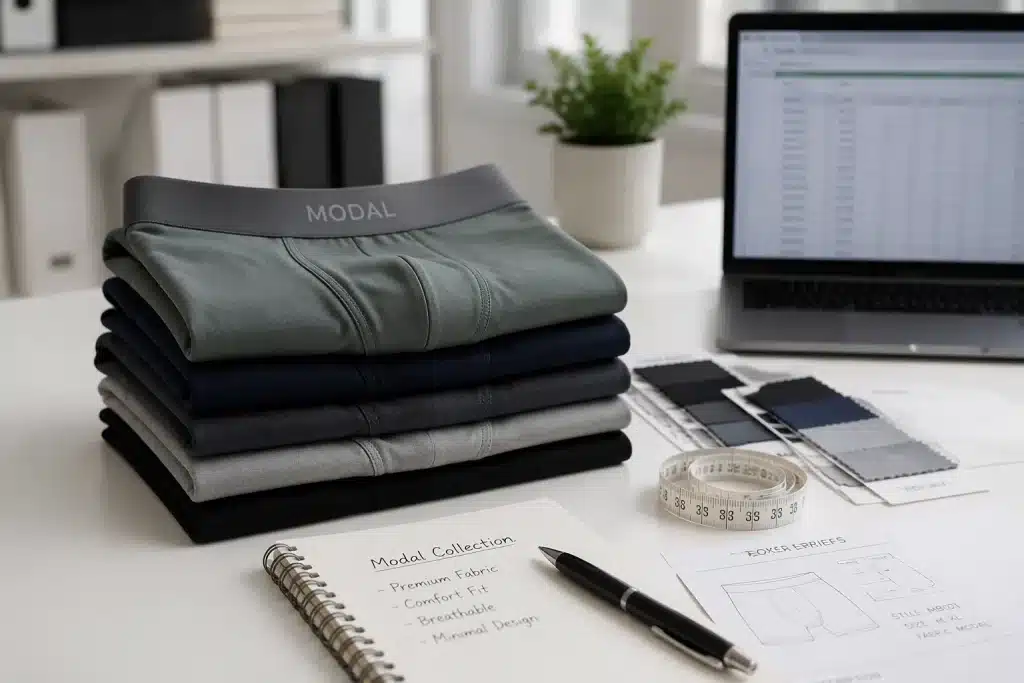
To choose a modal boxer briefs manufacturer for your brand, focus on five key factors: material quality, production capabilities, customization options, cost and MOQ, and communication reliability.
Material quality shapes comfort and durability. That’s why you should compare fiber composition, fabric weight, stretch recovery, and wash-test results. Fiber names alone don’t establish performance. Production capabilities determine whether a manufacturer can scale with your growth. Customization options let your underwear brand stand out on the shelf. Cost and MOQ directly affect your profit margins. Communication reliability predicts how smooth your long-term partnership will be. Whether you’re vetting a bamboo viscose underwear supplier or comparing manufacturers, these five areas separate great partners from costly mistakes. Start by asking the right questions early.
Key Takeaways
Ask for fabric specifications first. Fiber percentages, GSM, stretch recovery, wash tests reveal true modal quality.
Check certifications carefully. OEKO-TEX certificates prove safety. GOTS certificates prove organic claims. Verify numbers through official label checks.
Assess factory equipment and capacity. Ask about knitting machines, monthly output, quality control standards. This ensures scalable growth.
Explore customization options. Custom waistbands, labels, packaging make your brand stand out. Request fit, sizing, samples before production.
Compare total costs carefully. Request FOB, EXW, CIF quotes plus MOQ per color, size. Avoid suspiciously low quotes.
Test communication before commitment. Send specific questions. Observe response speed and clear communication. A responsive manufacturer will make a reliable partner.
Start with a trial order. Verify stitch quality, waistband recovery, delivery timing. Then scale with confidence.
Build a long-term partnership. Put payment terms and exclusive rights in writing. Choose a manufacturer invested in your growth.
Evaluate Modal Fabric Quality
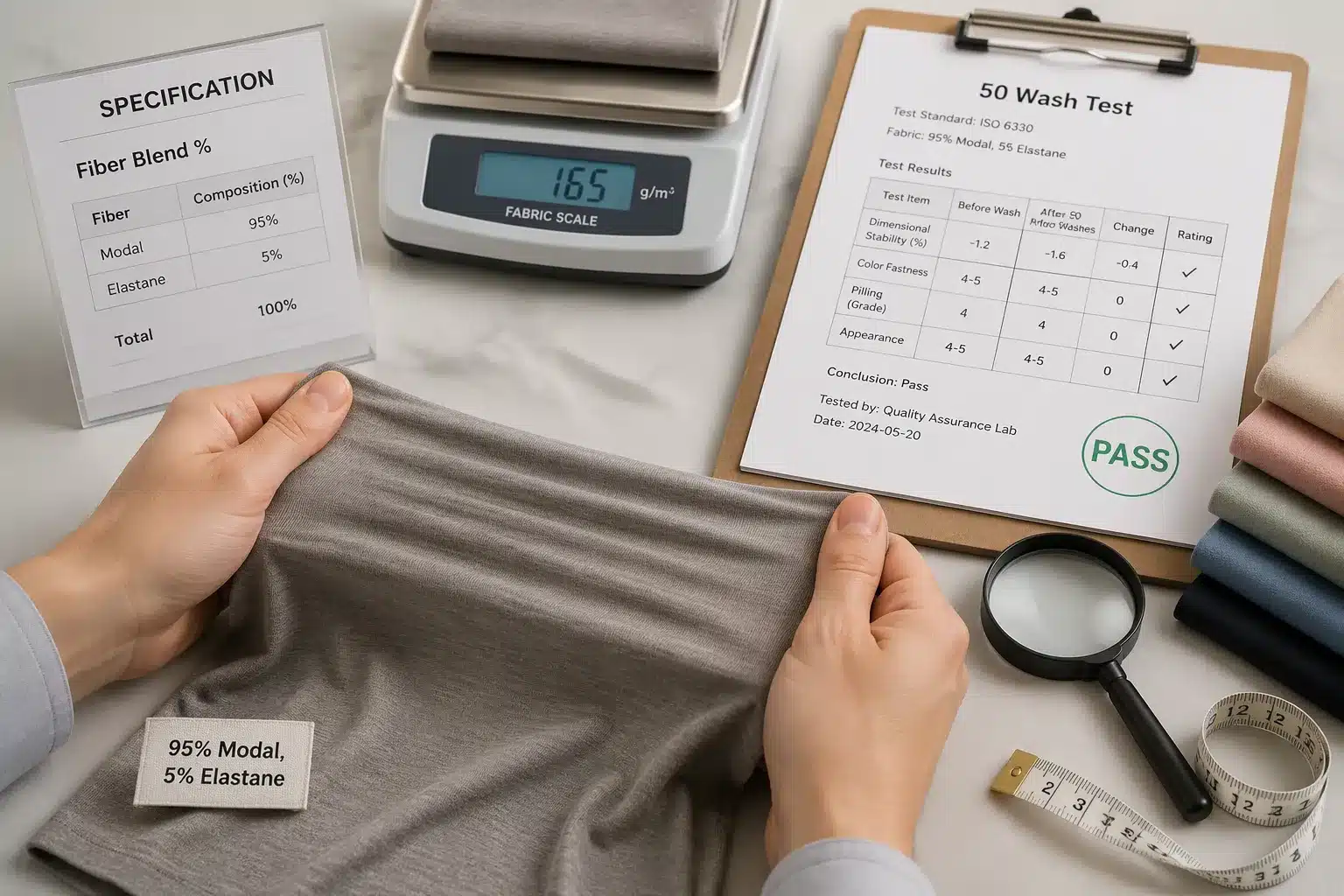
Comfort is the first thing your customer feels. It’s also the hardest thing to fix after production. So before you sign anything with a modal boxer briefs manufacturer, dig into the fabric itself. A soft hand feel means nothing if the fabric pills after five washes. Ask for data, not descriptions.
Verify Fibre Composition and Weight
Ask for fibre blend percentages
A supplier might say “modal blend” and leave it there. That’s not enough. You need exact percentages. Is it 95% modal with 5% elastane? Or 60% cotton and 40% modal? Each blend behaves differently. Cotton-modal blends are breathable, comfortable, and durable. They also hold up well across seasons. For organic options, look for GOTS-certified organic cotton. That certification proves the cotton is genuinely organic. Without it, you’re paying a premium for a label.
Ask for the blend breakdown in writing. Then match it against the certificate. A legitimate supplier will share this without hesitation.
Request fabric weight (GSM)
Fabric weight tells you how substantial the material feels. It also predicts opacity and durability. Here’s a quick reference:
GSM range | What it means for men’s underwear |
|---|---|
100–150 GSM | Ultra-light, sheer, or seamless styles |
150–180 GSM | Everyday underwear with solid opacity and durability |
140–220 GSM | Modal/bamboo viscose jersey range; silky drape, lighter than cotton at the same weight |
For opaque, durable modal boxer briefs, 150–180 GSM hits the sweet spot. It sits inside the modal jersey range while staying breathable. Anything below 150 GSM risks being see-through. That’s a problem most customers won’t forgive.
Test Stretch and Wash Durability
Request wash-test results
A fabric that looks great in a sample photo can fall apart after 50 washes. Ask for wash-test results before you commit. One strong benchmark is the AATCC 79 absorbency test. Some QA teams wash a sample garment 50 times, then run the official test. If a water drop takes longer than 3 seconds to absorb and spread, the fabric lot gets rejected. That’s a concrete standard. It tells you the fabric still performs after real-world use.
Ask for stretch recovery data
Stretch recovery matters for fit. A waistband that sags after a week feels cheap. So does a pouch that loses shape. Ask how the fabric performs after repeated stretching. Does it snap back? Or does it stay stretched out? Good stretch recovery keeps the garment snug and supportive. It also protects your brand’s reputation for construction quality.
Compare Modal and Bamboo Viscose Underwear Supplier
Check certifications (OEKO-TEX, GOTS)
Certifications separate serious suppliers from talkers. OEKO-TEX STANDARD 100 is a key one. It verifies that every component — body fabric, gusset layers, elastics, trims — meets safety limits. Here’s what a valid certificate looks like:
Attribute | Detail |
|---|---|
Standard | OEKO-TEX® STANDARD 100 |
Product class | Product Class I |
Certificate no. | 26.HCN.12213 |
Holder | Shenzhen Ljvogues Sports Fashion Ltd |
Issuing institute | Hohenstein Laboratories |
Valid through | 31 July 2027 |
Verification | Official OEKO-TEX® Label Check plus the current certificate PDF |
Always verify the certificate number through the official OEKO-TEX Label Check. Then match each material against the certificate’s article list. A certificate only covers the named articles. It doesn’t blanket everything a factory produces.
For cellulosic lines, look for certified Lenzing Modal. Genuine Lenzing Modal uses an unadulterated micro-structure. It absorbs and releases moisture naturally, without artificial resins. That’s a real performance difference. It’s also a strong selling point for premium modal underwear.
Red flag: no test reports or certificates
If a supplier can’t produce test reports or certificates, walk away. Fibre names alone don’t establish performance. A fabric called “modal” might contain mostly polyester. Without documentation, you have no proof of composition, weight, or durability. No certificates means no accountability. That’s a risk your brand can’t afford.
Assess Manufacturing Capabilities
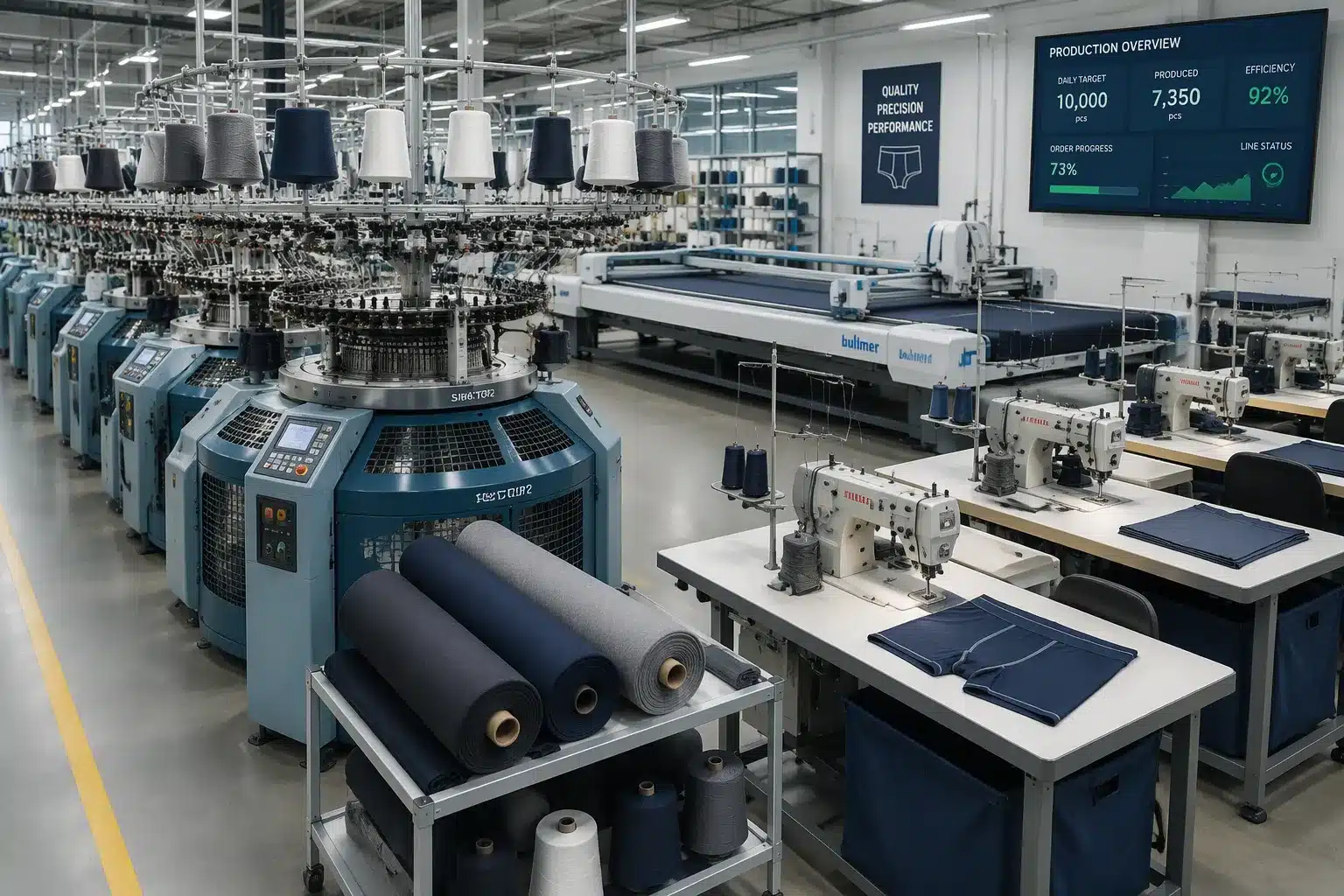
Great fabric means nothing without solid manufacturing behind it. So once you’ve validated the material, turn your attention to the factory floor. Can this modal boxer briefs manufacturer actually produce at the volume you need? Do they have the equipment, the capacity, and the quality systems to support your underwear brand as it grows? These questions matter just as much as the fabric itself.
Evaluate Equipment and Technology
Ask about knitting machines and sewing lines
The machinery a factory uses shapes what they can produce. Ask specifically about their knitting machines. Are they circular knitting machines? What gauge? For men’s boxer briefs, the right equipment produces a smooth, consistent fabric with even stretch. Then ask about sewing lines. How many? What types of stitches do they use for seams and waistbands? Flatlock stitching, for example, creates smooth seams that reduce chafing. That matters for men’s underwear comfort.
You should also ask how they handle fabric cutting. Automated cutting tables produce more consistent pieces than manual cutting. That consistency shows up in the final fit. A factory with modern equipment can hold tighter tolerances across thousands of units. That’s construction quality you can count on.
Red flag: outdated machinery for high-volume orders
If a manufacturer still relies on manual cutting and older sewing machines, they may struggle with large orders. Inconsistent sizing and seam failures become more likely as volume increases.
Outdated equipment also slows down underwear production. That delay ripples through your entire supply chain. Ask for photos or a video walkthrough of the production floor. A confident manufacturer will share this without hesitation.
Confirm Capacity and Scalability
Ask for monthly output and lead times
Capacity tells you whether a manufacturer can grow with you. Ask for their monthly output in units. Then ask for typical lead times for bulk orders. A factory producing 50,000 units per month handles volume differently than one producing 500,000. Neither is wrong. The question is whether their capacity matches your growth plans.
Also ask about peak season lead times. Many factories slow down during busy periods. If they can’t give you a clear answer, that’s a warning sign. You need predictable timelines to plan inventory and marketing.
Red flag: capacity too low for growth plans
A manufacturer with low monthly output might handle your first order fine. But what happens when you double or triple your volume? If they can’t scale, you’ll be scrambling for a new partner mid-growth.
That disruption hurts your brand. It also costs you time and money. Choose a manufacturer with room to grow. Ask directly: “Can you handle three times our current volume within a year?” Their answer reveals a lot.
Review Quality Control
Ask about AQL standards and defect rates
Quality control separates professional manufacturers from casual ones. Ask about their AQL standards. AQL stands for Acceptable Quality Limit. It’s a statistical method for inspecting batches and deciding whether to accept or reject them. Most apparel factories use AQL 2.5 for major defects and AQL 4.0 for minor defects. These are industry-standard benchmarks.
Defect type | Typical AQL level | What it covers |
|---|---|---|
Major | 2.5 | Functional flaws like broken seams or wrong sizing |
Minor | 4.0 | Cosmetic issues like loose threads or small marks |
Ask for their actual defect rates. A factory with a high rejection rate wastes your money and delays shipments. A factory with low defect rates delivers consistent construction quality.
Request a QC checklist or inspection report
A serious manufacturer has a documented quality control process. Ask to see their QC checklist. It should cover fabric inspection, in-line checks during sewing, and final inspection before packing. Request a sample inspection report from a recent order. This shows you exactly how they catch problems.
Their QC process should also verify the fabric data you collected earlier. That means checking fibre composition, fabric weight, stretch recovery, and wash-test results against the approved standard. Fibre names alone don’t establish performance. A good manufacturer tests every batch and keeps records. If they can’t show you a checklist or report, that’s a red flag. You’re trusting your brand to their word alone.
Check Customization Options
Your modal boxer briefs need to look and feel like your brand. Not like a generic product with your logo slapped on. So customization is where you separate your own underwear line from the competition. Ask potential manufacturers what they can actually customize. The answer tells you whether they’re a real partner or just a contract sewer.
Confirm Private Label Services
Ask about custom waistbands, tags, and packaging
A good manufacturer offers several branding touchpoints. Here’s what to look for:
Waistband — pick an existing design or build a custom one with your logo woven in.
Private labeling — custom labels, hang tags, and woven tags reinforce your brand identity.
Packaging — custom poly bags, boxes, or eco-friendly materials align with your market position.
These details matter for a men’s boxer brand trying to stand out. A custom waistband alone can lift perceived value. Pair it with branded packaging, and you’ve got a product that feels premium modal quality from the first touch.
Red flag: manufacturer restricts branding
Some manufacturers limit what you can put on the garment. They might require their own label inside or refuse custom packaging. That’s a problem. Your brand identity lives on the product. If a factory won’t let you own that space, find another partner. Manufacturers who support full private label services understand brand building. Those who don’t are just order takers.
Evaluate Design Customization
Ask about fit, rise, leg length, and pouch design
Fit isn’t just a waist measurement. It’s a connected system. Rise, pouch volume, seat coverage, leg length, waistband tension, and fabric recovery all interact. Change one, and you affect the others. Ask how the manufacturer approaches pattern development.
Design Dimension | Standard Variations |
|---|---|
Fit | Connected system — rise, pouch, seat, leg length, waistband tension, and fabric recovery interact |
Rise & Seat Coverage | Controls how high the garment sits and back coverage |
Leg Length / Geometry | Length, circumference, and opening tension affect movement and silhouette |
Pouch / Front Construction | Conventional, contoured, anatomical, or fly construction |
Seam Placement | Center seams, side seams, multi-panel constructions |
Fabric (Modal context) | Modal and soft-touch blends for drape and smooth feel |
Request custom sizing and grading (XS to 4XL)
A full size range matters. Ask if they grade from XS to 4XL. Size labels can be printed inside or woven, based on your specifications. Some manufacturers also prioritize sustainable materials like modal, recycled nylon, spandex, and recycled polyester. If sustainability is part of your brand story, confirm they source these fabrics.
Request Sampling
Ask for sample lead time and cost
Sampling is your first real quality check. Ask how long samples take and what they cost. A reasonable sampling process includes a pre-production sample made from your complete tech pack. This sample lets you verify fibre composition, fabric weight, stretch recovery, and wash-test results before bulk production. Fibre names alone don’t establish performance. You need to test the actual fabric.
Request samples of previously made underwear too. These show the manufacturer’s baseline construction quality. Compare them against your specifications. Check seams, waistband recovery, and overall finish.
Red flag: excessive sample fees or refusal to sample
Some factories charge high sample fees or refuse to sample altogether. That’s a dealbreaker. A confident manufacturer stands behind their work. They’ll produce samples at a fair cost because they know construction quality speaks for itself. Refusing to sample means they’re hiding something. Maybe their stitching is inconsistent. Maybe their fabric sourcing is unreliable. Either way, you can’t afford that risk.
Compare Cost, MOQ, and Lead Times
Pricing shapes your margins, but it never tells the whole story. A low unit price can disappear once you add freight and duties. Fabric quality alone often drives half the cost of modal boxer briefs.
Understand Pricing Structure
Ask for FOB, EXW, or CIF pricing
Incoterms define who pays for shipping and insurance. Each one changes your final cost per unit.
Incoterm | What it means for you |
|---|---|
EXW | You handle everything after the factory gate, including trucks, port fees, customs. |
FOB | Factory pays to load goods at the port. You cover the rest. |
CIF | Factory covers shipping and insurance to your destination port. |
Ask for quotes under all three terms. Then calculate your total landed cost. A cheap EXW quote may lose its appeal after freight and customs. Ask where the fabric comes from. Request a fabric swatch before you commit.
Red flag: quotes significantly lower than market average
Everyone wants a good deal. However, a quote far below market usually means a corner was cut. The fabric might have wrong fibre composition or weight. The fabric may lack stretch recovery. Ask manufacturers to walk you through their cost breakdown. A confident supplier explains their numbers.
Negotiate MOQ
Ask for MOQ per color, size, and style
MOQ, or minimum order quantity, sets the smallest order a factory accepts. Many factories quote one MOQ for the whole order. The real question is per style, color, and size. A factory might require 500 units per color and size, so 5 colors and 4 sizes jump to 10,000 units. Ask for the full breakdown in writing. Unique fabric colors require larger dye lots, raising minimums. Premium fabric needs higher minimums.
Red flag: MOQ too high for a new brand
moqs for underwear often sit in the thousands. New brands tie up cash in inventory they may not sell. When minimums feel risky, ask about trial orders. Start with a smaller run at a slightly higher unit price. A manufacturer with no flexibility may not be the right partner yet.
Clarify Lead Times
Ask for bulk order and peak season lead times
Lead time is the gap between order approval and delivery. Ask for their standard bulk lead time. Then ask about peak season delays. Many factories slow down before holidays or trade shows. Fabric sourcing alone can take two to four weeks. Ask if the fabric is in stock or made to order.
Red flag: vague or unrealistic lead time promises
Beware a supplier who says “we ship in 2 weeks” without detail. A proper lead time accounts for fabric sourcing, dyeing, sewing, and inspection. Ask for the step-by-step schedule. men’s underwear is a repeat purchase category, so delivery timing matters for loyalty.
Verify the Right Manufacturer’s Communication
You can learn a lot about a factory before you ever place an order. Communication reveals how they’ll treat you when problems arise. A manufacturer who answers quickly and clearly now will likely do the same when your shipment gets delayed. So test their communication before you commit.
Test Responsiveness
Send inquiries and note response time
Send a detailed inquiry to each manufacturer on your shortlist. Include your questions about fabric specs, MOQ, and lead times. Then watch the clock. A buyer’s guide to clothing manufacturing suggests brands can expect a free quote within 48 hours. That’s a reasonable benchmark for initial replies. Vague inquiry emails tend to get ignored, so make yours specific. Ask direct questions and see how they respond.
Red flag: slow responses or evasive answers
A brand reportedly ended a three-year relationship with a factory not because of sample quality, pricing, or missed deliveries, but because every question took a day and a half to answer. By the time responses arrived, decisions had already been made without the factory’s input.
An industry professional emphasized that factories must answer all buyer emails within the same day. Weekly production updates should come proactively, before you even ask. Factories that are strong on quality and shipping but slow in communication risk losing brand clients. Some brands route orders through trading houses or sourcing agents that guarantee a single responsive point of contact. If a manufacturer takes days to reply or dodges your questions, that’s a warning sign.
Check References
Ask for references from similar brands
Ask the manufacturer for references from brands similar to yours. A factory that works with established underwear labels should have no problem sharing contacts. When you reach out to those references, ask about communication, quality consistency, and how the factory handles problems. Their answers tell you more than any sales pitch.
Red flag: refusal to provide references
A confident manufacturer will connect you with happy clients. If they refuse or make excuses, that’s a red flag. Maybe their clients aren’t satisfied. Maybe they have something to hide. Either way, you deserve proof of their track record. Move on to a factory that welcomes transparency.
Assess Problem-Solving
Ask how they handle defects or delays
Problems happen in manufacturing. The question is how a factory responds. Ask directly: “What happens if you find a defect in our order?” and “How do you handle shipping delays?” A good manufacturer has clear answers. They’ll explain their inspection process, their communication protocol, and how they make things right.
Red flag: unwillingness to discuss problems
Some factories avoid talking about defects or delays. They might say “that never happens” or change the subject. That’s not confidence — it’s avoidance. Every factory faces production challenges. A partner who won’t discuss them honestly won’t solve them when they occur. You need a manufacturer who plans for problems, not one who pretends they don’t exist.
Build Long-Term Partnership with the Manufacturer
Finding the right partner is step one. Building a lasting relationship takes time and intention. Treat the first order as a test run, not a marriage. Then grow together as trust builds.
Start with Trial Order
Place a small order to test quality and delivery
A trial order reveals what a sales pitch cannot. Place a small order first. Watch how the manufacturer handles communication, production, and shipping. Do they hit the promised lead time? Does the packaging arrive intact? These small signals predict how they will perform on larger runs.
Use this order to verify the fabric one more time. Compare fibre composition, fabric weight, stretch recovery and wash-test results against the approved standard. Fibre names alone do not establish performance. The trial order gives you real data from a real production run.
Evaluate if the manufacturer meets your standards
Set clear pass-or-fail criteria before the order ships. Check stitch quality, waistband recovery, and size consistency. Do the samples match the bulk order? If the trial order passes, you have a partner worth scaling with. If it fails, you saved yourself a costly mistake.
Negotiate Terms
Discuss payment terms and exclusivity
Payment terms protect both sides. Ask about deposits, balance schedules, and accepted payment methods. A typical split might be 30% deposit with 70% due before shipment. Negotiate terms that work for your cash flow.
Exclusivity matters for your own underwear line. Ask if the manufacturer will sell your designs to competitors. Some factories offer exclusivity for a minimum volume commitment. Others refuse. Know where they stand before you invest in custom patterns.
Red flag: no written contract or unclear terms
A handshake deal is not a contract. If the manufacturer avoids written agreements or gives vague answers about payment, walk away. You need clear terms in writing.
Plan for Growth
Ask about capacity expansion and new fabrics
Your underwear brand will evolve. Ask if the manufacturer plans to add capacity or new fabric options. Can they source recycled materials or new blends down the road? A forward-thinking partner invests in growth. That benefits you both.
Red flag: manufacturer not interested in long-term relationship
Some manufacturers only want quick orders. They show no interest in your brand’s future. If they dodge questions about scaling or new fabrics, that is a warning. You need a partner who sees your success as their success.
The right modal boxer briefs manufacturer or bamboo viscose underwear supplier checks five boxes. Fabric quality leads. Compare fiber composition, fabric weight, stretch recovery, and wash-test results. Fabric names alone don’t prove performance. Production capabilities, customization, cost, MOQ, and communication follow. Every fabric choice shapes your brand.
Choosing a partner is a process, not a one-time decision. Request fabric samples. Ask about fabric durability. Negotiate fabric pricing and terms. Test fabric consistency across orders.
Build the relationship step by step. A manufacturer who respects your fabric standards will grow with you. Your fabric deserves that commitment. Start today and build something great.
FAQ
What should I check first when evaluating a modal boxer briefs manufacturer?
Start with the fabric itself. Ask for fibre composition, fabric weight, stretch recovery, and wash-test results. Fibre names alone don’t establish performance. A supplier might say “modal blend” without proving anything. Get the data in writing before you talk about price or timelines.
How do I know if the fabric weight is right for men’s underwear?
For opaque, durable modal boxer briefs, aim for 150–180 GSM. That range gives you solid coverage and breathability. Anything below 150 GSM risks being see-through. Ask the manufacturer for the fabric weight upfront. If they can’t provide it, that’s a warning sign.
What certifications should a modal underwear supplier have?
Look for OEKO-TEX STANDARD 100 and GOTS certification. OEKO-TEX verifies that every component meets safety limits. GOTS proves organic cotton is genuinely organic. Always verify certificate numbers through the official label check. A certificate only covers named articles, so match each material against the list.
Can I request custom sizing from XS to 4XL?
Yes, many manufacturers offer full size grading from XS to 4XL. Size labels can be printed inside or woven, based on your specs. Ask about their grading process before you commit. A factory that can’t handle your full size range may not fit your brand’s needs.
What’s a reasonable MOQ for a new underwear brand?
MOQs vary widely. Many factories quote minimums in the thousands per color and size. For a new brand, that ties up cash in inventory. Ask about trial orders at a slightly higher unit price. A manufacturer with no flexibility may not be the right partner yet.
How do I test a manufacturer’s communication before ordering?
Send a detailed inquiry with specific questions about fabric specs, MOQ, and lead times. Watch how fast they respond. A reasonable benchmark is a quote within 48 hours. Slow replies or evasive answers signal problems ahead. Factories that answer same-day tend to stay responsive long-term.
What should I look for in a trial order?
Use a trial order to verify quality and delivery. Check stitch quality, waistband recovery, and size consistency. Compare the bulk order against your approved sample. Does the fabric match the specs? Did they hit the promised lead time? If the trial passes, you have a partner worth scaling with.
How do I negotiate payment terms and exclusivity?
Ask about deposits, balance schedules, and accepted payment methods. A typical split might be 30% deposit with 70% due before shipment. For exclusivity, ask if they’ll sell your designs to competitors. Some factories offer exclusivity for a minimum volume commitment. Get everything in writing.
See Also
Selecting Private Label Men’s Underwear Manufacturer For 2026 Success
Low Minimum Order Underwear Production For Small Boxer Brief Runs
Key Factors When Evaluating Men’s Underwear Manufacturers In 2026
Wholesale Men’s Underwear Buying Guide For United Kingdom Purchasers