
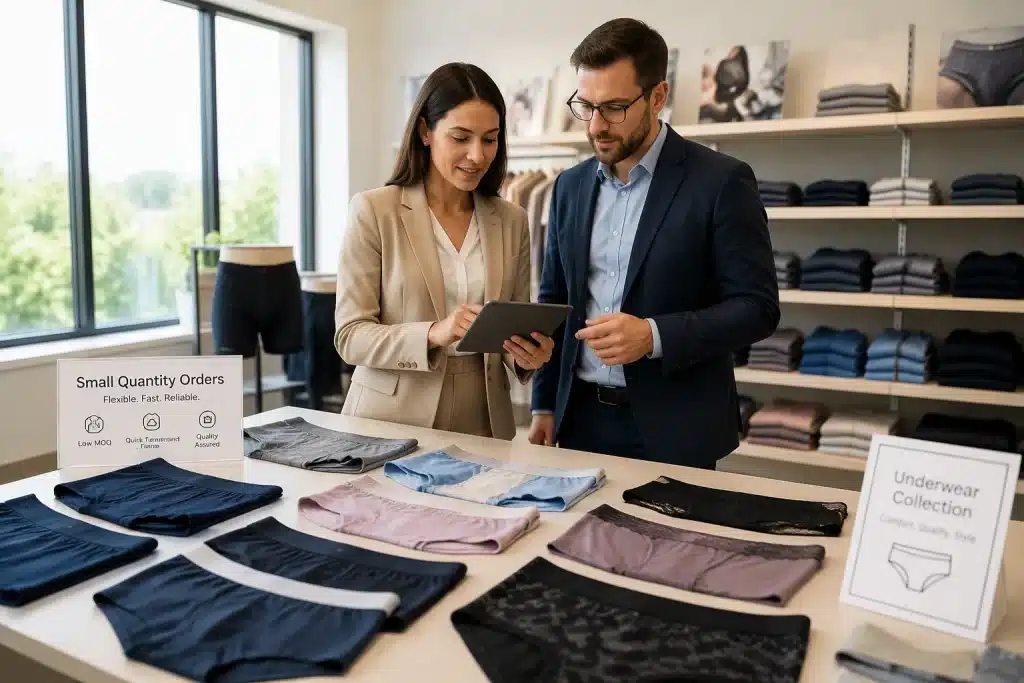
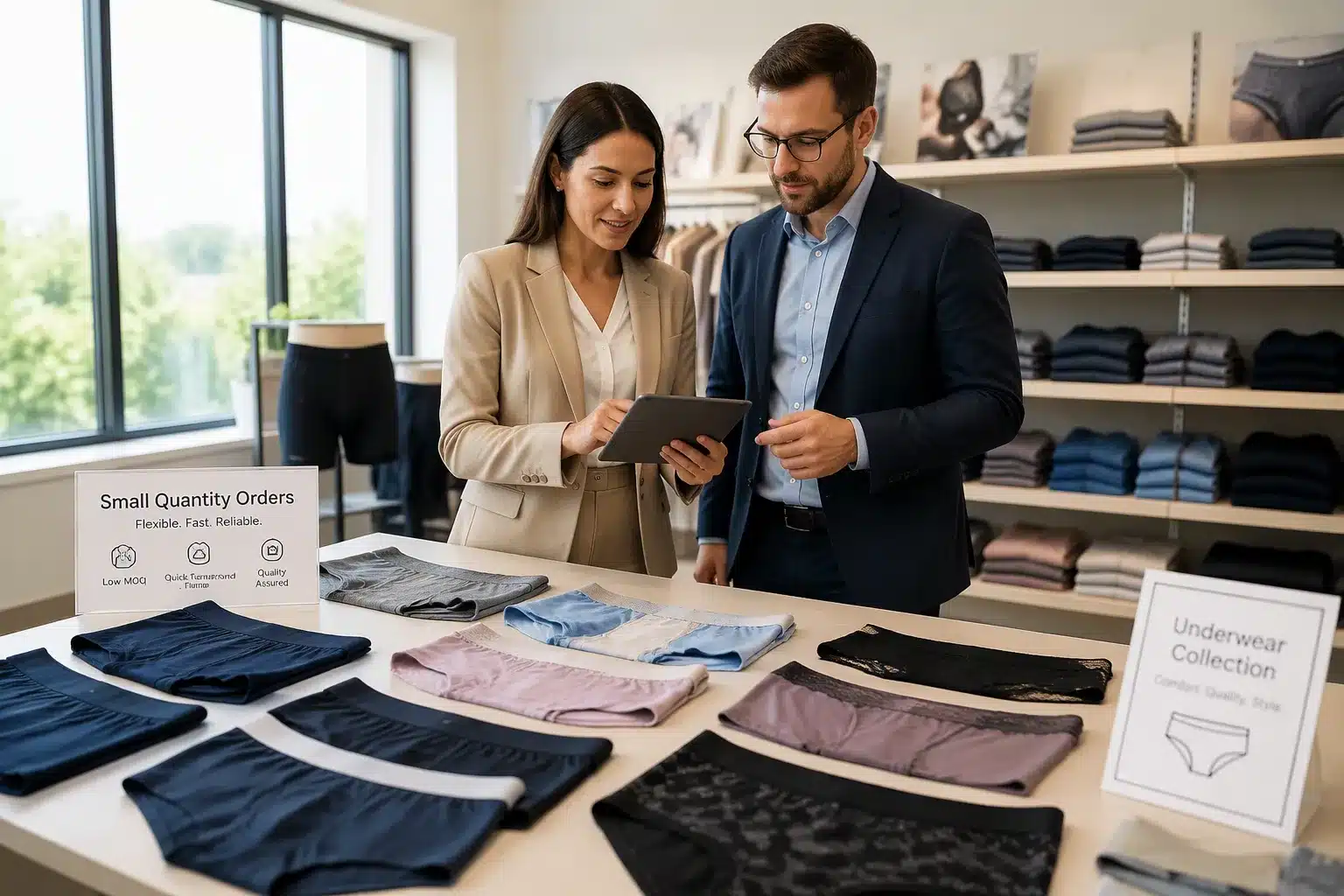
Indeed, you can find UK manufacturers offering underwear low minimum order UK. I discovered them through online directories, trade shows, and good old-fashioned networking. This guide explains where to look, how to vet a manufacturer, and how to negotiate terms for low-minimum underwear orders in the UK that genuinely suit a small brand. You don’t need manufacturing experience — low MOQs reduce your risk, stock, and start-up costs. I’ll also show you how to check whether that 500-piece minimum applies to each style, colour, or order, and examine separate minimums for branded waistbands and packaging. When considering private label underwear MOQ, always clarify these details. Brands like Hongku Underwear began with small runs, so this route is real.
Key Takeaways
Low MOQs go from 50 to 500 units, cutting risk and upfront costs for new brands.
Find UK manufacturers on sites like Maker’s Row, Sewport, and Faire.
Always check certifications such as OEKO-TEX and ETI to ensure safe, ethical production.
Ask for and test samples before you place big orders. This helps you avoid poor quality and losing money.
Try to get lower minimums by agreeing to wait longer for your order or paying more for each item.
Check if minimums apply for each style, colour, or order. Also check for separate add-on minimums.
Avoid scams by checking businesses on Companies House and HMRC VAT checker.
Begin with a small test order and build trust for future bulk orders with makers.
Underwear Low Minimum Order UK and Private Label Underwear MOQ
What Counts as a Low MOQ?
In the UK underwear industry, a low minimum order quantity usually sits between 50 and 500 units. That range covers small production runs and small to medium production runs. I’ve seen factories quote 100 units per style as their floor. Others won’t touch anything under 300. It really depends on the manufacturer.
Small Runs (50–200 Units)
This is the sweet spot for new brands. You can order 50 to 200 pieces and test the market without drowning in stock. ZORWILD, for example, offers a 50-piece MOQ for custom men’s underwear. That’s a proper low minimum order quantity for a real product.
Mid-Tier Runs (200–500 Units)
Once you’ve proven your concept, you might step up to 200–500 units. This range still counts as low for many UK factories. It gives you better unit pricing without a huge commitment.
Why Low MOQs Reduce Risk
Less Stock, Less Money Tied Up
A hundred pieces production run costs far less than a thousand. You keep cash free for marketing, website builds, and photography. Dead stock kills small brands. Low MOQs stop that problem before it starts.
Safer Launch for New Brands
If a design flops, you’ve lost a small amount. You can pivot fast. That safety net matters when you’re still learning what your customers want.
Typical MOQs for Underwear
Boxers, Briefs, and Trunks
Most UK manufacturers set minimums per style, per colour. So a 500-piece minimum might mean 500 in one colourway, not 500 spread across five colours. Always confirm this before you commit. Also check separate minimums for branded waistbands and packaging. Those add-ons often carry their own MOQs.
Lingerie and Made-to-Order
Some lingerie sourcing services, like those from Germany for B2B, work with production with zero MOQ’s for small batch or made-to-order work. That’s rare but real. Luxury lingerie and accessories often follow this model.
Underwear pricing varies by fabric, trims, and compliance. A low unit price can become expensive when every SKU requires a separate minimum quantity. So do the maths on your full order, not just the per-piece rate.
Where to Find UK Garment Manufacturers for Underwear
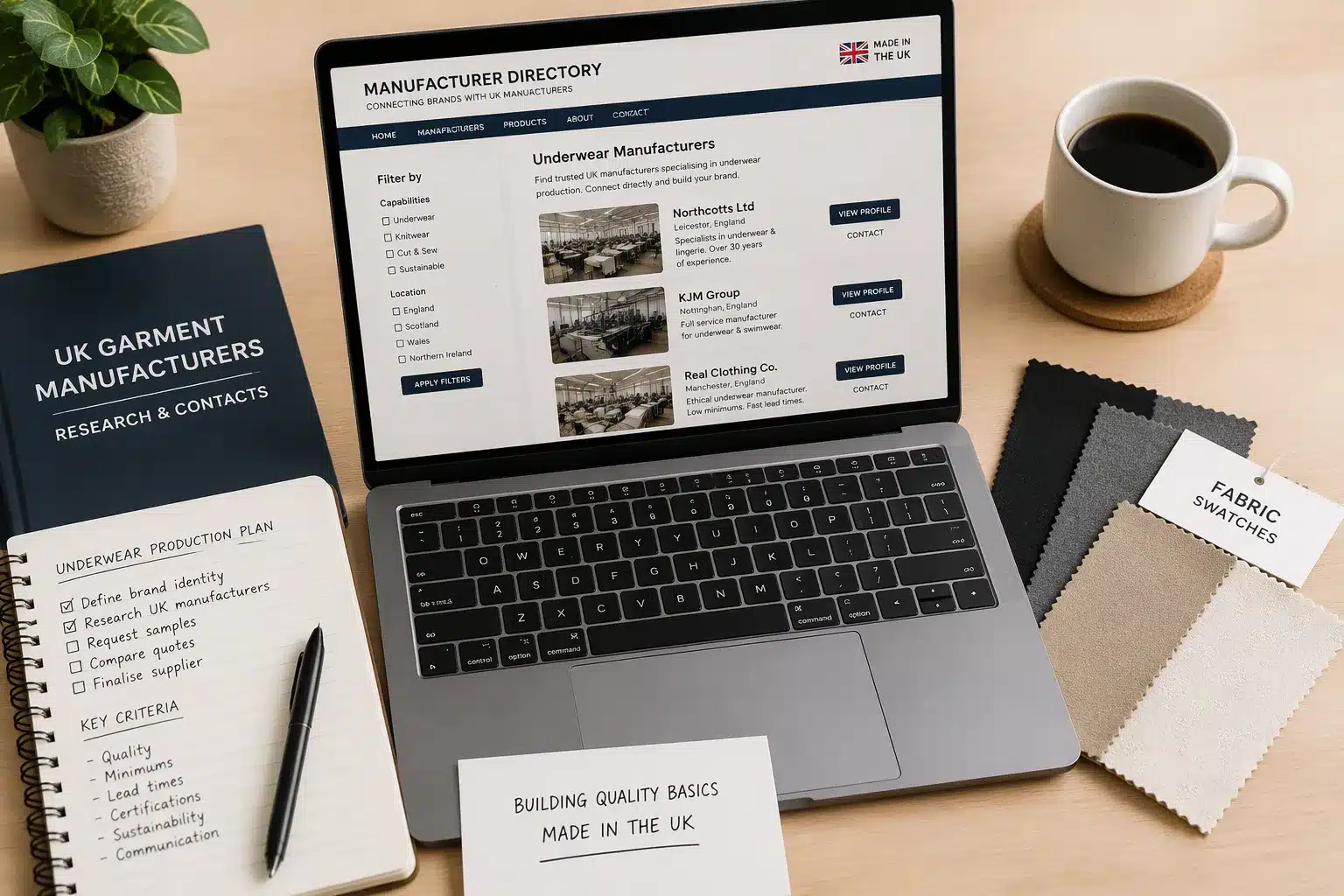
Finding the right underwear manufacturer doesn’t need to feel impossible. I spent weeks hunting for mine. The secret is knowing exactly where to look. I’ll share what worked, what didn’t, and which platforms actually delivered results. Here are the best starting points I found.
Online Directories and Platforms
Several directories exist purely for connecting brands with production partners. Some are free to browse. Others charge a small fee. Start with the free ones and see what works for you.
Maker’s Row and Sewport
Maker’s Row gives you direct access to factories. You can filter by location, speciality, and minimum order size. Sewport works the same way but covers more countries. Both platforms let you message manufacturers directly and compare quotes side by side. I found two of my shortlisted underwear factories this way.
Faire and No-Minimum Vendors
Faire stands out because it offers thousands of independent clothing brands. The platform carefully vets its suppliers. Many of those suppliers operate with no minimum order requirements. That matters when you’re launching a first collection. You can order small batches of underwear to test the market before committing to bigger runs. No awkward emails. No lengthy negotiations. Just simple ordering through their platform.
UKFT Member Directory
The UK Fashion and Textile Association (UKFT) keeps a member directory of vetted uk clothing manufacturers. It’s less flashy than the big platforms, yet incredibly reliable. Every business on that list has passed UKFT’s checks. You’ll find cut & sew clothing manufacturer options here too. Small family-run operations manufactured in england the very best underwear I’ve inspected.
Trade Shows and Events
Digital research only takes you so far. Nothing beats meeting a manufacturer in person. Trade shows let you compare dozens of suppliers in one room.
Pure London and Source Fashion
Pure London is one of the biggest fashion trade shows in the country. Source Fashion focuses specifically on responsible sourcing. Both events attract hundreds of suppliers each year. Walk the aisles with a clear checklist. Ask about their underwear minimums. Confirm whether the 500-piece minimum applies per style, per colour, or per order. Check separate minimums for branded waistbands and packaging before committing inventory. Then compare their sample turnaround times.
Local Networking Meetups
You don’t need to travel to London to find good contacts. Check Eventbrite and Meetup for local fashion events. Universities often host open days for fashion graduates. Local textile groups sometimes organise factory tours. I met my most reliable clothing manufacturers for small businesses at a small meetup in Manchester. The organiser introduced me to three local makers before lunch. Nobody else in the room saw that opportunity. I did.
Social Media and Word of Mouth
Sometimes the best leads come from conversations rather than directories. Real people share real experiences. Those stories point you toward makers you’d never find on Google.
LinkedIn Groups
LinkedIn has active groups where production teams post their capabilities. Search for terms like “garment manufacturers” or “private label underwear.” Join the groups, read the conversations, and reach out to genuine people. A polite message about your project gets surprising results. One good connection can open doors to dozens of workshops.
Instagram and Facebook Communities
Instagram is where most small underwear brands hang out. Search hashtags like #ukmanufacturing or #smallbatchproduction. You’ll find workshops showing off their latest underwear lines. Many of these businesses post their MOQ range right in their bio. I discovered a clothing manufacturer for your small business through an Instagram comment thread. Facebook groups for small business owners often share recommendations too. I’ve seen plenty of examples where brands have manufactured some of their products in the uk through contacts made on social media.
A Final Word on Global Options
Don’t ignore overseas production entirely. UK brands sourcing from Pakistan can benefit from UK sizing and labelling, export documents, freight planning, duty guidance, and lower minimum quantities. India stands out as one of the few Asian countries that can fulfil apparel sourcing orders with relatively low MOQs. If you’re stuck, ask Hongku Underwear for recommendations. They’ve built strong relationships with partners over the years. Their team responds quickly and genuinely cares about small brands. Their advice saved me weeks of research.
Finding a UK Manufacturer: How to Vet Them
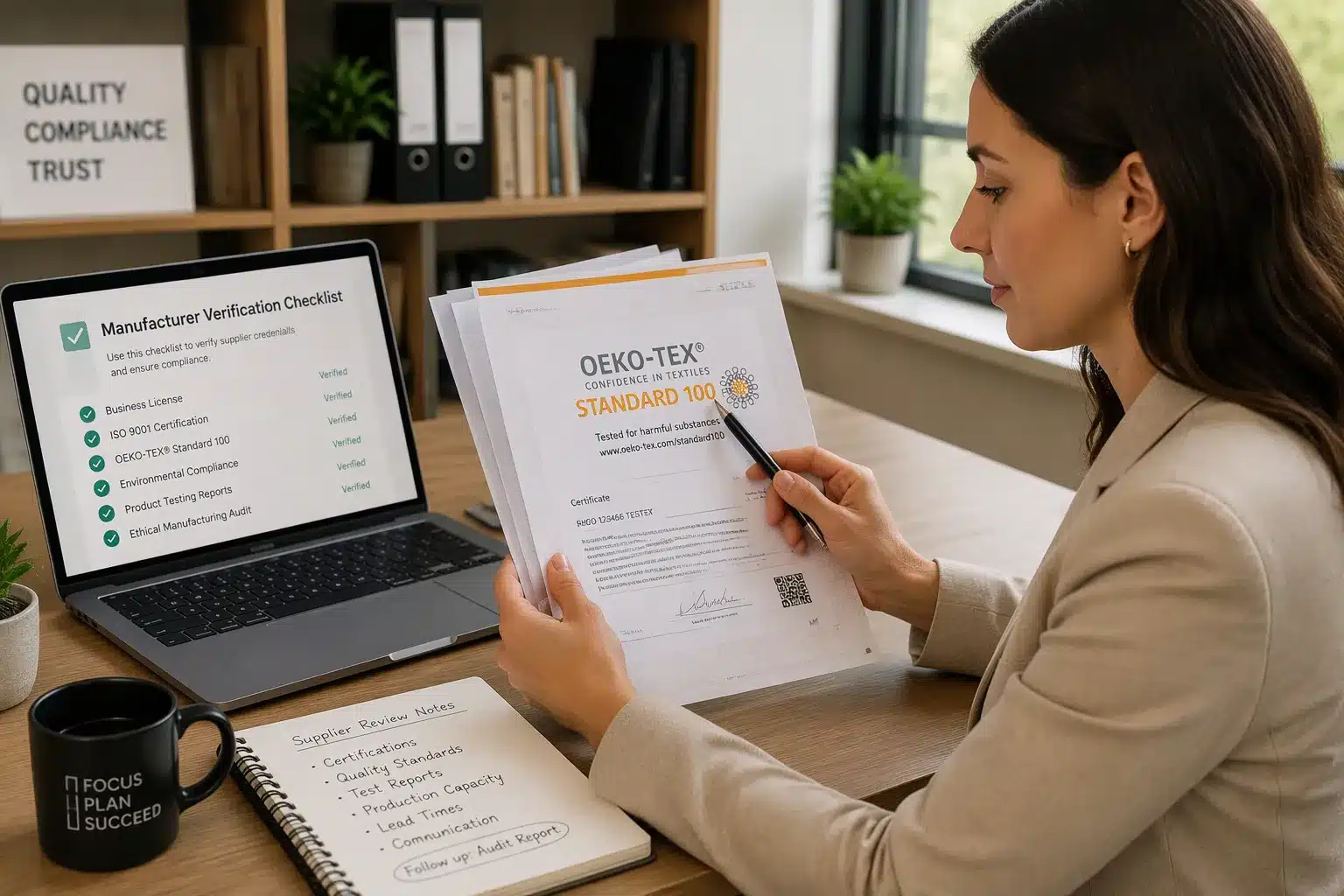
Finding a UK manufacturer is hard work. Checking them properly takes even more effort. I found this out the hard way. I almost signed with a factory that seemed perfect on paper. Here is how I tell real makers apart from ones you should stay away from.
Check Certifications and Compliance
Certifications show whether a factory meets basic ethical and safety rules. Ask for proof before you talk about prices. A good manufacturer will send documents straight away.
Ethical Trading Initiative (ETI)
ETI membership shows a company promises to treat workers fairly. Check the ETI website yourself. Don’t just trust a logo on a factory’s homepage. I always check the member list myself.
OEKO-TEX Standard 100
This one matters most for underwear. The certification tests every part — fabric, thread, elastic, labels, buttons, and prints. Not just the outer fabric. Underwear needs at least Product Class II, which covers direct skin contact. Class I is stricter and kept for baby items.
The testing covers much more than banned substances. It checks for carcinogenic dyes, formaldehyde, heavy metals, phthalates, and pesticides. Formaldehyde is capped at 75 ppm for skin-contact items. Lead, cadmium, and mercury must stay below detection limits. Phthalates are banned completely.
Certification renews every year, so the report is a record at one point in time. Ask which mill and article are covered. The certificate attaches to a material through the partner factory, not to you as the buyer. In Germany and Scandinavia, big retailers won’t stock uncertified underwear at all. Treat this as market access, not a nice extra.
Modern Slavery Act Statements
Any UK business above the turnover threshold must publish a yearly slavery and human trafficking statement. Search the government registry. Read the statement carefully. A vague paragraph with no detail tells you a lot.
Read Reviews and Ask for References
Reviews give you a starting point. References give you the truth.
Google Reviews and Trustpilot
Check both platforms. Look for patterns, not one-off complaints. A factory with fifty good reviews and two angry ones is probably fine. A factory with no reviews at all deserves suspicion. Ask yourself why nobody has bothered to write about them.
Past Client Contacts
Always ask for two or three past clients you can contact directly. Then actually call them. I ask three questions: Did the factory hit deadlines? How did they handle mistakes? Would you order again? The pause before an answer says as much as the words.
Request Samples Before Committing
Never place a bulk order without a sample. Ever. This single step has saved me thousands.
What to Look For in a Sample
Check the stitching first. Pull gently at the seams. Look for loose threads, skipped stitches, and uneven hems. Wash the sample twice, then check for fabric shrinkage and colour fading. Measure the garment before and after washing. Compare those numbers against the size chart. Inconsistent sizing kills repeat business faster than anything else.
Sample Costs and Turnaround
Sample costs vary widely. Some factories charge a fee and refund it against your first bulk order. Others charge nothing but expect commitment. Turnaround usually runs a few weeks, though complex designs take longer. Ask upfront whether the sample fee is refundable.
A single garment sampling order makes sense here. You test one piece before risking money on hundreds. Hongku Underwear always tests before bulk production, and I’ve adopted the same rule. It’s simply good practice.
One last check before you commit inventory: confirm whether that 500-piece minimum applies per style, per colour, or per order. Ask about separate minimums for branded waistbands and packaging too. These details change your total cost dramatically. Get every answer in writing.
Negotiating with UK Clothing Manufacturers on MOQ
Negotiation isn’t a battle. It’s a chat about what suits both sides. I’ve talked my way into lower minimums three times now. Here’s what truly helped.
Offer Longer Lead Times
Why Flexibility Helps
Factories plan their production many weeks ahead. A rushed order makes them squeeze you between bigger clients. That costs them money. When you give them breathing room, you become an easy order to slot in. I told one factory they could fit my underwear run whenever they had a gap. They cut my minimum right away.
Proposing a 12-Week Turnaround
Twelve weeks sounds slow. It isn’t, not in garment production. I now build that window into every plan. The factory gets scheduling freedom. I get a lower minimum and a calmer launch. Everyone wins.
Pay a Higher Price Per Unit
The Trade-Off Explained
Small runs cost more per piece. That’s just how manufacturing works. Setup, cutting, and sewing time stay about the same whether you order 100 or 1,000 units. So the factory spreads those costs across fewer items. I accept a higher unit price in return for a lower entry point.
When Paying More Makes Sense
Paying more makes sense when you’re testing a design. You’re buying information, not just underwear. Once a style sells, you scale up and the price drops. Never chase the cheapest unit price on a first run. Chase proof instead.
Build a Long-Term Relationship
Start with a Small Trial Order
I always open with a trial run. One style, one colour, modest quantity. It shows the manufacturer I’m serious without asking them to gamble. Hongku Underwear negotiated its first minimum exactly this way. They started small, proved the demand, then grew.
Promise Future Volume Honestly
Only promise what you can deliver. Factories remember broken promises. I tell them my realistic forecast and nothing more. Honest numbers build trust faster than big ones.
Before you commit to inventory, validate one thing. Does that 500-piece minimum apply per style, per colour, or per order? Ask about separate minimums for branded waistbands and packaging too. Garment manufacturers in Izmir, Turkey, such as Alfa Spor Giyim, may quote a 300-piece minimum for T-shirts. Share your quantities by style, colour, and size so they can confirm how the minimum applies. Get every answer in writing. That single step protects your cash and keeps your underwear launch on budget.
Common Pitfalls When Sourcing Low MOQ Underwear
I’ve made mistakes in this game. I’ve lost money. I’ve wasted weeks. So let me save you the pain. Here are the traps I fell into and how you can dodge them.
Scams and Fake Manufacturers
Some people pretend to run underwear factories. They take your deposit and vanish. I nearly lost £800 to one of them.
Red Flags to Spot
Watch for a business with no physical address. Check for zero reviews anywhere online. Be suspicious if they demand full upfront payment only. Real manufacturers take a deposit and the balance on delivery. They also let you visit their premises. If they refuse a visit, walk away.
How to Verify a UK Business
Always check before you pay anything. Here’s my routine:
Search the company on Companies House to confirm it’s formally registered.
Check the VAT number using HMRC’s free GOV.UK VAT checker at gov.uk/check-uk-vat-number. Enter the 9-digit number with or without the GB prefix. A valid result shows the registered business name and address.
Compare that name and address against their invoices and contracts.
Ask for their official VAT registration certificate for your records.
Keep your checking records for at least 6 years.
Cross-referencing both systems builds a complete picture of credibility. Under HMRC Notice 726, you may be held liable for unpaid VAT of another VAT-registered business. So do your due diligence properly.
Hidden Costs
The quoted price rarely tells the full story. Extra charges creep in fast.
Setup Fees and Pattern Grading
Many factories charge a setup fee before production starts. Pattern grading costs extra too. That’s the work of scaling your design across multiple sizes. Ask about these fees upfront. Get every number in writing.
VAT and Customs
UK-based production means UK VAT on top of your quote. Overseas sourcing brings customs duties and freight charges. Budget for both. A cheap unit price means nothing if hidden costs double your total.
Quality Issues
Bad quality kills a brand faster than anything. I learned this the hard way.
Inconsistent Sizing and Stitching
One batch arrives perfect. The next runs small. Loose threads appear at the seams. Skipped stitches show up on the waistband. Always measure samples against your size chart before bulk production.
Fabric Shrinkage and Colour Fading
Wash your sample twice. Measure it again. Check whether the fabric shrinks or the colour fades. Cheap dye jobs bleed in the wash. Your customers will notice.
Hongku Underwear always tests before bulk production. I’ve adopted that rule myself. It catches these problems early.
One last check before you commit inventory: confirm whether that 500-piece minimum applies per style, per colour or per order. Ask about separate minimums for branded waistbands and packaging too. Get every answer in writing.
So here is my plan for you. First, decide your low MOQ goal. Then look at UK directories like Maker’s Row, Sewport, and Faire. Check each manufacturer with care. Look for certifications, reviews, and samples. Be flexible when you negotiate — longer lead times can lower minimums. Stay away from scams and hidden costs.
Start today. Ask three manufacturers for quotes. Order samples before bulk. Confirm whether that 500-piece minimum applies per style, colour, or order. Ask about separate minimums for branded waistbands and packaging too.
Remember, brands like Hongku began with small orders. Low MOQs are a proven path. You can launch your underwear line without a huge upfront investment. I built my underwear brand this way, and you can too.
FAQ
What counts as a low MOQ for underwear in the UK?
I treat anything from 50 to 500 units as low. Some makers go lower for underwear. Others won’t budge below 300. It depends on the factory and the style you want.
Can I really order just 50 pieces of custom underwear?
Yes. I’ve seen it happen. ZORWILD offers a 50-piece minimum for custom men’s underwear. That’s a genuine low entry point for a new brand testing its first underwear line.
Where do I start looking for underwear makers?
Try Maker’s Row, Sewport, and Faire first. Faire vets its suppliers and many carry no minimums. The UKFT directory works well too. I found two of my best underwear contacts through these platforms.
How do I check an underwear factory is genuine?
Search Companies House and the HMRC VAT checker. Ask for two past client references and actually call them. A real underwear maker lets you visit. One that refuses a visit isn’t worth your deposit.
Should I always order a sample before bulk underwear production?
Always. No exceptions. Wash the sample twice, then check for shrinkage and colour fading. Measure it against your size chart. Hongku Underwear tests before bulk, and I follow the same rule for every underwear run.
Does a 500-piece minimum apply per style, colour, or order?
Ask this before you commit. I’ve seen it mean 500 in one colourway, not 500 spread across five. Confirm separate minimums for branded waistbands and packaging too. Get every answer in writing for your underwear order.
How can I negotiate a lower minimum on underwear?
Offer a longer lead time, like 12 weeks. Factories slot easy orders into gaps. I also accept a higher unit price on a first underwear run. Start with a small trial and promise future volume honestly.
What hidden costs should I expect when sourcing underwear?
Setup fees and pattern grading catch most people out. UK VAT applies on top of your quote. Overseas sourcing adds customs and freight. A cheap unit price means nothing once these extras land on your underwear invoice.
See Also
A Complete Guide To Wholesale Men’s Underwear For British Buyers
How To Source Private Label Men’s Underwear In The UK Easily
Low Minimum Order Underwear Production For Small Runs Of Boxer Briefs
Finding The Best Manufacturer For Custom Waistband Underwear Explained
What To Look For In Men’s Underwear Manufacturers During 2026