
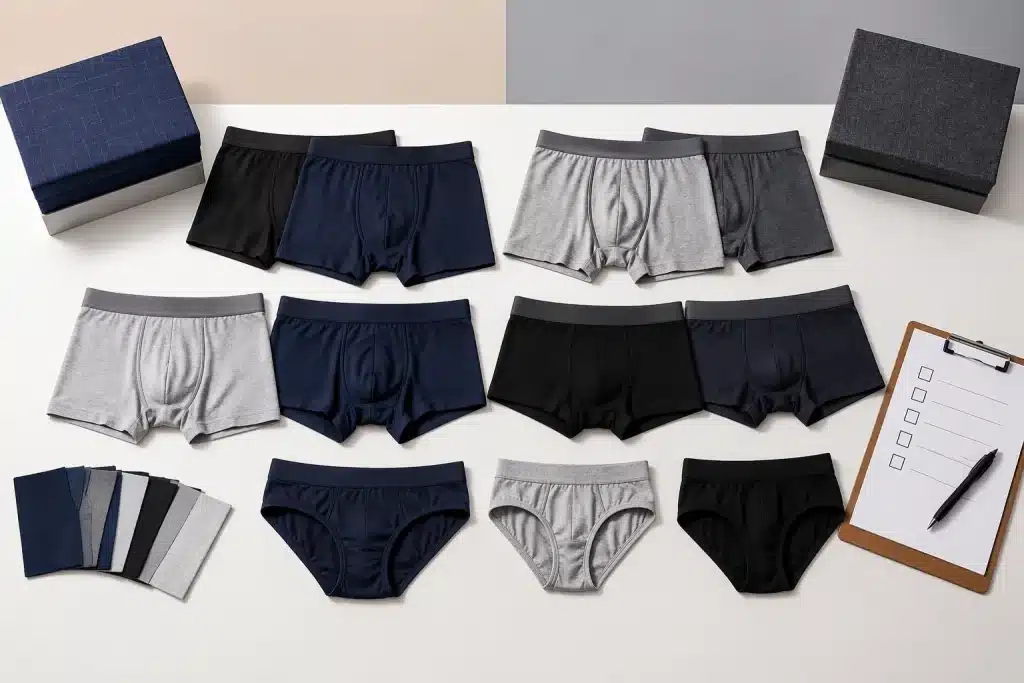
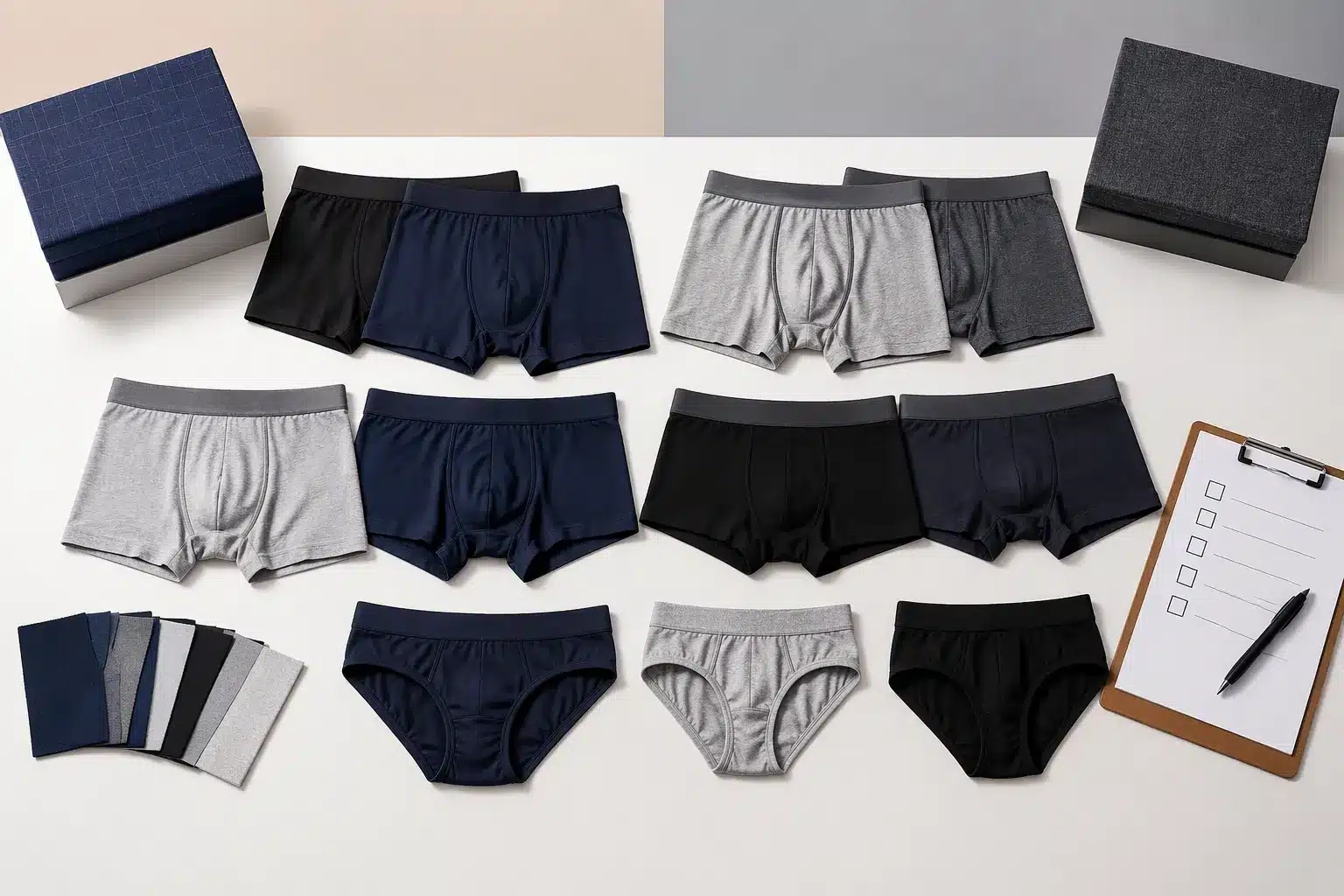
I compare a wholesale mens underwear manufacturer using three key numbers: MOQ, pricing, and lead times. Quality and communication back these up. Five side-by-side comparisons let you rank underwear manufacturers in a fair way, not by sales talk. Each one shows what to expect, what to ask, and which trade-offs matter before you ask for quotes on any underwear program.
Key Takeaways
Compare suppliers on MOQ, pricing, lead times, quality, and communication all together, not just one factor.
Ask for a complete RFQ that includes MOQ, fabric specs, QC process, sampling cost and timeline, and lead times so you get clear answers.
Check the factory’s business scope and ask for audits or a video tour. This will confirm they are a real manufacturer, not a middleman.
MOQ Comparison for Wholesale Mens Underwear Manufacturer
Typical MOQ Ranges
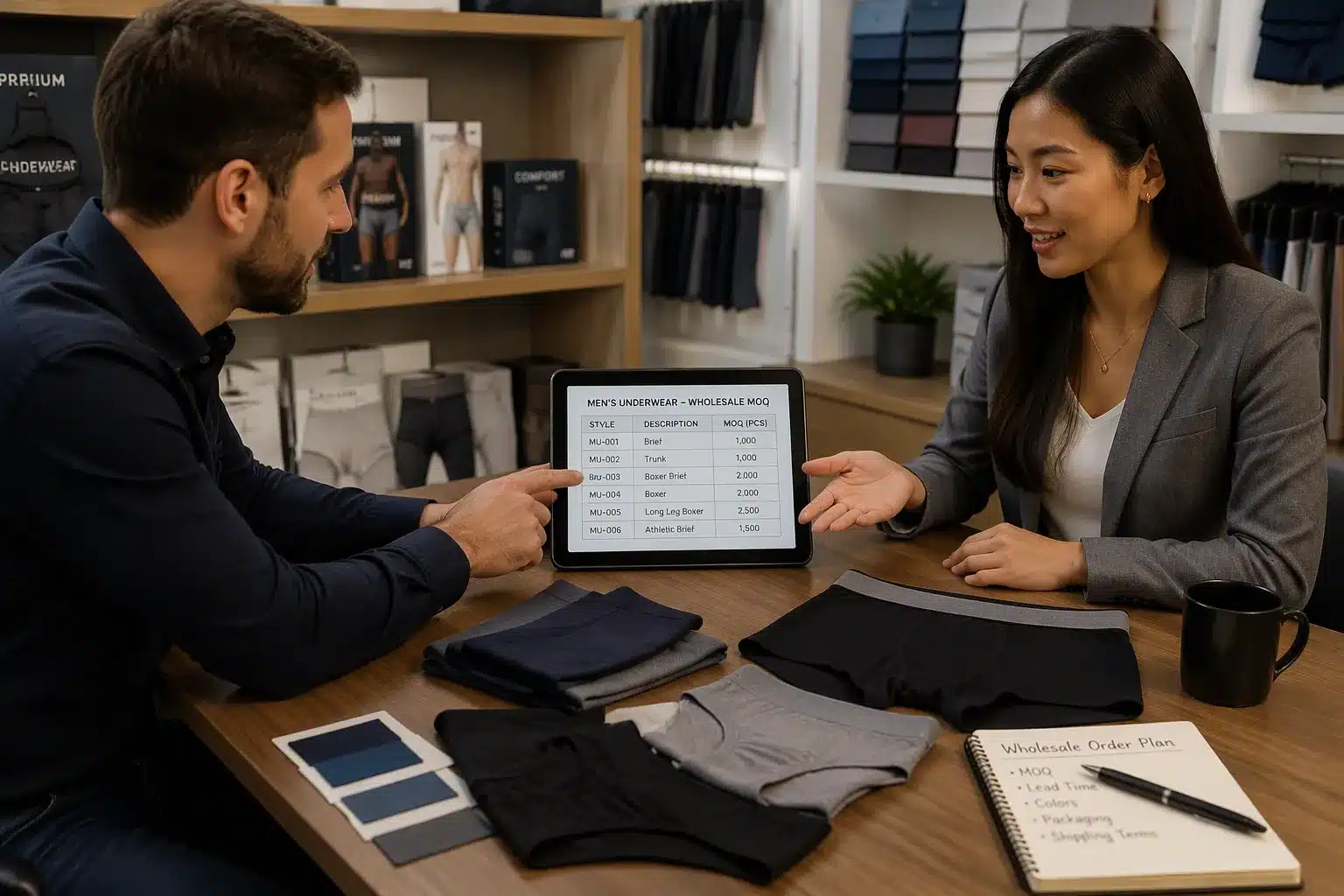
MOQ is the first number I check when I vet a wholesale mens underwear manufacturer. The spread is wide, and that spread tells you a lot about how a factory runs.
Here is what I see most often in real quotes:
Order Type | Minimum Quantity |
|---|---|
Standard order | 2,000 pieces per style and color |
Trial order (first-time buyers) | From 1,000 pieces |
Those are the documented floors for many factories. Some suppliers go lower. I have seen MOQs start well below that, and many factories set floors from 100 pieces. What drives the gap? Stock fabric versus custom dyeing, trims, and labeling. A factory holding fabric in stock can cut a small run fast. Custom dyeing forces a mill minimum, and that minimum flows straight into your MOQ.
This is why ready-stock private label programs sit at the low end. The fabric already exists. Full custom oem/odm work sits at the high end, because every component starts from zero. I treat the moq-cost relationship as a simple rule: the lower the MOQ, the higher the per-piece price, and the less room you have to negotiate.
Negotiating a Lower MOQ
Small buyers still have levers. I use four, and they work.
First, pick stock colors. Custom dyeing is the biggest MOQ driver, so drop it and the floor drops with it. Second, simplify trims. A basic waistband and standard stitching cost less and need fewer setup runs. Third, combine styles in one order. Two styles at half the quantity each can hit the same production minimum as one large run. Fourth, ask for a pilot order.
Some factories can accept trial orders of 300–500 pieces per color. That range is where low-moq manufacturing gets real for a new brand. I always ask for it directly, and I ask in writing. Low MOQ clothing manufacturers and low-moq clothing manufacturers compete on exactly this flexibility, so use that competition. Request a full RFQ: MOQ, fabric specs, QC process, sampling cost and timeline, and lead times. A custom oem/odm quote without those details is not a quote. It is a guess.
Pricing Comparison Across Suppliers
What Drives Underwear Pricing
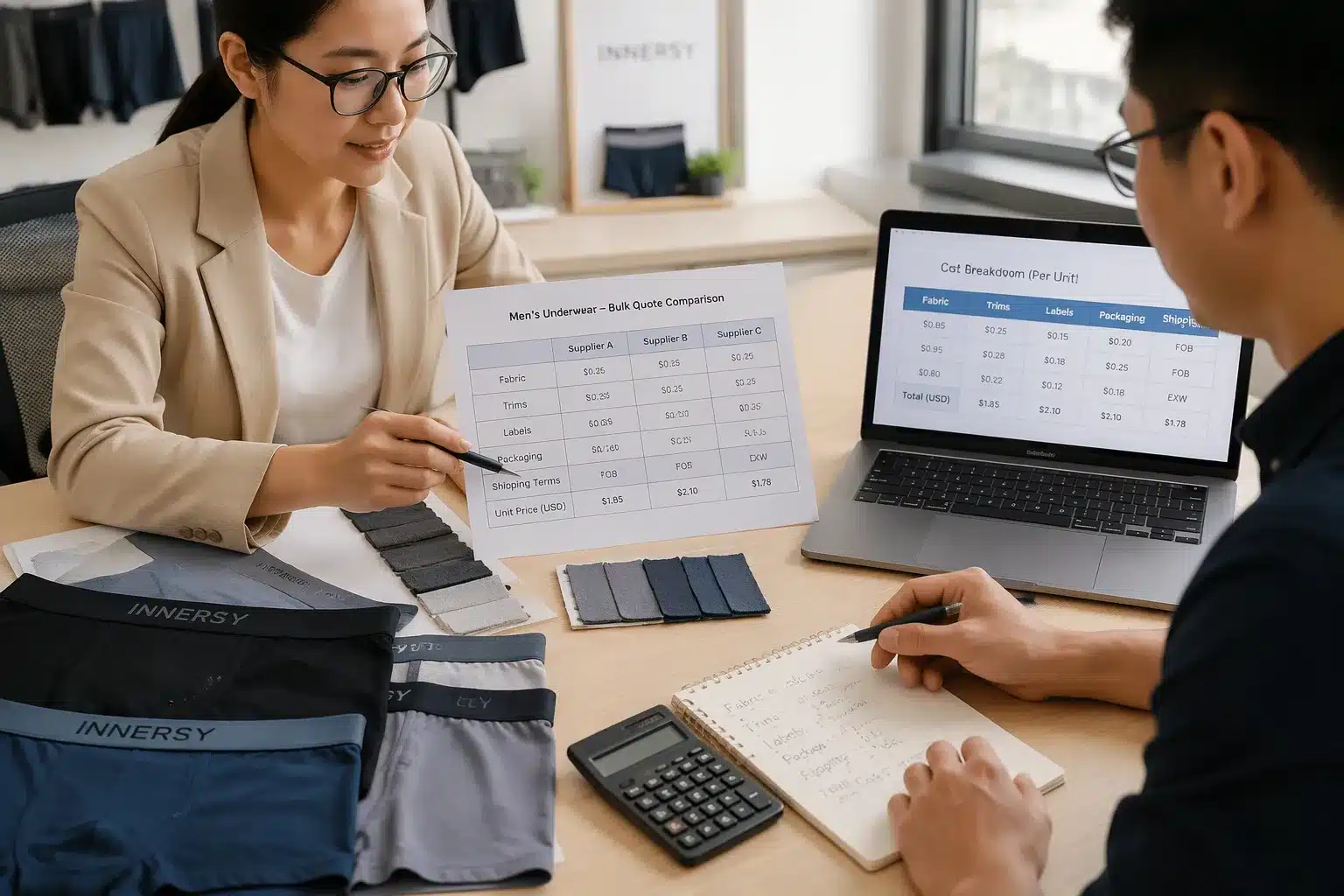
Pricing looks easy on a quote sheet, but it is not. Before I compare two numbers, I have every supplier break the quote into parts. Fabric, trims, printing or embroidery, labels, packaging, and shipping terms each change the price. A cheap quote often hides thin fabric or a basic waistband. That is not a saving. It is a different product.
I also keep sample fees separate from bulk pricing. Custom samples usually cost €60–€300. That is several times the per-piece production price, so never treat a sample fee as your unit price. This matters for brand founders and purchasing managers testing Chinese OEMs with trial orders of 300–500 pieces per color. The sample cost is a one-time charge for tooling and setup. It does not tell you what bulk will cost.
Comparing Quotes Apples to Apples
I ask every factory for an all-inclusive fob pricing sheet. That means one fob unit price per style, with fabric, trims, labels, and packaging listed inside it. Shipping terms stay separate and clearly named. Without this, my pricing comparison is just noise.
Here is what I clarify before I compare anything:
Fabric composition and weight
Trim and waistband specification
Printing or embroidery placement and method
Label and packaging details
Shipping terms and who pays
Then I check the moq behind each quote. A low fob unit price on a huge moq is not cheaper for a new brand. I ask for tiered pricing across quantity bands, because pricing tiers show how serious a factory is about small buyers. Ready-stock private label programs usually show flat pricing tiers. Full custom oem/odm work shows steeper tiers, since setup cost spreads across volume. Custom oem/odm quotes should also state sampling cost and timeline in writing.
I compare unit pricing only after all of this lines up. Two quotes with the same unit price can carry very different cost once trims and packaging differ. My rule: request the full RFQ, then compare. A wholesale mens underwear manufacturer that answers every line earns a second look. One that sends a single number does not.
Lead Time and Production Timeline
Typical Lead Time Ranges
Bulk production usually takes 25–35 days after you approve the sample. I see that range as normal for a wholesale mens underwear manufacturer. A factory that promises 7-day bulk turnarounds should get a closer look. That speed rarely holds once real production starts.
The full timeline has three stages: sampling, production, and shipping. Sampling comes first. Custom samples usually cost €60–€300 and take time to make and ship. Sample approval starts the clock for bulk. Nothing moves until you sign off. I always confirm this in writing, because a vague production timeline hides delays. Ask for the sampling timeline and the production lead time as separate numbers. Then add shipping on top. That total is your real timeline.
Reliability Signals to Check
I check a few signals before I trust any production timeline. First, I require performance claims to come from test results, not marketing talk. Second, I confirm the factory links product design to test method to real use. Third, I verify claim-to-test links: leakproof tied to fit and edge leakage, odor control backed by real material evidence. Fourth, I raise claims at the OEM brief and sampling stage, not after packaging artwork is final. Fifth, for washable products, I confirm colorfastness testing sits inside material review.
I also check fit across representative body sizes, garment recovery after stretch, and washing behavior through wash cycles. Branding, packaging, and destination-market documentation should be confirmed before final sample approval. These checks protect your production lead time. A factory that answers them clearly earns trust. One that dodges them will cost you weeks. Request the full RFQ — MOQ, fabric specs, QC process, sampling cost and timeline, and lead times — and compare the answers side by side.
Underwear Quality and Communication
Quality Checks That Affect Cost and Speed
Don’t judge just one factory. I put several wholesale mens underwear manufacturer candidates side by side. I compare them on quality, price, moq, lead time, communication, and production capability. This side-by-side view shows weak spots fast.
Verification comes first. I ask for audits, certifications, and a live video tour of the floor. A factory that hesitates on any of these is a risk. Then I go through the QC process: incoming fabric checks, in-line inspection, and final inspection before packing. Ready-stock private label orders move faster here, since the fabric is already approved. Full custom oem/odm work needs more checkpoints, and each one adds cost and time. I also use EU/US/UK size conversion charts as a practical QC reference, so fit stays consistent across markets.
Communication as a Risk Indicator
Slow, vague replies tell me more than any brochure. I test every supplier with a full RFQ: moq, fabric specs, QC process, sampling cost and timeline, and lead times. Clear answers within a day or two signal a healthy operation.
I also qualify a backup supplier before I need one. Capacity, quality, logistics, and willingness to run pilot orders of 300–500 pieces per color all matter. Ready-stock private label programs make that trial easy. Full custom oem/odm and custom oem/odm runs take longer to prove. I keep one qualified backup in production planning at all times.
Overall Value Assessment
A Simple Supplier Scoring Framework
I score every supplier on the same five points: MOQ, pricing, lead times, quality, and communication. Then I give each one more or less weight based on what my business needs most. A brand in a hurry to launch cares more about speed. A brand focused on profit cares more about unit price. The weights change, but the five points stay the same.
Before I score anything, I ask each factory for one RFQ checklist: MOQ, fabric specs, QC process, sampling cost and timeline, and lead times. I also ask if they take trial orders of 300–500 pieces per color. Ready-stock private label programs usually answer fast. Full custom oem/odm and custom oem/odm quotes take longer, and that delay is a clue itself. A factory that answers every line earns points. One that skips lines loses them.
When to Walk Away
Some signals end the conversation. A vague quote, a refusal to explain terms, or a lead time that seems too good all point the same way. So does a supplier with no provable production capacity for repeat orders.
I also check the paperwork. If the registered scope lists only wholesale or import-export, with no manufacturing items, that supplier is a middleman, not a plant. If the contract seller, proforma invoice seller, and bank beneficiary turn out to be different legal entities, I walk. No single check decides it. I score all eight signals and look at the overall shape. Five or more pointing the same way is a reliable read. A mixed result where the plant looks real but the contracting entity differs is the classic structure risk, and it is dangerous only when undisclosed.
Look at moq, pricing, and lead times as a group, not one by one. Quality and communication decide the rest. Give each supplier a score on all five, weight them by what matters most to you, then ask for samples and written quotes. Pick three factories, compare them side by side, and line up a backup before your first bulk order. I check whether they do ready-stock private label or custom oem/odm, because that changes your production risk.
FAQ
Can I really start with a trial order of 300–500 pieces per color?
Yes, many factories accept pilot runs in that range. Ask directly and in writing. Request a full RFQ: moq, fabric specs, QC process, sampling cost and timeline, and lead times.
Should I pick a supplier on the lowest moq alone?
No. Judge moq, pricing, and lead times together. A low moq with a high unit price may still fit a new brand. Weigh all five criteria before you commit.
How do I spot a real factory versus a middleman?
Check the registered business scope for manufacturing items. Ask for an audit, certifications, and a live video tour. Vague answers on capacity or moq signal a trading company.
See Also
Essential Wholesale Guide to Men’s Underwear for UK Buyers
Finding a Reliable UK Wholesale Supplier for Men’s Underwear
How to Choose the Best Private Label Men’s Underwear Manufacturer UK
What to Look For in Men’s Underwear Manufacturers During 2026
Choosing a Private Label Men’s Underwear Manufacturer in 2026