
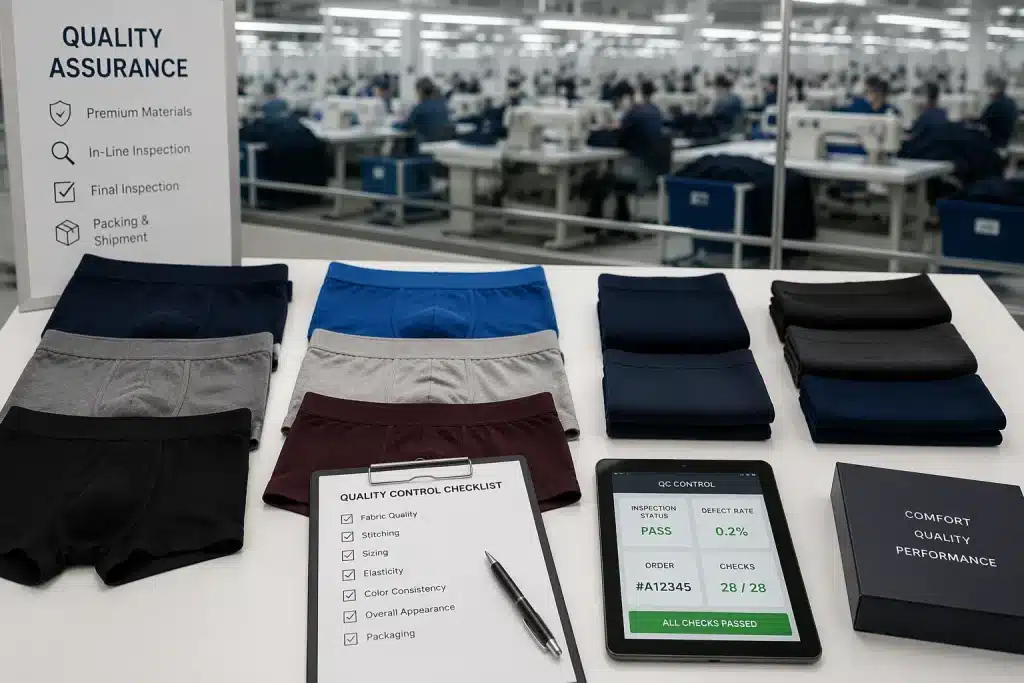
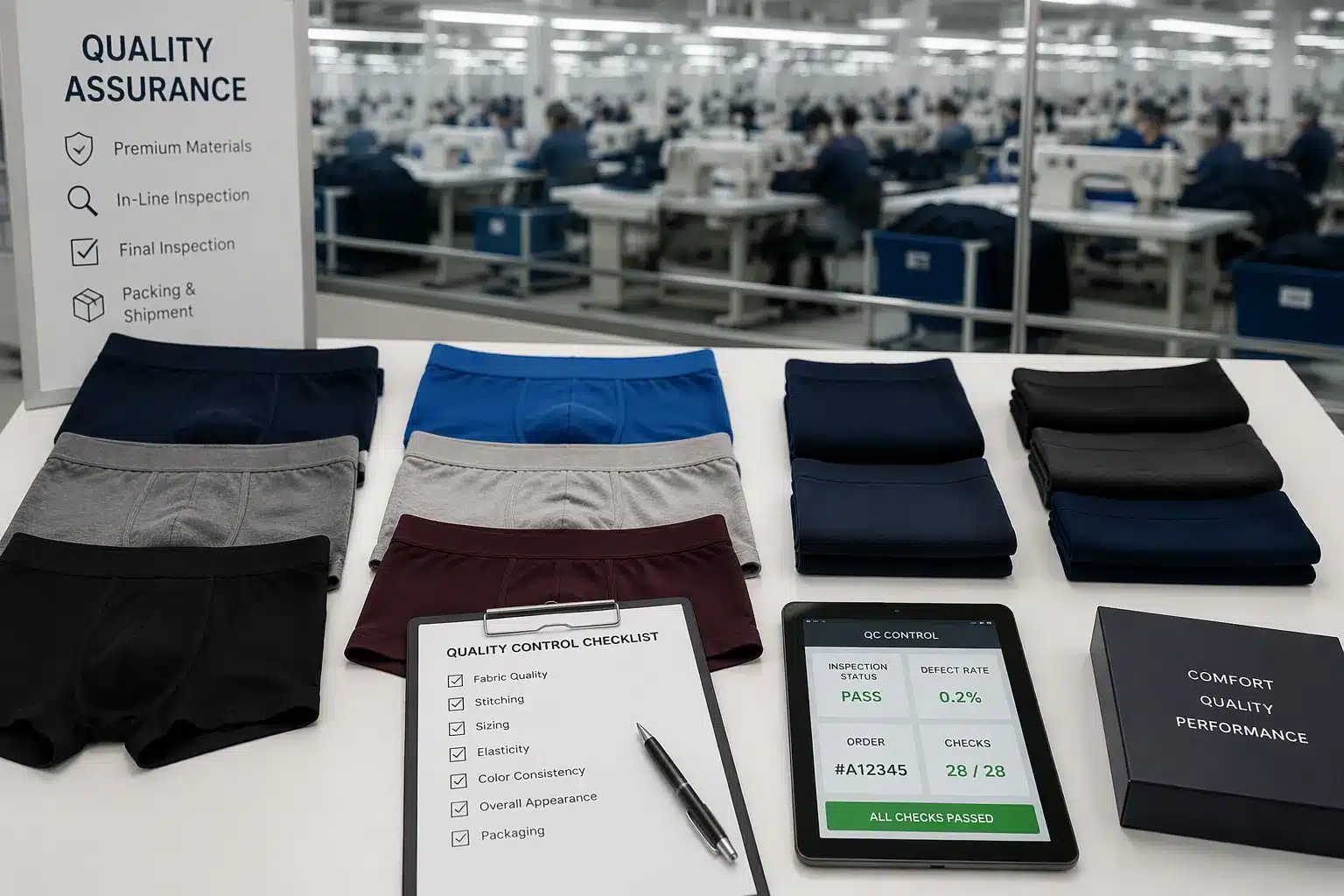
Four numbers decide whether a first production run sinks or sails with a men’s underwear OEM: MOQ, sample, QC, and lead-time. Get MOQ wrong and cash sits in unsellable stock. Approve a weak sample and bulk copies every flaw. Skip QC and defects ship. Underestimate lead-time and launch day slips.
First-time brand owners lose real money here. Most of it is avoidable with the right questions upfront.
One style can anchor an entire underwear line. Run this checklist style by style, from your first DM or WhatsApp message to final shipment. It suits an underwear brand testing small batches with mens underwear manufacturers you can verify, as demand for custom underwear grows. Whether you are comparing an underwear manufacturer or vetting several underwear manufacturers, these four numbers separate a smooth run from a costly one.
Key Takeaways
Ask for the MOQ for each style, color, and size. This helps you avoid hidden minimums.
Get the sample fees and refund rules in writing before you pay.
Set a clear AQL standard and define defects for quality control.
Add 2–3 extra weeks to your lead times to cover delays.
Check a factory using its licenses, audit reports, and a live video tour.
Get a better deal by grouping colors together or promising to order again.
Always try on and test samples before you approve bulk production.
Use a 12-item checklist to get exact quotes and avoid changes.
Quick Answer: 5 Hard Metrics for Mens Underwear Manufacturers
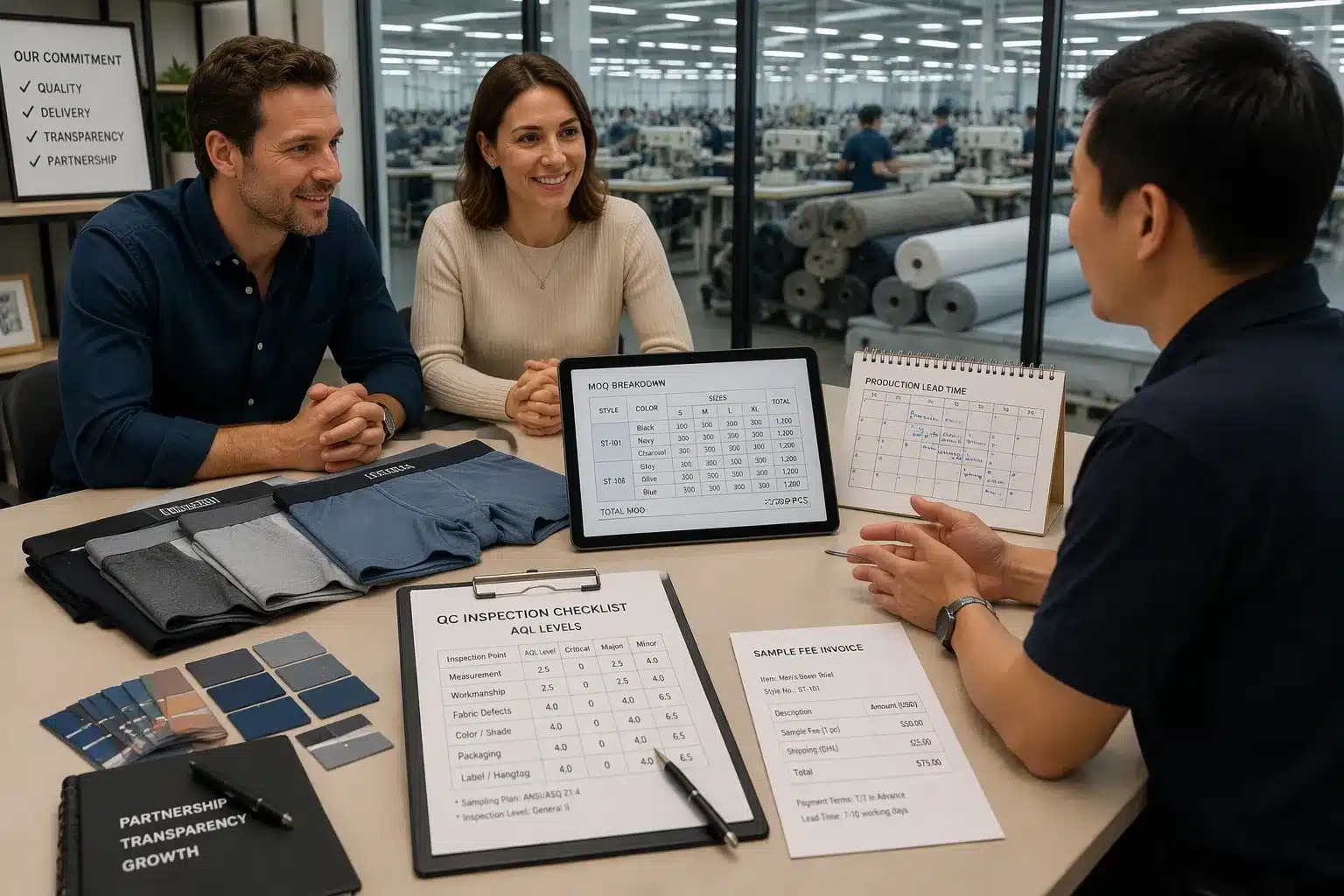
Five numbers let you compare mens underwear manufacturers before anyone cuts fabric: MOQ, sample rounds and fees, QC standard and AQL, bulk lead-time, and payment terms. Ask for all five on the first call. A factory that answers fast and in writing is usually a factory you can work with.
The Five Numbers
MOQ per Style, Color, Size
Minimum order quantity is rarely one number. Most factories quote it per style, per color, and sometimes per size, so a “500 piece” figure can quietly mean 500 per colorway. Stock fabric keeps that number low. Your own developed fabric pushes it up, because the mill runs its own minimum. Small-batch programs do exist, and one style can anchor the whole underwear line while you test demand. Ask for the figure in three parts — per style, per color, per size — and write all three down.
Sample Rounds and Fees
Ask how many sample rounds are included and what each round costs. Then ask the question that saves real money: are sample fees refundable against the bulk order? Some factories credit the fee back once you place production. Others do not. Get the answer in writing before you pay.
QC Standard and AQL
AQL means acceptable quality limit. It is the defect rate a factory agrees to work to, and it sets how many units an inspector pulls from each lot. Underwear checks usually split defects into critical, major, and minor, with critical ones — needle damage, wrong labels — treated as zero tolerance. Ask which AQL level they apply to underwear, who inspects, and whether the report reaches you before the balance is due.
Bulk Lead-Time in Days
Lead-time is calendar days from deposit plus approved sample to goods ready to ship. Not from your first message. Not from the quote date. Here is what the numbers usually look like:
Production scenario | Bulk lead time (days) |
|---|---|
First order — brand-new style (incl. new fabric development) | 45–60 (longer if fabric must be developed) |
Repeat order — known style | 30–40 |
Deposit and Payment Terms
Payment structure shows how much risk the factory expects you to carry. A common split looks like this:
Stage | Payment Obligation |
|---|---|
Order confirmation | 30% deposit of total order value |
Prototype approval | 40% payment |
Before shipment | 30% balance |
Deposits for OEM and ODM orders typically land between 30% and 50% of total order value. Late payment often carries a penalty, sometimes 1.5% monthly interest. Quotes are usually in USD unless stated otherwise.
Why These Five Matter
Cash Flow and Inventory Risk
MOQs and payment terms decide how much cash leaves your account before a single unit sells. A high minimum across four colors locks money into sizes nobody buys. Lead-time decides when that cash comes back. Sample fees look small, yet three rounds across three styles add up fast.
Factory Discipline Signals
Vague answers on AQL or sample fees preview the bulk run. A manufacturer who quotes precise numbers now will likely hit them later. One who says “don’t worry, we’re professional” is telling you something too.
Using Metrics on a First Call
Ask for Numbers, Not Brochures
Skip the catalog. Ask directly: can you handle trial orders of 300–500 pieces per color? Then send your RFQ details — style and silhouette, fabric and weight, colorways, size breakdown, target quantity, destination market, and label or packaging needs. Clear inputs get you a real quote instead of a range. This is also where you learn whether they support custom underwear programs at your scale. Every underwear brand hits this wall on the first order, so ask early.
Score Each Factory 1–5
Give each factory a score from 1 to 5 on every metric. Add the scores. Compare totals side by side. The winner is rarely the cheapest quote — it is the one with no weak column. A factory that scores 4, 4, 4, 4, 4 beats one that scores 5, 5, 2, 5, 5 every time. Keep the sheet for your men’s underwear launch and update it after each order.
Real Factory vs. Trader: Evidence to Request
A factory that owns its cutting and sewing lines gives you real control over fit, waistband construction, and QC. That matters most with custom underwear manufacturers. You can walk the floor, fix a pattern, and catch a bad seam before it ships. A trader cannot do any of that.
Documents That Prove Capability
Business and Export Licenses
Ask for the business license and the export license. The first proves the company legally exists in China. The second proves it can ship abroad under its own name. Match the company name on both documents to the name on your quote.
Factory Audit Reports
Request any recent audit report. A real underwear manufacturer will send one without hesitation. Check the audit date, the factory address, and the scope of the review.
Social Compliance Records
Social compliance records show how the site treats workers and handles safety. Buyers in the US and EU often need them. Ask which standard applies and when the last review happened.
Production Floor Evidence
Live Video Walkthrough
Book a live video call and ask to see the cutting and sewing lines. Look for waistband attaching machines, flatlock machines, and inspection tables. Some manufacturers run a product demo, like a brief with a custom logo waistband, so you can picture your own branded custom underwear for men.
Machine List and Output
Ask for a machine list with counts. Then ask how many units leave the line each day. The two answers should agree. A factory building a serious underwear line will know both numbers cold.
In-House vs. Outsourced Steps
Ask which steps happen under their roof. Cutting, sewing, and finishing should be in-house. Dyeing and printing are often outsourced, and that is fine. Just know where your goods travel.
Red Flags of a Trader
Vague Capacity Answers
A trader dodges capacity questions. “We can handle anything” is not an answer. Push for daily output and current load.
No Sample Room
Ask for a photo of the sample room. No sample room means no pattern control. Your fit becomes a guess.
Pressure to Skip Verification
Walk away from anyone who rushes you past documents or a video tour. A full-service b2b clothing manufacturer welcomes checks. Pressure to skip them is the loudest warning you will get.
Treat every claim as unproven until a document or a camera confirms it. That habit protects your first production run and every order after it.
MOQ: Ranges and Negotiation Tactics
How MOQ Is Calculated
Per Style, Color, Size
If you want to create your own underwear line, treat MOQ as the first financial gate. The minimum order quantity is rarely one number. Most factories quote it per style, per color, and sometimes per size, so a “500 piece” figure can quietly mean 500 per colorway. Ask for the figure in three parts, write all three down, and repeat the question for every underwear style you plan to sell. MOQs stack fast across styles.
Stock vs. Custom Fabric
Stock fabric keeps minimum order quantities low. Your own developed fabric raises them, because the mill runs its own minimum before your factory even starts. Most mens underwear manufacturers quote both options, so ask which fabric base the quote assumes. A custom knit can double the gate before sewing begins.
Small-Batch Program Options
Small-batch programs do exist. Ask directly whether the manufacturer can accept trial orders of 300–500 pieces per color. If you plan to set up an underwear business on a lean budget, this is the question that decides your launch. Get the answer in writing, with the per-color figure spelled out.
Negotiation Levers
Bundle Colors to Hit MOQ
Bundle colorways under one style to reach the threshold. Four colors at 125 pieces each can clear a 500-piece minimum that no single color would hit alone. The factory cuts one pattern, and you get variety on the shelf. Ask for the bundle confirmed in writing.
Tiered Pricing and Repeat Commitments
Ask for tiered pricing. A written commitment to repeat orders often unlocks a better rate than a one-off push for a discount. Frame it as a partnership: first order small, second order bigger, price steps down at each tier. Vague promises do not count here.
Start With One Style
Many factories let a brand start an own underwear line with a single style and expand later. One style proves the fit, the waistband, and the sell-through before you commit deeper. It also shortens sampling and keeps your first production run simple.
Planning Your First Order
Size Curve and Color Split
Build a realistic size curve. Weight the middle sizes heaviest, keep the extremes thin, and split colors by what your market actually buys. A men’s underwear launch with four colors and a flat size split ties up cash in sizes nobody wants. Underwear sizing runs tight at the edges, so thin extremes cost you little.
Cash and Inventory Trade-Offs
Every extra color and size adds cash and inventory risk. The math is simple: fewer SKUs, faster sell-through, quicker reorder. Treat the first run as a test, not a bet. An underwear brand that reorders fast beats one sitting on stock, and custom underwear orders should start small for the same reason.
Sampling: Process and Approval
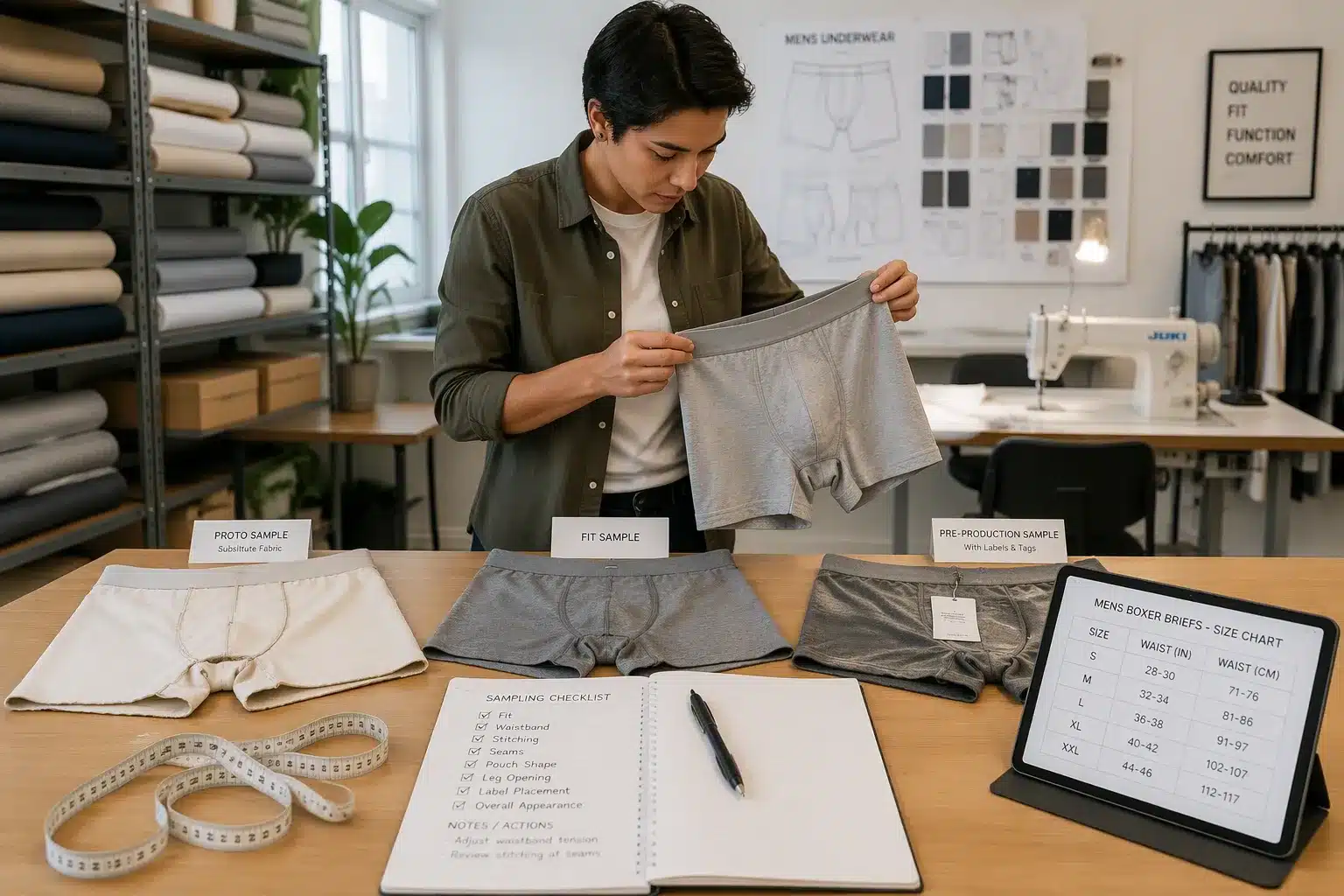
Sampling is where your underwear line gets proven before bulk. Fit, fabric hand-feel, waistband recovery, and stitching all get tested on a real garment. Skip this step and you are betting on a factory’s guess. Do it right and you hold a physical standard that bulk production must match.
Sample Types
Proto and Fit Samples
Development starts with a conversation. Share your product concept, reference images, estimated quantity, and any customization requirements with the manufacturer. If you are planning a trial order of 300–500 pieces per color, say so now — it shapes how the factory approaches your sample.
The first physical version is the proto sample. It tests the design and construction, often using substitute fabric. Think of it as a rough draft in garment form. Next comes the fit sample. This one checks measurements and fit on a real person. Some factories also run size set samples across different sizes to check grading and fit across the full range.
Here is how the main sample types line up:
Sample Type | Purpose |
|---|---|
Proto sample | Tests the design and construction, often using substitute fabric |
Fit sample | Checks measurements and fit on a real person |
Salesman/photo sample | Made in final fabric and colors for marketing and pre-orders |
Pre-production sample | Confirms every detail before bulk (fabric, trims, labels, decoration) and becomes the standard against which bulk production is checked |
Photo and Pre-Production Samples
Once fit is locked, the photo sample comes next. This one is made in final fabric and colors, ready for marketing and pre-orders. It is the version you photograph for your website and social channels.
The pre-production sample is the final gate. It confirms every detail — fabric, trims, labels, decoration — and becomes the standard against which bulk production is checked. Approve this one and you have a reference point for every QC conversation that follows.
Custom Fit Options
Some manufacturers offer custom-made fits so brands can offer a tailored fit. That means the pattern is built around your measurements, not pulled from a stock block. If your underwear brand targets a specific body type or fit preference, ask whether custom fit development is available. It adds time to sampling but gives you a product nobody else sells.
The Sampling Workflow
Concept, Reference Images, Quantity
The workflow starts before any fabric is cut. Send your concept, reference images, and estimated quantity. Be specific about customization — waistband logos, unique patterns, multiple colorways. The clearer your inputs, the fewer sample rounds you need. A manufacturer who asks good questions here is a manufacturer worth keeping.
Measurement Chart and Fit Comments
Once the fit sample arrives, measure it against your chart. Note every deviation. Fit comments should be specific: “waistband sits 1 cm too low at the back” beats “feels off.” Clear comments shorten the revision loop. Vague ones stretch it out.
Approval and Sign-Off
The approval loop runs on measurement charts, fit comments, revisions, and written sign-off. Do not pay the deposit until the sample is approved in writing. That signature protects both sides. It locks the standard, and it gives the factory a clear target for bulk.
Common Sampling Pitfalls
Skipping the Fit Round
Some brands try to save time by jumping from proto to pre-production. That shortcut costs more than it saves. Fit problems caught in bulk become rework, markdowns, or dead stock. The fit round exists for a reason — use it.
Unclear Comments
“Make it better” is not a fit comment. Neither is “looks good” when you have not measured. Unclear feedback forces the factory to guess, and guesses rarely match what you pictured. Write specific, measurable notes every round.
Approving Without Wear Testing
This is the big one. Never approve a sample without wear testing. Put it on. Move around. Check for waistband roll and seam comfort. A sample that looks perfect on the table can fail after an hour of real wear. Wear testing is the only way to catch waistband recovery problems and seam chafing before they reach production.
A sample you have not worn is a sample you have not tested. Approve with your body, not just your eyes.
Treat sampling as the foundation of your custom underwear program. Every round you invest here saves ten problems later. And when you are ready to move to bulk, you will have a signed standard that makes QC simple.
QC: Standards and Inspection Points
QC for an underwear line covers fabric, construction, and labeling — not just visual defects. A small trial order still needs a written standard. Without one, you and the factory argue about “acceptable” after the goods are sewn.
QC Standards to Set
AQL Level and Defect Definitions
AQL means acceptable quality limit. It sets the defect rate a factory agrees to work to and how many units an inspector pulls from each lot. Underwear checks usually split defects into three groups:
Defect category | Examples |
|---|---|
Critical | Needle damage, wrong labels, safety issues |
Major | Broken seams, waistband failure, wrong size |
Minor | Loose threads, slight color variance |
Critical defects get zero tolerance. Ask the manufacturer which AQL level applies to your trial order and get the answer in writing.
Measurement Tolerances
Set tolerances for waist, rise, leg opening, and inseam before production starts. A sample that measures within tolerance today proves the pattern. Bulk units that drift outside it fail. Write the numbers on the approved sample sheet, and measure against that same sheet at every checkpoint.
Colorfastness and Shrinkage
Ask for colorfastness and shrinkage test results on the actual fabric. Custom underwear in dark dyes needs this most. Shrinkage beyond your stated limit turns a medium into a small after one wash.
Inspection Checkpoints
Fabric Incoming Check
Inspect fabric on arrival. Check shade against the approved swatch, weight, and stretch recovery. Reject a bad dye lot before it reaches the cutting table.
In-Line and End-Line Checks
In-line checks catch problems while the line still runs. Watch waistband attaching and flatlock seams. End-line checks confirm every unit before finishing.
Pre-Shipment Inspection
This is your last gate. Pull units per the AQL plan, measure against the chart, and check labels and packing. For men’s underwear, wear-test a few pairs for waistband roll.
Third-Party Inspection Options
When to Book an Inspector
Book a third party on your first bulk run, or whenever you cannot visit the factory. The cost is small against a failed shipment.
What to Include in the Report
The report should list lot size, sample size, AQL level, defect counts by category, measurement results, and photos. Ask for it before you release the balance.
A QC report you cannot read is a QC report you cannot use. Demand defect counts, not adjectives.
Lead-Time: Stages and Buffer Planning
Lead-time is the calendar time from deposit plus approved sample to goods ready to ship. It is the number people underestimate most often for a new underwear line. Founders count the sewing days and forget everything around them.
Lead-Time Stages
Fabric and Trim Sourcing
This stage starts with lab dip and fabric approval, which usually takes 3–7 days. Material then gets lab-tested before cutting for shrinkage, colorfastness, GSM, and composition. Custom fabric and a custom waistband logo both add time here, because each one needs its own approval loop.
Cutting, Sewing, Finishing
Bulk production runs 45–60 days after PPS approval and deposit. Repeats from stock fabric move faster at 30–40 days. A trial order of 300–500 pieces per color follows the same sequence, and the bulk stage is where the schedule changes the most.
QC and Packing
Final inspection happens a few days before dispatch, usually at AQL 2.5, Level II. Packing and delivery follow. Sea freight to the EU or UK runs 25–40 days port-to-port, so build that into your launch date too.
Typical Durations
Stock vs. Custom Fabric Timelines
Stock fabric shortens the front end of the manufacturing process. Custom development stretches it, with fully custom sampling taking 12–18 days from color confirmation. The pre-production sample needs 5–7 days after bulk fabric arrives.
Peak Season Delays
Factories slow down around major holidays. Book your slot early and confirm the factory’s holiday calendar in writing before you pay the deposit.
Buffer Planning
Build a 2–3 Week Buffer
Add a 2–3 week buffer to every quote. Fabric delays and inspection rework eat up the schedule fast.
A lead-time without a buffer is a wish, not a plan.
Milestone Tracking and Alerts
Track five milestones: deposit, lab dip approval, PPS sign-off, inspection booking, and dispatch. Set an alert for each one. A missed milestone early is cheap to fix. A missed one late is not.
Fabric and Construction Specs for Your Underwear Line
The fabric and construction you choose shape your underwear line. They also change three numbers: MOQ, sampling time, and QC rules. Choose a stock knit and a simple waistband, and your trial order stays small. Choose a custom knit with a logo band, and every step takes longer. Settle these specs before you ask for a quote.
Fabric Choices
Cotton, Modal, Bamboo Viscose
Cotton lets air through, holds up to hard washing, and costs the least. Modal feels softer and hangs better, but it costs more. Bamboo viscose wins on feel and fits a sustainable custom underwear image. Each choice changes your price and your buyer. Ask the manufacturer which base they keep in stock before you fall for a swatch.
Stock vs. Custom Knit
Stock knit keeps a small trial order possible. Custom knit raises the mill minimum and adds weeks. For a first run, stock fabric with your own waistband logo is the smart middle path. Confirm the dye lot in writing, since shade can shift between lots.
Weight and Stretch
Ask for fabric weight and stretch recovery numbers on the spec sheet. Heavier knits feel more premium. Better recovery holds its shape after washing. Get both numbers in writing, then compare them across factories.
Construction Details
Waistband Type and Recovery
The waistband makes or breaks comfort. Pick a wide, flat band that sits flush and does not roll. Covered elastic beats exposed elastic, because it avoids direct skin contact and suits latex sensitivity. Ask for high-resilience, anti-roll elastic with smooth stitching and reinforced construction.
Pouch and Fly Design
Briefs and boxer briefs come with open fly or closed fly designs. Pouch structure shapes support and fit. Ask the manufacturer to show both options in a sample, then wear-test each one.
Stitching and Seams
Flatlock seams lie flat against the skin. They cut friction along the inner thighs and seat. Tagless labels remove another rubbing point. Pre-shrunk cotton limits shrinkage in hot washes. Here is how these details map to quality:
Construction Detail | Critical Quality Requirement | Effect on Comfort/Quality |
|---|---|---|
Waistband | Wide, flat band that sits flush and does not roll; elastic covered in cotton fabric | Prevents digging and rolling; covered elastic avoids skin irritation |
Seam construction | Flatlock seams lying flat, or fully seamless construction | Reduces friction along inner thighs and seat |
Label design | Tagless printed or heat-transfer labels | Eliminates repetitive rubbing during long wear |
Cotton treatment | Pre-shrunk or sanforized cotton | Minimizes shrinkage, preserving fit |
Spec Decisions That Affect Sampling and QC
Shrinkage and Colorfastness Tests
Dark dyes and custom knits trigger extra testing. Ask for shrinkage and colorfastness results on the actual fabric before bulk. Write the limits into your approved sample sheet.
Hand-Feel Approval
Hand-feel needs your sign-off, not the factory’s. Approve the fabric swatch in writing before production starts. That signature becomes your QC reference.
12 Items to Confirm Before You Request a Quote
Copy this list into an email or a WhatsApp message. Fill in every line before you hit send. A complete brief gets you a real quote. A vague one gets you a range, then three revisions.
Style, silhouette, and size range
Fabric composition and weight
Colorways and print methods
Quantity and size breakdown
Target market and compliance needs
Incoterms and destination port
Sample timeline and named approver
QC standard and inspection method
Packaging type and artwork
Label content and placement
Barcode format and data
Deposit and payment schedule
Product Spec Essentials
Style, Silhouette, Size Range
Name the exact cut: brief, trunk, boxer brief, or boxer. State the rise and the size range you plan to sell. A factory cannot quote a pattern it cannot picture.
Fabric Composition and Weight
Give the fiber blend and the fabric weight. Say whether you want stock fabric or a custom knit. This single answer moves your MOQs more than any other line in the brief.
Colorways and Print Methods
List each colorway and how it gets there: dyed yarn, sublimation, or screen print. Attach a Pantone reference where you have one. Print method changes cost and lead time, so name it early.
Commercial Terms Essentials
Quantity and Size Breakdown
Give a total and a split. A trial order of 300–500 pieces per color is a common starting point. Show how many units land in each size, not just the grand total.
Target Market and Compliance
Say where the goods ship. US and EU buyers often need social compliance records and fiber content labels. Name the standard you need and let the manufacturer confirm it.
Incoterms and Destination
Pick your Incoterm — FOB, EXW, or another — and name the destination port. Freight and duty sit outside most quotes, so ask what is excluded.
Process Essentials
Sample Timeline and Approver
Set a target date for the pre-production sample. Name one person who signs off. Two approvers slow every round.
QC Standard and Method
State your AQL level and who inspects. Ask whether a third-party report reaches you before the balance is due.
Packaging, Labels, Barcodes
Manufacturers can attach custom labels and packaging, so put labeling and barcode details in the first message. Include polybag type, hangtag artwork, care label text, and barcode format. These details belong in the brief, not in a later email thread.
Clear inputs shorten sampling and prevent quote revisions. Every blank line in your brief becomes a question the manufacturer has to guess at. Fill them all in, and your first quote will be close to your final price.
RFQ: Specs, Quantities, Market, Delivery Terms
A complete RFQ helps an underwear manufacturer give you an accurate quote fast. A half-filled brief gets you a range, then three rounds of changes. Send everything at once, and the first number you get back is usually close to the final price.
You can start talking in a DM or WhatsApp chat. Discuss custom fabrics, waistband logos, patterns, and colorways there. Then move the whole discussion into one written RFQ. That document keeps the chat organized, and it gives your manufacturing partner one clear source of truth.
Building the RFQ Package
Tech Pack and Measurement Chart
Your tech pack holds the flat sketches, construction notes, stitch types, and a full measurement chart with tolerances. Keep tech packs for the manufacturer short and visual. One page per style works better than a forty-page deck nobody reads.
Reference Samples and Swatches
Attach reference images and, when you can, a physical sample or fabric swatch. A photo shows the look. A swatch shows the hand-feel. Together they save you a sample round.
Volume Forecast and Repeat Plan
State your estimated quantity clearly. A trial order of 300–500 pieces per color is a common starting point. Add your forecast for the next two orders. Factories price and schedule differently when they see a repeat plan.
Comparing Quotes Fairly
Normalize Price Against Spec
Compare every quote against the same spec sheet. If one factory quotes stock fabric and another quotes a custom knit, the prices are not comparable. Turn each quote into a per-unit cost at your stated quantity before you compare.
Check What Is Excluded
Ask what is not included in the number. Sampling fees, freight, duties, and packaging are the usual exclusions. A cheap quote with freight missing is not cheap.
From Quote to Purchase Order
Lock Sample Approval First
Do not sign a PO until the pre-production sample is approved in writing. That signature locks the standard for bulk.
A quote without an approved sample is a promise. A PO without one is a gamble.
Payment Schedule and QC Holdback
Match the payment schedule to milestones. A 30% deposit on confirmation is common, with the balance tied to a passed inspection at AQL 2.5, Level II. Hold that final payment until the QC report lands in your inbox. It is your last lever, and it works.
Four pillars, one mental model: MOQ sets your cash gate, sampling locks the standard, QC protects the standard, and lead-time tells you when the money comes back. Miss one and the run wobbles.
Keep the 12-item pre-quote list and the RFQ package close. They turn your first chat with any underwear manufacturer into a working conversation instead of a fishing trip.
Vet two or three factories side by side on the same metrics. Compare scores, not sales pitches. Treat that first small-batch order as a relationship-building run — a custom underwear line built on one verified partner beats five cheap quotes every time.
FAQ
What is the smallest order I can place?
Many factories accept trial orders of 300–500 pieces per color. Ask for the figure split by style, color, and size. Stock fabric keeps that number low. A custom knit raises it, because the mill runs its own minimum first.
Are sample fees refundable?
It depends on the factory. Some credit the fee back against your bulk order. Others keep it. Ask before you pay, and get the answer in writing. Three rounds across three styles adds up fast.
How do I verify a factory is real?
Request the business license, export license, and a recent audit report. Then book a live video walkthrough of the cutting and sewing lines. Match the company name on every document to the name on your quote. A real manufacturer welcomes these checks.
Should I book a third-party inspection?
Yes, on your first bulk run. It is also worth the cost whenever you cannot visit the site yourself. Ask for defect counts by category, measurement results, and photos. Get the report before you release the balance.
How much buffer should I add to lead-time?
Build in 2–3 weeks. Fabric delays and inspection rework eat up a schedule fast. Track five milestones: deposit, lab dip approval, PPS sign-off, inspection booking, and dispatch. A missed milestone early is cheap to fix.
What payment terms are normal?
A 30% deposit on confirmation is common, with the balance tied to a passed inspection. Deposits for OEM orders typically land between 30% and 50% of total order value. Hold the final payment until the QC report reaches your inbox.
Can one style anchor my whole line?
Yes. Many factories let a brand start an own underwear line with a single style and expand later. One style proves the fit, the waistband, and the sell-through before you commit deeper. It also keeps sampling short and simple.
What should I send in my first message?
Send your style, fabric, colorways, size breakdown, quantity, destination market, and label needs. Add reference images and your sample timeline. Clear inputs get you a real quote instead of a range, and they cut quote revisions.
See Also
Small Batch Boxer Briefs Production With Low Minimum Order Quantities
Selecting a UK Low MOQ Underwear Manufacturer for Your Brand
Guide to Custom Waistband Underwear Manufacturers for Emerging Brands
Seven Best Low MOQ Boxer Briefs Manufacturers for Small Businesses
Choosing OEM or ODM for Private Label Men’s Underwear in the US