
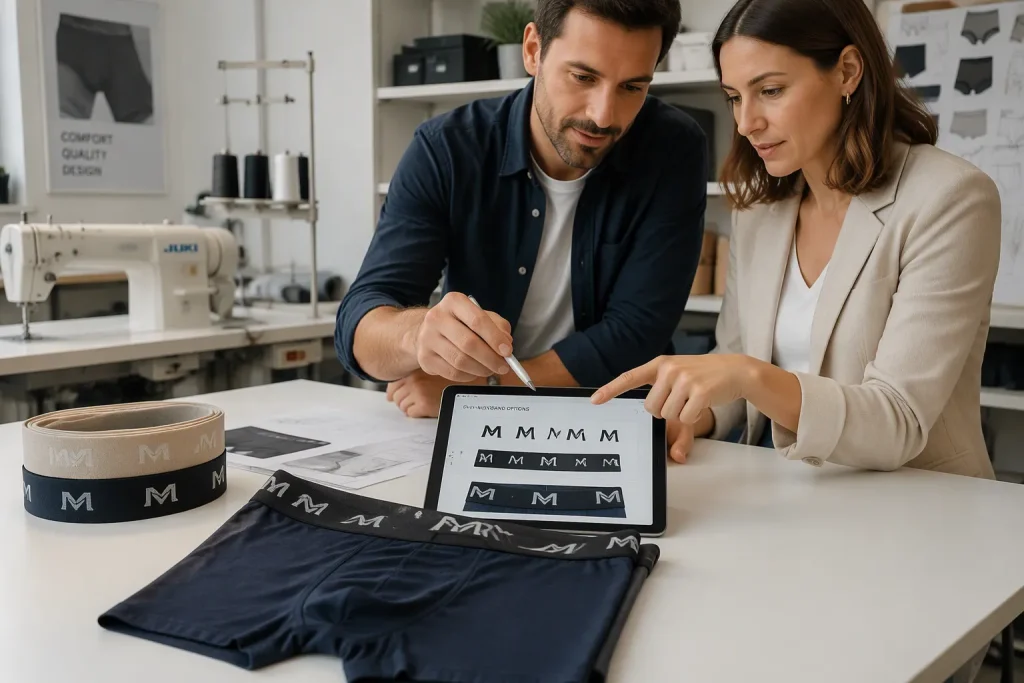
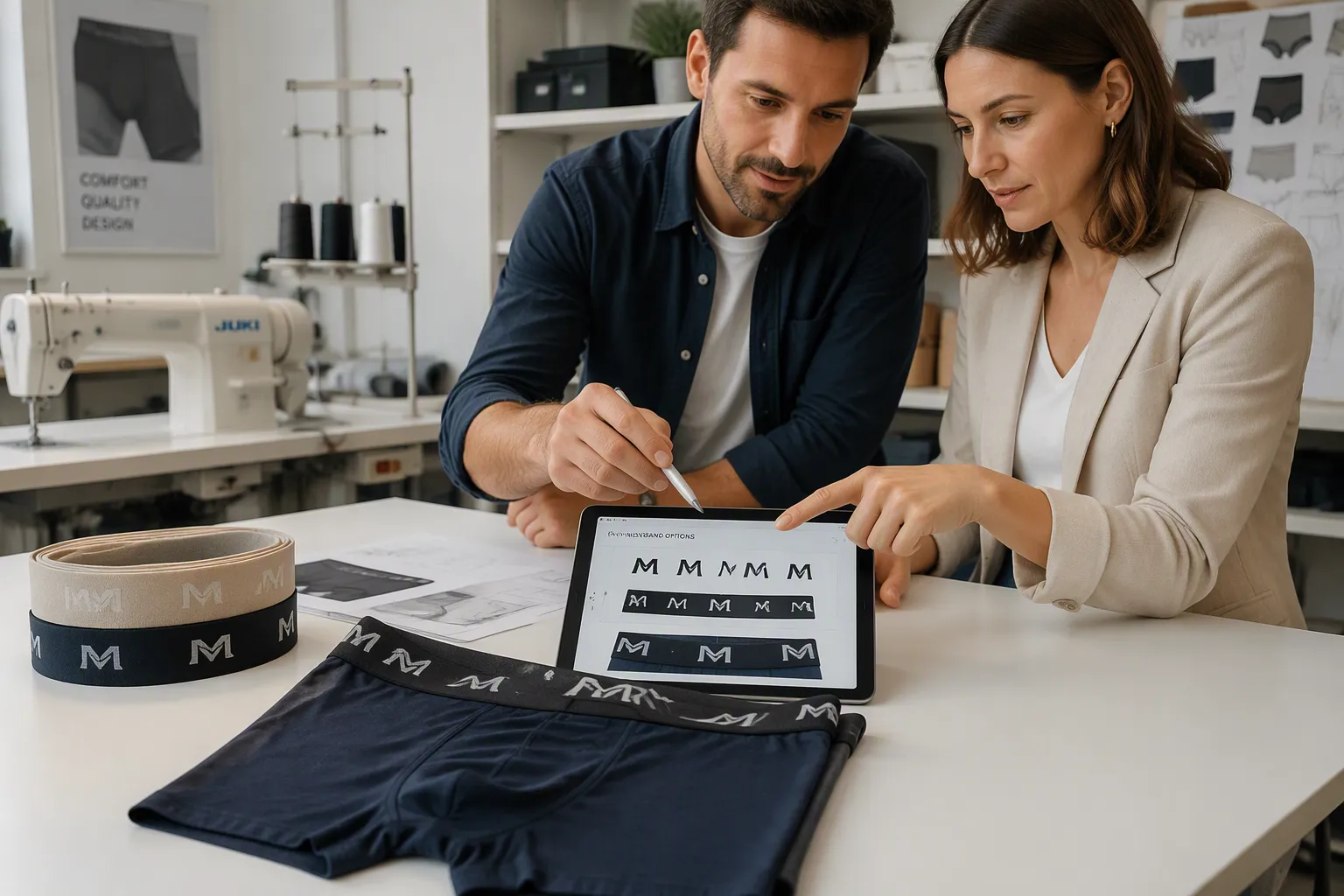
How do you choose a custom waistband underwear manufacturer for your brand? You evaluate six things: customization capabilities, quality standards, compliance, minimums, communication, and willingness to partner with new brands. This guide walks you through each checkpoint in order. That way, you can vet any custom waistband underwear manufacturer with confidence. You will know what questions to ask and what answers to expect. The right manufacturer becomes a true partner for your waistband and private label underwear packaging needs. Let’s dive in.
Key Takeaways
Define your waistband requirements: elastic type, width, logo method, and label style.
Choose a manufacturer with in-house production for better quality control and faster development.
Check certifications like OEKO-TEX and BSCI to ensure safety and ethical practices.
Understand MOQs, pricing tiers, and sampling fees to plan your budget and test the market.
Evaluate communication and project management for smooth collaboration and timely updates.
Plan logistics, packaging, and scalability to support your brand’s growth.
Match product design to wear occasions and brand identity for a cohesive customer experience.
Ask key questions about capabilities, certifications, MOQs, and communication before signing.
Define Your Waistband Requirements
The waistband is a small detail with big branding power. A branded waistband boosts recognition every time someone wears your product. Before you contact any supplier, nail down three things: elastic type and width, logo method and placement, and label style.
Choose Elastic Type and Width
You have three main elastic options. Elastomer elastic offers a smooth, rubber-like feel. Woven elastic delivers a structured, durable finish. Knitted elastic provides soft stretch and comfort. Common widths include 20mm, 30mm, and 40mm. A 20mm band suits lightweight briefs. A 40mm band works well for men’s boxers or athletic styles. Think about how much tension your customer wants. A tighter band feels secure. A softer band feels relaxed.
Pick a Logo Method and Placement
Your custom waistband logo can take many forms. Jacquard weaving creates a logo woven into the waistband fabric itself. This method gives a premium, lasting look. Silicone print adds a raised, tactile feel. Heat transfer and screen print offer vivid colors. Embroidery brings texture. DTG and sublimation handle detailed, full-color artwork. For jacquard woven waistbands, the design lives in the weave. For a printed waistband, the ink sits on the surface.
Placement matters too. You can center the logo at the front. You can place it on the side hip. You can run it all the way around. Each choice changes how visible your custom underwear branding becomes. A center-front logo catches the eye first. An all-around design creates a bold, repeating pattern.
Decide Tagless vs. Woven Labels
Tagless print means the label information prints directly onto the fabric. This approach maximizes comfort because nothing scratches the skin. Woven labels sewn into the band feel more traditional and premium. They also let you show care instructions and size details clearly. Your choice depends on your brand positioning. Comfort-focused brands often pick tagless. Premium brands may prefer woven labels. Hongku Underwear supports both tagless and woven label options, so you can match either path.
One more thing: confirm your artwork files and size ratios early. Ask about sampling charges and packing instructions before you commit. These details shape your custom waistband design from day one.
Evaluate a Custom Underwear Manufacturer’s Capabilities
Once you know what you want, the next step is finding out whether a supplier can actually build it. Capability checks separate real factories from trading companies. You want proof, not promises.
In-House Production vs. Outsourcing
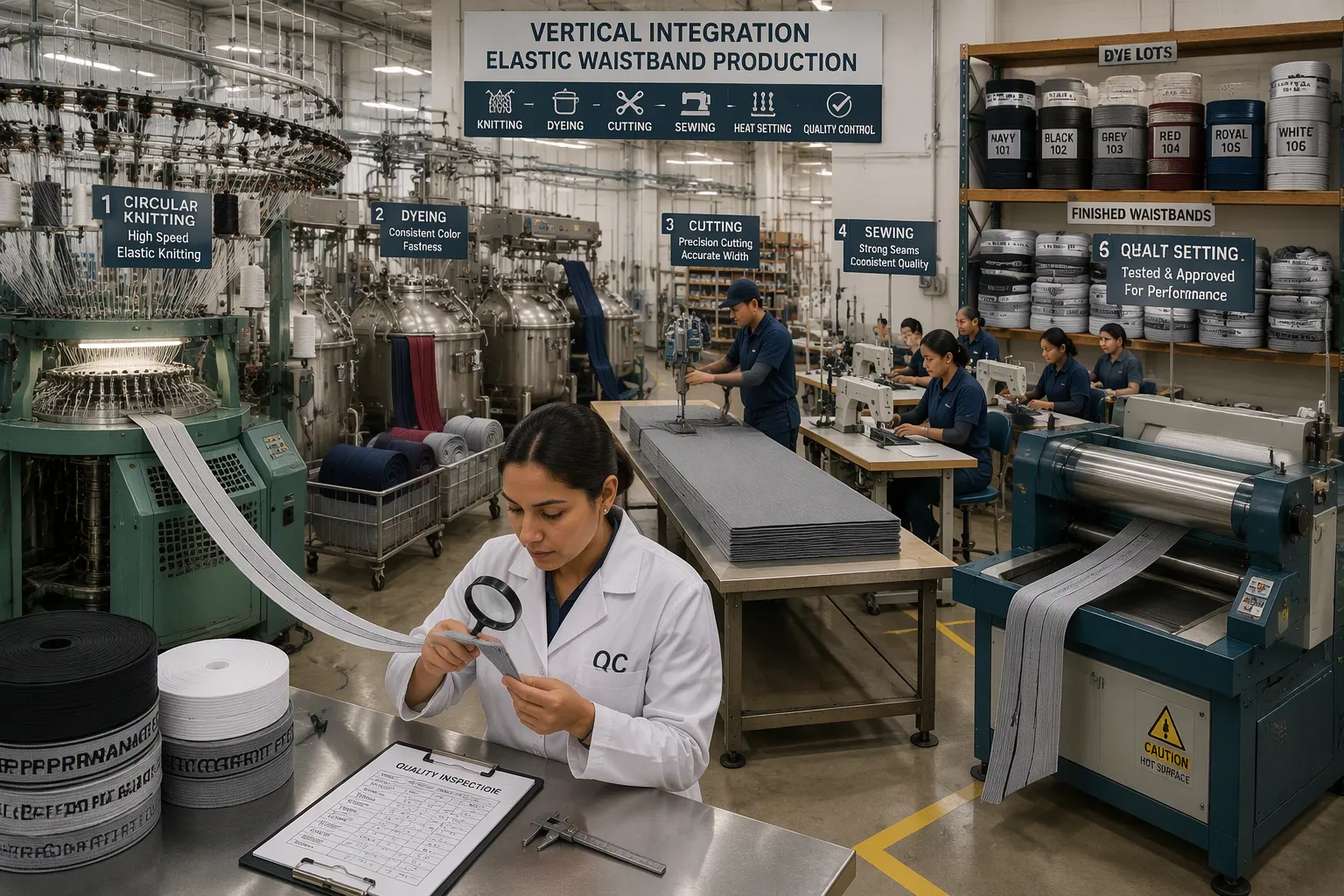
In-house elastic and waistband lines matter because they keep quality control under one roof. When a factory runs its own circular knitting, dyeing, cutting and sewing, and heat-setting, it catches defects at the fabric stage. That beats discovering problems after the garment is sewn. A 5-stage quality control system protects your brand from a single bad batch. One flawed run can sink a startup’s reputation before it scales.
Ask specific questions about subcontracted steps. Which stages leave the building? Who owns those partners? How do you trace a defect back to its source? Factories with vertical integration report a 99% material quality pass rate. They lock shade, weight, stretch, and recovery to spec across dye lots. Outsourced production often drifts on shade and stretch between sampling and bulk. That drift becomes your problem at retail.
The main advantage to working with an underwear manufacturer in the USA is that you can be sure that your garments are made ethically and with high-quality standards. If you manufacture underwear in the USA you won’t have to pay tariffs or skyrocketing shipping costs that are hampering many brands that source in China.
The decision to manufacture underwear in the USA should not be taken lightly as much of this production has been outsourced for decades to Asia. It is more difficult to find the components like custom jacquard elastic in the USA due to production being primarily overseas.
Their in-house capabilities ensure clients maintain control over every detail, from initial concept to finished product.
Here is how the two models compare across the dimensions that matter most to a new brand:
Quality Control Dimension | In-House (Vertical Integration) | Outsourced Production |
|---|---|---|
Material consistency | Shade, weight, stretch, and recovery locked to spec and repeatable across dye lots; reported 99% material quality pass rate | Shade variation between dye lots and stretch percentage drift between sampling and bulk are common failure points |
Development speed | New fabric requirements developed and validated internally; cycles 4–6 weeks faster than standard external sourcing | Queued behind other brands’ mill schedules, slowing iteration |
Compliance & traceability | Oeko-Tex Standard 100 and GRS certifications backed by full chain-of-custody traceability | Recycled-content claims cannot be traced back through the chain; compliance evidence sits outside the managed relationship |
Root cause of defects | Quality decided at the fabric stage before cutting, enabling upstream control | Failures originate at the fabric stage but are misattributed to sewing; a sourcing constraint, not a sewing problem |
Custom Waistbands and Printing Capacity
An experienced OEM/ODM manufacturer owns the equipment that makes your waistband customization capabilities real. Look for jacquard looms, silicone printing lines, heat transfer presses, screen print stations, embroidery machines, DTG printers, and sublimation setups. A custom jacquard waistband requires a loom that weaves your logo directly into the elastic. Silicone printing needs a different line entirely. Ask which machines sit on the factory floor and which get subcontracted.
This is where a custom underwear manufacturer proves its depth. If the factory outsources its jacquard waistband work, your lead times stretch and your quality control weakens. A custom waistband line running in-house keeps your custom underwear with logo production tight and repeatable.
Fabrics, Niche Expertise, and R&D Support
Fabric range tells you how well a manufacturer can match your market. Cotton, modal, bamboo, nylon, and spandex blends cover most needs. Ribbed fabric construction adds texture and stretch. Certifications matter here too: GRS-certified RPET with spandex, GOTS-certified organic cotton capped at 280 GSM, bamboo blends, Amfori BSCI, and OEKO-TEX Standard 100.
Niche experience separates specialists from generalists. Men’s boxers, period underwear, and transgender underwear each demand different patterns, panel construction, and fit logic. A factory with 27 to 30 years of underwear experience has solved these problems before. That history shortens your learning curve.
Hongku Underwear runs custom waistband lines in-house and offers R&D support for new brands. Their team helps you move from concept to sample without guessing. For oem or private label underwear production, that kind of backup matters. Ask any potential partner how they handle custom underwear manufacturing challenges specific to your niche. Also confirm whether they quote garment, waistband, and packaging minimums separately, and whether they need your artwork, size ratios, sampling charges, and packing instructions upfront. Those details shape your timeline and your budget.
Assess Quality Control and Compliance
Quality control separates a factory that talks a good game from one that ships consistent product. You need proof that every batch matches the approved sample. Compliance covers worker safety, material safety, and legal accountability. Ask for documents, not verbal assurances.
Certifications and Fabric Testing
Certifications tell you what a factory has actually verified. OEKO-TEX STANDARD 100 tests fabrics, trims, finishes, and dyes for harmful substances, so materials stay safe against skin. OEKO-TEX STeP certifies environmentally friendly and socially responsible production facilities. BSCI audits labor rights and workplace safety in supplier factories. WRAP verifies lawful, humane, and ethical production practices. Each one covers a different risk area, so check which certificates apply to your specific order.
Fabric composition and safety testing reports back up those certificates. An organic underwear product page shows OEKO-TEX Standard 100 coverage across every component, including lace trim, mesh fabric, elastic, stitching, and dyes. Ask your manufacturer for test reports attached to your order file. If they cannot produce them, walk away.
Stitching and Colorfastness
Stitching durability depends on density and seam strength. Factories verify stitch density and seam strength, use flatlock or overlock stitching to reduce chafing, and reinforce stress points at leg openings and the crotch. Inline QC checks happen at cutting, sewing, and finishing, plus first-off approval on every line. That means someone inspects the first piece off the machine before the run continues.
Colorfastness testing covers washing, rubbing, and light exposure. Fabrics get lab-tested for colorfastness to washing and perspiration, with test reports attached to your order file. A three-stage QC process — inline checks at cutting, sewing, and finishing, a sealed pre-production sample approved in writing, and a final AQL 2.5 inspection covering quantity, workmanship, measurements against sealed spec, packing, and carton drop checks — catches problems before they reach you.
Waistband Recovery Standards
Waistband quality lives or dies on recovery. A band that stretches out after five wears destroys customer trust. Fabrics get lab-tested for stretch recovery before cutting. The test identifies the specimen — body fabric, narrow elastic, a cut waistband component, or a finished garment waistband — then marks the starting gauge length and records the relaxed measurement. The lab defines the load or extension, keeps it constant between samples, and records hold time, loading cycles, and release procedure.
Recovery measurement happens after an agreed interval. The lab records residual change and tension, then repeats after laundering under consistent temperature, cycle count, detergent, and drying route. ASTM D5278/D5278M-26a specifies three washing and drying cycles for its narrow-elastic method. ASTM D4964 requires both parties to agree on laundering temperature and cycle count. Hongku Underwear documents recovery benchmarks this way, keeping photographs, raw measurements, and approval decisions together so every reorder matches the original spec.
Understand MOQ, Pricing, and Sampling
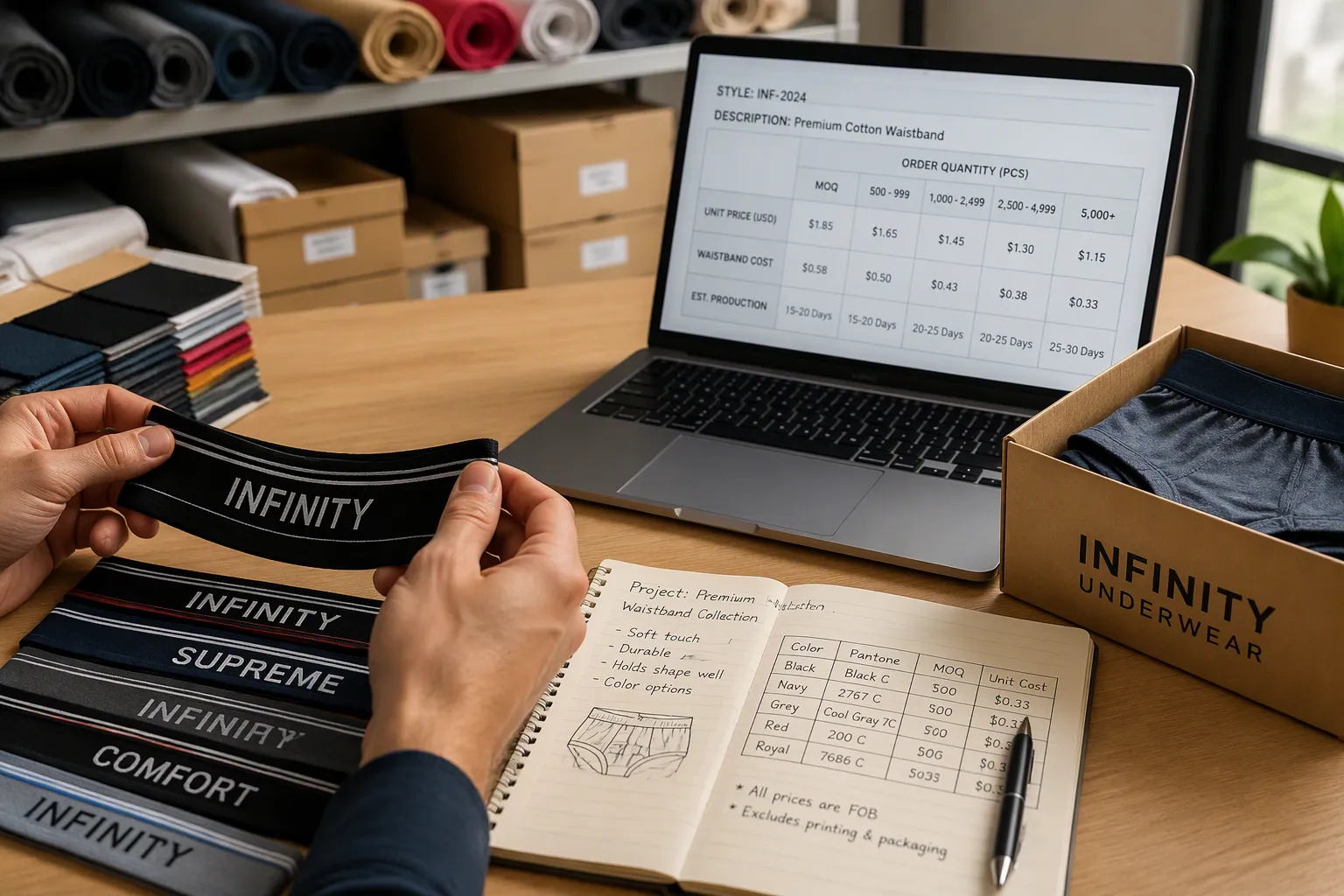
New brands often worry that factories will ignore them until they order thousands of pieces. That fear is outdated. Many custom underwear manufacturers now offer low MOQs for underwear starting from 50 pieces. That volume suits small-batch production and lets you test the market before you commit real money. You get a real product in real hands without betting your whole budget.
Sample Turnaround and Fees
Speed matters when you are racing to launch. Some manufacturers offer 7-day sampling to speed up product development. That quick turnaround lets you see and feel your waistband before you sink money into bulk. Ask about the sampling process upfront. A good factory walks you through each round, from your first concept to the final approved piece.
Sampling fees usually apply. The key question is whether those fees come back to you. Many factories refund the sample fee against your bulk order once you place it. So a sample that costs you upfront often becomes free at scale. Confirm this in writing before you pay. Also ask how many revision rounds the fee covers. Unlimited revisions sound generous, but they can stall your timeline. A clear revision limit keeps everyone moving.
Bulk Pricing Tiers and MOQ
MOQ is not one number. It is set per waistband style and per color. A basic solid band may start at 50 pieces. A custom jacquard waistband with multiple colors may require more. Always separate three MOQs: garment, waistband, and packaging. A factory might quote 50 pieces for the garment but 500 for a custom printed waistband and 1,000 for a branded box. Validate each one independently. Otherwise you approve a garment MOQ you can afford and discover the packaging minimum later.
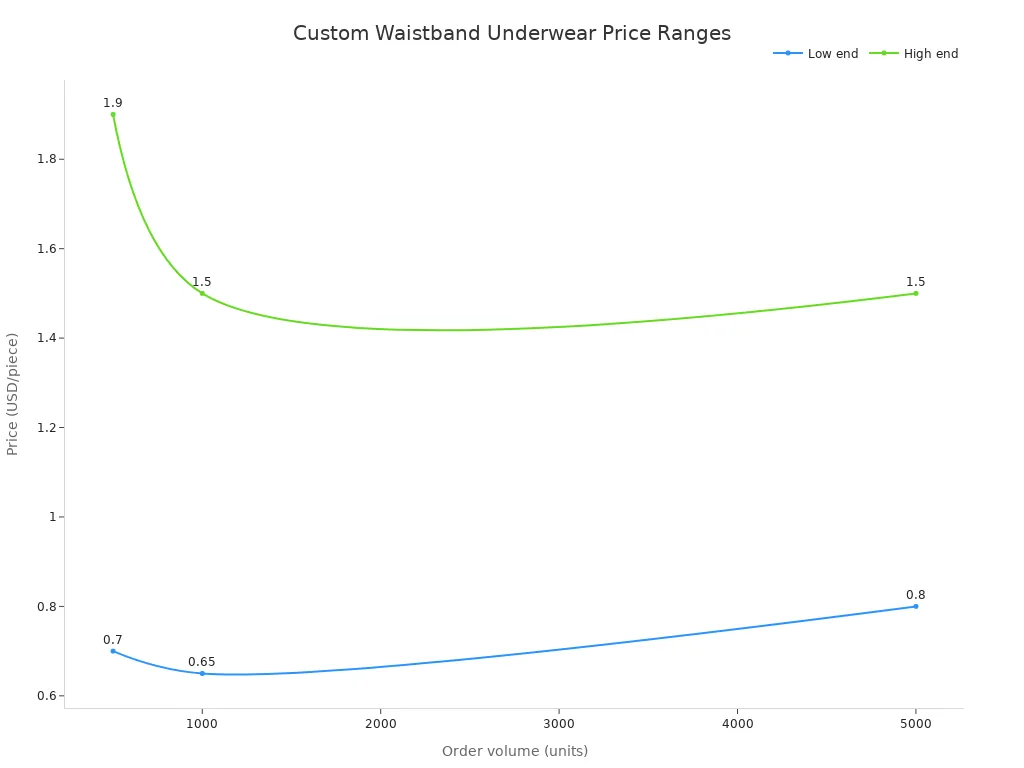
Price breaks follow volume. The table below shows typical per-piece ranges for waistband-focused bulk boxer underwear across three order sizes.
Requested volume | Example suppliers with waistband/custom features | Reported price range (USD/piece) |
|---|---|---|
500 units | STITCHES (elastic), SENSIBLE SOURCING BD (waist band), LENNOX FASHION BD (custom cotton) | $0.70–$1.90 |
1,000 units | MAXIMO INTERNATIONAL (elastic waistband), FIBER FUSION (customizable waist/logo), FM SOURCING INTERNATIONAL (customized boxers) | $0.65–$1.50 |
5,000 units | MATRIX APPARELS TRADE LINK (elasticated waist), S.N.M. APPARELS (wholesale organic cotton) | $0.80–$1.50 |
These ranges come from cross-supplier examples, not one factory’s stepped schedule. Still, they show the band narrowing as volume rises. At 500 units you might pay $0.70 to $1.90 per piece. At 1,000 units that range tightens to $0.65 to $1.50. At 5,000 units it sits at $0.80 to $1.50. The low end drops, and the high end comes down too.
How Custom Waistbands Affect Cost
Waistband customization drives cost more than almost any other detail. Method matters first. A jacquard waistband weaves your logo into the elastic. That requires a loom and setup time, so it costs more per style. A printed waistband uses ink on the surface. Silicone print adds a raised, tactile layer and its own line. Each method carries different tooling and run costs.
Color count changes everything. More colors mean more passes, more setup, and higher waste. A one-color logo on a 20mm band is cheap. A five-color design on a 40mm band is not. Width plays a role too. Wider bands use more elastic, which raises material cost. Logo complexity adds another layer. Fine detail and tight registration demand slower runs and more QC.
Before you approve anything, confirm your artwork files, size ratios, sampling charges, and packing instructions. These four items shape your quote and your timeline. A manufacturer who asks for them early is a manufacturer who plans ahead. That is the partner you want for custom underwear manufacturing.
Check Communication and Workflow
A manufacturer who replies fast and keeps you informed is worth more than one who saves you a few cents per piece. Communication breakdowns cause missed deadlines, wrong specs, and costly rework. You need a partner who treats your project like their own.
Responsiveness and Project Management
Set a reply-time benchmark before you sign anything. Ask how quickly the factory answers emails and messages during business hours. A dedicated account manager should own your project from start to finish. That person becomes your single point of contact, so you never chase five different departments for an update.
Hongku Underwear structures client communication around a named account manager. That manager coordinates sampling, production, and shipping updates. You get one voice, one thread, and one person accountable for your timeline. Ask any potential supplier who your contact will be and how they handle questions outside their time zone.
Timelines and Revision Processes
Sampling rounds follow a clear path. The technical design team builds a presentation pack with your first samples in actual colors, not plain white. They source correct fabrics and trims right away. Custom dye jobs stay a last resort. Once the instruction pack goes out, fast cross-communication between the vendor, pre-production teams, and technical designers keeps everything on track.
Your color sample then goes to the main design hub for review. If the design team confirms the fit, that sample becomes the primary prototype for initial fit comments. A second prototype, if needed, typically uses standard white mid-spec fabric. Once the core look and fit win approval, development transfers to regional production hubs. The latest prototype becomes the design intent reference. The local region then processes the first fit sample, remaining fits, and final pre-production samples before bulk manufacturing begins. Ask about revision limits upfront. Unlimited rounds sound great, but they stall timelines. A clear cap keeps everyone moving.
Design File Handling
Confirm which file formats the factory accepts for your waistband artwork. Vector files like AI or EPS work best for jacquard and print. High-resolution PNG or TIFF files suit sublimation and DTG. Ask how they track revisions. Version control matters when you approve round three and someone references round one by mistake.
This is also the moment to validate separate garment, waistband, and packaging minimums. Confirm your artwork, size ratios, sampling charges, and packing instructions in writing. A manufacturer who asks for these details early plans ahead. That is the partner you want guiding you step by step from design to bulk production.
Review Logistics, Packaging, and Scalability
Great product means nothing if it arrives late or looks wrong on the shelf. Logistics and packaging turn your design into a real brand experience. Scalability decides whether your supplier can grow with you.
Lead Times and Shipping
Standard lead times give you predictable planning. Rush orders cost more and squeeze factory capacity. Ask your custom waistband underwear manufacturer for both timelines before you commit. Air freight moves fast but costs the most. Sea freight saves money but adds weeks. Express shipping sits in the middle for urgent restocks. Match the method to your launch date and your margin.
Private Label Underwear Packaging
Packaging shapes how customers judge your brand before they touch the product. A luxury gift box with a magnetic closure and foil stamping suits boutique and premium lines. A retail window box with a PVC window and hanging tab works for physical stores. An eco-friendly zipper bag fits e-commerce and stays recyclable. A custom kraft box appeals to sustainable collections. Polybag bundles and header cards handle bulk and retail display. You can also add hang tags, care labels, branded tissue paper, and molded trays. These private label underwear packaging choices should match your price point and your values.
Reorder Consistency and Scaling
Reorder consistency protects your reputation. Color matching and elastic batch consistency must hold across every run. A vertically integrated supplier keeps fabric and garment production under one roof, so one QC team enforces a single standard like AQL across all lots. Hongku Underwear stores repeat-order specs, including your artwork, size ratios, sampling charges, and packing instructions, so your second order matches your first. Validate separate garment, waistband, and packaging minimums before you scale. Confirm every detail in writing.
Capacity planning matters as your order sizes grow. A facility with 10,375 sqm, 221 employees, and 27 R&D staff can absorb bigger runs without losing quality. The production floor uses FMS and automated logistics transmission, which keeps output steady. When your volumes climb, negotiate an annual volume agreement. That locks pricing and priority capacity. A supplier with strong R&D and fast sampling supports shorter launch cycles and smaller batch sizes. Country is a data point. Capability is the decision.
Build a Custom Underwear with Logo Strategy
The same custom underwear with logo concept can look completely different once you define who wears it and when. A soft shaping brief is right for everyday sets. A structured tucking brief works for close outer layers. Your manufacturer should tailor the product to your market and fit, not copy a generic block.
Match Product to Wear Occasion
Start with the outfit. The wear occasion sets front panel, rise, band tension, and material behavior. Use this focus:
Wear occasion | Review focus |
|---|---|
Everyday use | No-tuck shaping brief; soft panel direction, lining, rise and balanced band tension |
Close outer layers | Tucking brief; defined front panel, leg opening and edge construction |
Minimal back coverage | Tucking thong; panel width, coverage, edge finish and position stability |
Added volume | Padded brief; insert cavity, retention method, weight and wash needs |
Swimwear | Tucking swim bottom; panel attachment, behavior after immersion, drying and chlorine |
Panel tension alone won’t fix a bad fit. Review panel depth, rise, leg-opening position, gusset construction, and elastic recovery together. Waistband comfort should feel invisible. If the band squeezes or rolls, the customer won’t wear it. For everyday wear, choose a softer panel and balanced tension. For tucking routes, define the front panel and edge finish.
Align Fabrics and Colors with Brand Identity
Your custom underwear branding sends a signal before anyone reads the logo. Fabric and color make that signal stronger. Organic cotton and bamboo blends say natural and breathable. Nylon and spandex blends say performance and support. Ribbed construction adds texture; flat-edged finishes create a smooth line under leggings or fitted dresses. If you sell custom logo underwear for an athletic audience, choose stretchy, moisture-wicking blends. If you sell a luxury line, choose dense organic cotton with a soft hand feel.
Match color to the wardrobe too. Light-colored workwear calls for low-contrast, flat-edge briefs with subtle print scale. High-rise trousers need a wide, gentle band that resists rolling. Long travel days need a stay-put hipster with secure rear coverage. Every material and trim should support one brand identity.
Request a Quote and Specs Review
Before you sign anything, request a quote and walk through the design spec with the manufacturer. This is a standard step, not an afterthought. The factory should see your artwork, size ratios, sampling charges, and packing instructions early. That lets them flag cost issues before you commit.
When you request a quote for custom underwear with logo, include the complete band spec. Specify elastic type, width, logo method, placement, and label route. Confirm garment, waistband, and packaging minimums separately. Then ask how the front panel works with the rise. This is where custom underwear branding becomes a collaborative process. Clear samples, costs, timelines, and approval checkpoints keep the project on track.
Before you sign, ask your custom waistband underwear manufacturer these five questions. Can you produce my exact elastic spec in-house? What certifications and test reports do you provide? What are your MOQs, sample fees, and price breaks? How do you handle revisions and communication? Can you scale from first order to wholesale volume? Also validate garment and packaging minimums separately. Confirm artwork, size ratios, sampling charges, and packing instructions in writing.
The right partner aligns with your brand values, quality bar, and growth stage — don’t settle for the lowest quote.
Hongku Underwear delivers private label underwear packaging and custom underwear with logo programs for new brands ready to grow.
FAQ
Quick answers to the questions new underwear brands ask most often.
What band width should I pick for my underwear?
A 20mm band suits lightweight briefs. A 30mm width stays versatile across styles. A 40mm band works for boxers or athletic wear. Think about your customer’s comfort. A tighter band feels secure. A softer one feels relaxed.
How low can custom underwear minimums go?
Factories now start around 50 pieces per style and color. But keep garment, waistband, and packaging minimums separate. A factory might quote 50 garments but 500 for the band. Validate each one before you commit.
What certifications prove a factory is legit?
OEKO-TEX Standard 100 tests fabrics for harmful substances. BSCI and WRAP audit labor practices. Ask for test reports attached to your order file. If they cannot produce documents, walk away. A good manufacturer shares them without hesitation.
How fast can I get a sample?
Some factories offer 7-day sampling. That quick turnaround lets you feel the elastic before bulk. Ask if the sample fee is refundable against your order. Confirm how many revision rounds the fee covers.
What is the difference between jacquard and printed band styles?
Jacquard weaves your logo into the elastic for a premium, lasting look. Printed bands place ink on the surface. Silicone print adds a raised, tactile layer. More colors and wider bands raise costs for either method.
How do I keep reorders consistent?
A vertically integrated factory stores your specs: artwork, size ratios, sampling charges, packing instructions. They lock shade, stretch, and recovery across dye lots. Ask if they keep repeat-order specifications on file before you sign.
What file format should I send for my logo?
Vector files like AI or EPS work best for jacquard and print. High-resolution PNG or TIFF suits sublimation. Ask how the factory tracks revisions. Version control prevents mixing up approved rounds.
See Also
How To Select The Best Custom Waistband Underwear Manufacturer
Essential Guide To Wholesale Men’s Underwear For UK Buyers
What To Look For In Men’s Underwear Manufacturers In 2026
Choosing A Private Label Men’s Underwear Manufacturer In 2026
Simplified Sourcing Of Private Label Men’s Underwear In The UK