
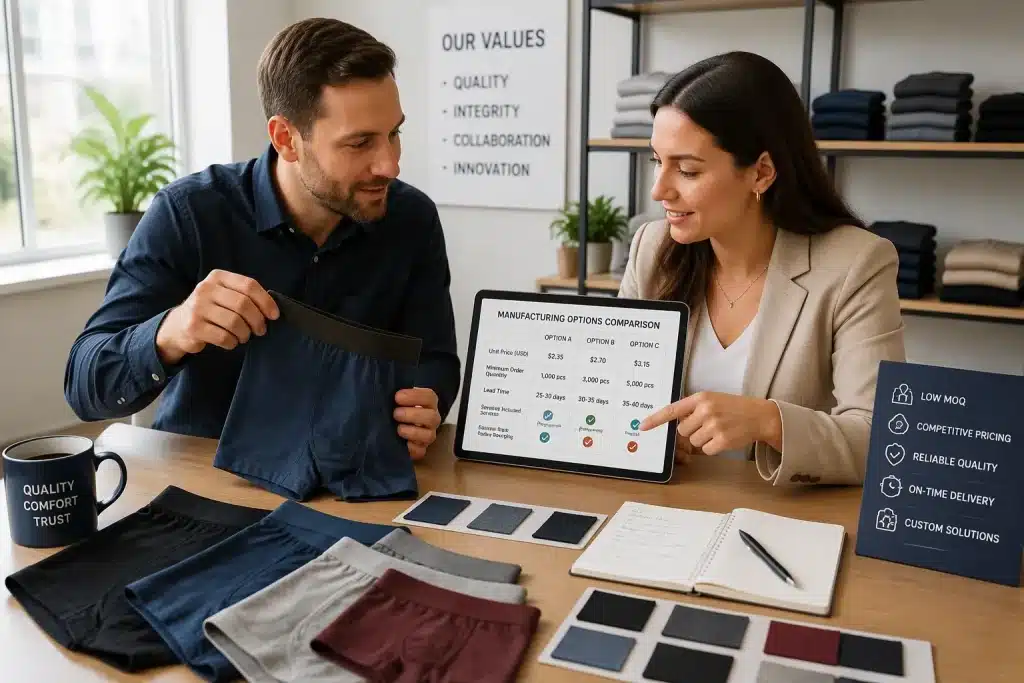
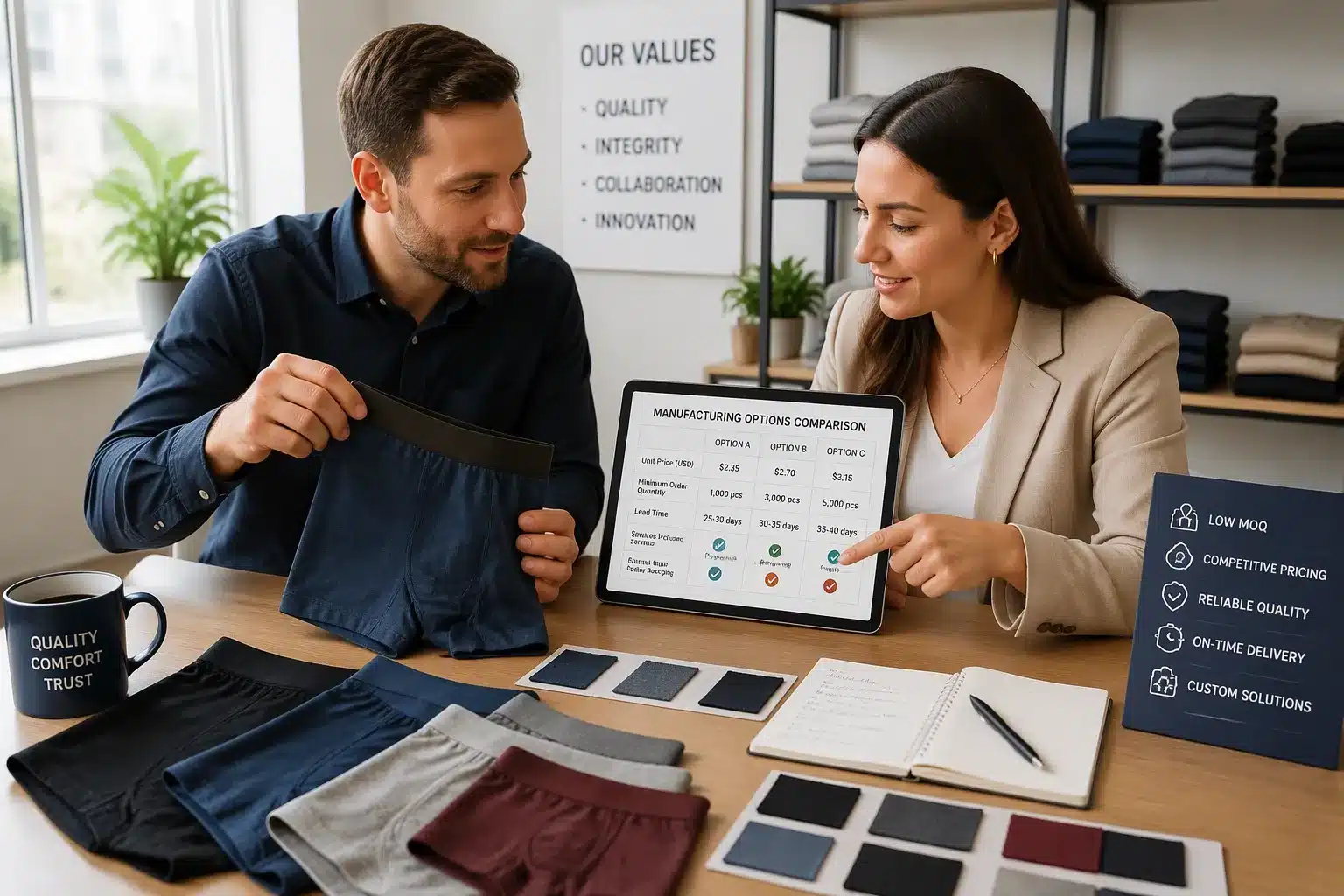
Minimum order quantity, pricing, and services decide most sourcing results. These three factors matter more in underwear than in almost any other clothing type. Fit, fabric, and sizing complexity make a wrong partner more risky. A supplier who cannot keep a steady size range or match a fabric’s stretch recovery will hurt a brand’s repeat business.
This comparison groups private label underwear manufacturers in the USA by capability tier. Readers can match order size and budget to the right option. Each tier has a different MOQ, and each MOQ shapes the pricing structure a brand should expect. The same logic applies when a brand checks any private label underwear manufacturers usa shortlist.
Key Takeaways
Pick the manufacturing tier that fits your order size: label-only for small tests, light customization for styles that already sell, and full OEM for custom fits.
Minimum order quantity (MOQ) is different for each tier. It pays for development work, not just the number of units.
Making only the label gives you low cost and fast turnaround, but you have less control over fit and fabric.
Light customization lets you choose custom colors and waistbands with low minimums. These often start at 30 units per style or color.
Full OEM lets you control the pattern and fabric, but it needs higher minimums and longer lead times.
Sample fees usually cost 2–5 times the unit price. These fees are often credited back when you place bulk orders.
Always get MOQ, sample fees, and lead times in writing before you commit to a manufacturer.
Begin with a small test order to check fit, quality, and communication before you scale up.
Quick Answer: Low-MOQ Private Label Options
Private label production usually begins with a manufacturer’s existing blocks and fabrics. Custom production begins with a tech pack. This difference affects both MOQ and cost. A brand that provides its own design files takes on development work, and that work raises the minimum order quantity. A brand that uses an existing block keeps development costs low and can place a smaller order.
Label-Only on Stock Styles
Label-only work is the simplest path. The manufacturer provides the stock style, fabric, and fit. The brand adds woven labels, printed care tags, and packaging. This option works for a men’s underwear brand testing 300 pieces per color. At that volume, label-only production is realistic with most suppliers, and customization stays limited to branding rather than fit or fabric. The trade-off is clear: low cost and fast turnaround, but no control over the block or the fabric blend. A low MOQ manufacturer will usually quote this tier first, and the MOQ stays predictable across colors.
The limits are worth stating plainly. A brand cannot change the fabric weight, the rise, or the leg opening at this tier. Waistband colors come from the supplier’s stock range. A 300-piece-per-color order can split across two or three colors, which keeps the total run modest. Brands that need a signature fit should treat label-only as a market test, not a final product.
Light Customization at Low Minimums
Light customization adds color, fabric selection within the manufacturer’s range, and custom waistbands. According to DesignTo Clothing, a USA-based custom underwear manufacturer, the minimum order quantity for private label underwear production starts at 30 units per style/color. Some projects need higher quantities depending on fabric, construction, and trims. For a brand ordering 300 pieces per color, light customization is comfortably feasible. The limits appear in trims and construction: specialty fabrics and complex seams push the minimum order upward. Brands that need low MOQ available options should confirm trim availability before sampling.
At 300 pieces per color, a brand can realistically request a custom logo waistband, two or three fabric choices, and matched thread colors. A new pattern or a revised size grade is not realistic at this volume. Those changes require pattern development, and development work sits in the OEM tier.
When to Move to Full OEM
Full OEM starts from a tech pack and gives the brand control over pattern, fit, and fabric. This tier carries the highest minimums. Some custom underwear manufacturers offer MOQs as low as 50 pieces per style with fast sample development, yet full OEM at 300 pieces per color is often tight. A brand at that stage should confirm pattern ownership and sample fees before committing. Full OEM fits brands with proven fit and a clear size range. Understanding MOQ meaning helps here: the figure reflects development work, not just unit count. Many apparel manufacturers who accept small MOQs sit in the label-only tier. A brand should compare lower MOQs against service scope and pick an underwear manufacturer USA option that matches its stage. One more MOQ check before signing: ask whether the quote covers all colors. A reliable underwear manufacturer USA partner states that clearly, and a strong private label underwear manufacturers usa shortlist will show it. For a 300-piece-per-color launch, an underwear manufacturer USA offering label-only and light customization covers the need.
Private Label vs. Custom: Cost and Branding Control
How the Two Models Differ
Private label begins with a product the manufacturer already makes. The buyer picks a stock style and adds their brand using labels, hangtags, and packaging. Custom manufacturing begins with a tech pack. The buyer sets the pattern, fabric, and construction, and the factory makes the product to that spec.
The cost structures come from that split. Private label has low development cost and a short time to market, measured in weeks. Custom work has higher development cost and longer timelines, measured in months. Neither model is better. Each one fits a different stage of brand growth.
Cost and Customization Trade-Offs
There is no single price for private label apparel manufacturing. Pricing depends on style, fabric, and order quantity. The same rule applies to custom work, where materials and trims change the quote basis. Buyers should ask how moqs impact do moqs have on pricing before comparing quotes, because the minimum is rarely one factory number. Garment quantity may pass, while a custom waistband or fabric carries a larger supplier minimum.
Cost dimension | Private label | Custom |
|---|---|---|
MOQ | Garment minimum plus component minimums | Mill and trim minimums often larger |
Unit price | Layered: development, materials, sewing, packaging, logistics | Same layers, with custom trims added |
Setup fees | Plates, dielines, artwork spread across units | Tooling ownership terms matter |
Allocated setup cost per garment = total setup and development charges ÷ planned saleable quantity
Keep setup charges apart from recurring unit costs. A printing plate may not recur on a repeat order, while labels and packaging do. Lower MOQ usually means a higher cost per unit but less capital at risk. Ready-stock private label at about 100 units keeps total investment near $100–150. Full custom OEM at 500 units per color runs about $750–1,500, and standard custom runs often start at 2,000+ pieces per style. A larger order quantity can earn a lower price per unit, yet it ties up more cash.
Branding Control by Model
Private label gives the buyer control over font size, color scheme, and logo placement, plus full ownership of the brand. The factory keeps the tooling and the core product. Custom work lets the buyer set geometry and materials, but exclusivity does not come automatically. It depends on written tooling, design-rights, and non-use terms.
Coherence is the practical test. When garment, label, and packaging vendors are separate, brand consistency is hard to hold. An underwear manufacturer usa with in-house label and packaging suppliers keeps that chain tight. Any underwear manufacturer usa shortlist should be checked for this integration before quotes are compared.
Capability Tiers at an Underwear Manufacturer USA Brands Can Use
What Each Tier Includes
Capability tiers show what a factory can really do for a brand, not how big the factory is. Three tiers cover most sourcing talks.
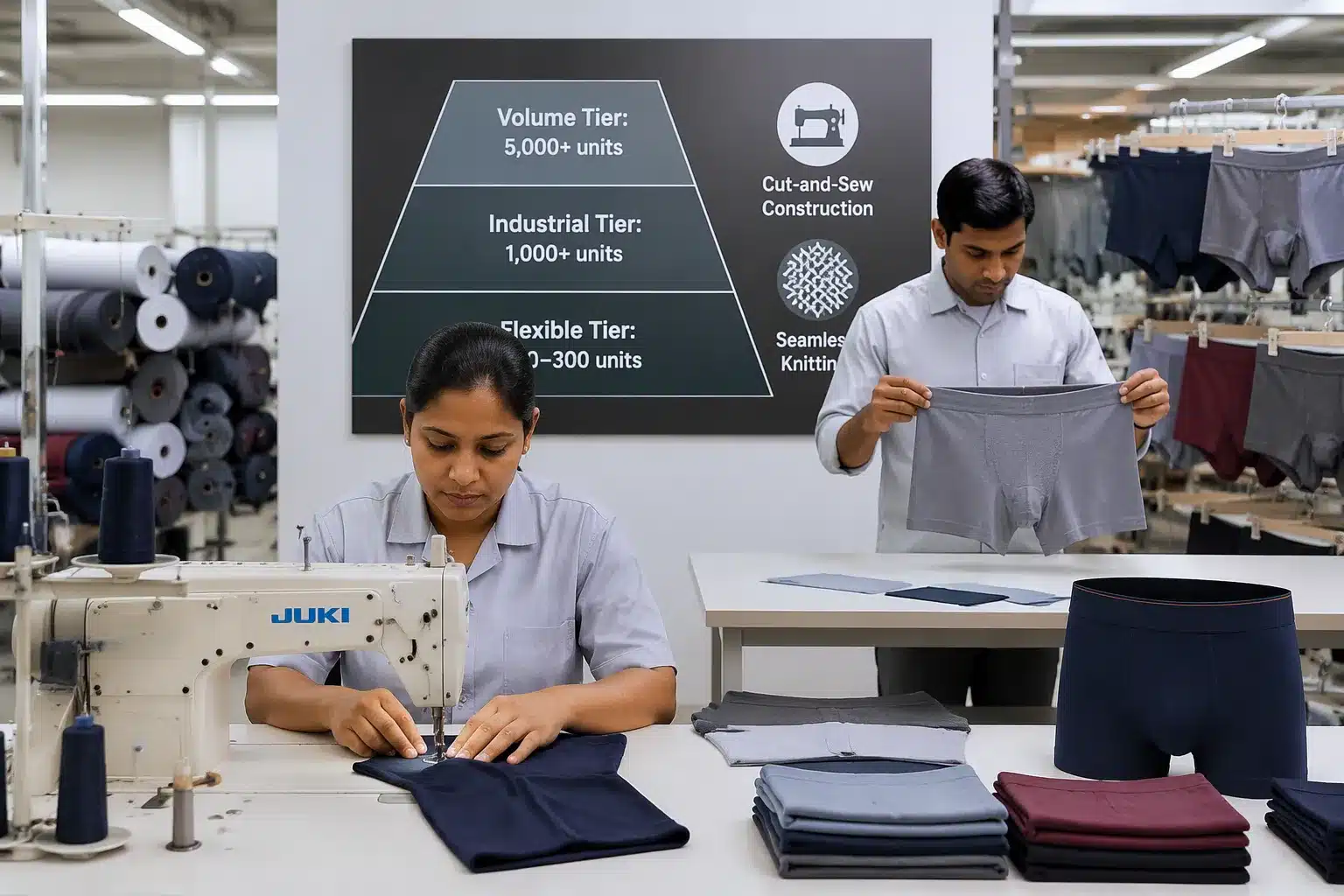
The flexible tier handles cut-and-sew construction. A cut and sew underwear manufacturer usa in this tier works with woven and knit fabrics, sews panels, and attaches waistbands. Order sizes run from 150 to 300 units, which fits startups and brands testing new styles. Most low moq programs live in this tier.
The industrial tier focuses on seamless knitting. Machines knit the garment in one piece, and calibration takes time. That calibration pushes the minimum to 1,000+ units per style. A brand that wants seamless construction should expect this threshold from any us underwear manufacturer with knitting capacity.
The volume tier sits above both. It covers mixed-SKU consolidation, custom retail packaging, dedicated line planning, and in time custom tooling. Each step up unlocks more service, and each step carries a bigger commitment.
Thresholds and Requirements
Volume thresholds follow a predictable ladder at many underwear manufacturers in the usa. The table below shows what each band unlocks.
Order Volume | Tier | What Unlocks |
|---|---|---|
1,000–4,999 pcs | Standard wholesale | Mixed-SKU consolidation, GS1 barcoding, standard polybag packaging |
5,000–19,999 pcs | Mid-volume | Custom retail packaging, store-brand support, territory protection eligibility |
20,000–49,999 pcs | High-volume | Dedicated line planning, seasonal capacity reservation, multi-market compliance pack |
50,000–99,999 pcs | Strategic | Exclusive SKU development, multi-shipment scheduling, EDI integration |
100,000+ pcs | Enterprise | Custom tooling amortization, joint demand forecasting, priority capacity allocation |
Distributor pricing starts at 1,000 pieces per purchase order across mixed SKUs. Below that line, standard MOQ pricing applies. A 50-piece program exists for startup validation at some suppliers.
Exclusivity terms scale the same way. SKU-level non-compete eligibility starts at 5,000+ pieces per order. Category-level exclusivity needs 20,000+ pieces cumulative volume. Full territory exclusivity needs 100,000+ pieces annual volume. Strategic partnership status needs a contractual annual commitment of 100,000+ pieces and 3+ completed production cycles.
Technical requirements also change by tier. Sampling costs usually run 2–5x the bulk unit price, and most suppliers credit that fee back when the bulk order is placed. Material safety documentation matters at every tier: OEKO-TEX for skin-contact activewear, GRS where recycled claims are made. Physical testing covers Martindale abrasion, shrinkage after pre-wash, and colorfastness.
Matching Brand Stage to Tier
A pre-launch brand should start in the flexible tier. A 150–300 unit run validates fit, fabric, and demand without tying up capital. The trade-off is a higher cost per unit and limited construction options. This stage also lets a brand learn how a domestic underwear manufacturer usa handles communication before committing to larger runs.
A brand with proven sell-through should move to the industrial tier or the 1,000–4,999 piece band. Seamless construction becomes viable at 1,000+ units per style. Mixed-SKU consolidation and standard barcoding arrive at the same point, which makes retail onboarding simpler.
Established brands with forecastable demand belong in the mid-volume and high-volume bands. Custom retail packaging and territory protection become available at 5,000+ pieces. Dedicated line planning and seasonal capacity reservation arrive at 20,000+ pieces.
Enterprise-scale brands gain tooling amortization and priority capacity at 100,000+ pieces. Few brands reach this band, and those that do negotiate annual commitments rather than per-order terms.
The practical rule: match the tier to confirmed demand, not projected demand. A brand that overstates volume to unlock a tier will carry inventory it cannot sell. A brand that understates volume pays more per unit than necessary. Review moq requirements against last season’s sell-through before requesting quotes. Compare private label underwear manufacturers usa options at the tier your numbers support, then confirm the underwear manufacturer usa can scale with you. A good underwear manufacturer usa states its thresholds openly, and that transparency is worth more than a lower quote.
Technical Inputs Manufacturers Will Ask For
Tech Packs and Size Charts
A tech pack tells the factory what to build. It shows measurements, construction, stitch type, fabric, and color. Underwear needs graded sizing, so the pack must show every size in the range, not just one sample size. A clear size chart with tolerances stops fit disputes later. Brands without a pack can often start from a stock block, which lowers the moq and shortens development.
Pattern ownership depends on where the block came from. When a brand uses the manufacturer’s existing block, the factory usually keeps the pattern and the design files. The brand owns its brand assets, not the block. A custom pattern is different. The brand pays for development, so the contract should state that the pattern, graded files, and digitized markers transfer to the brand on final payment. Negotiate three points: file transfer format, reuse rights if the brand leaves, and a clause stopping the factory from selling the same custom pattern to another buyer. Put these terms in writing before sampling begins.
Logo Waistbands and Labels
Waistbands carry the most visible branding on underwear. Factories will ask for artwork files, Pantone colors, and the technique you want, such as woven, printed, or jacquard. Each technique has its own setup cost and its own minimum. A custom jacquard waistband often carries a higher component minimum than the garment itself, so confirm both numbers with any underwear manufacturer usa before quoting.
Labels follow the same logic. Woven main labels, printed care labels, and size tabs each need artwork and placement instructions. Care labels must match the fabric content and wash instructions in the tech pack. A mismatch between label text and actual fabric creates a compliance problem at retail. Send final label artwork as vector files and approve a physical proof before bulk production.
Packaging and Hangtags
Packaging is where small details create delay. Factories need hangtag artwork, dielines, polybag specs, and barcode data. GS1 barcodes must be supplied by the brand, not generated by the factory. Folded versus hanging presentation changes the polybag size and the carton count, so state it early.
Ask for a packaging proof alongside the garment sample. A proof catches color shifts and die-line errors before the print run. Confirm who stores the printing plates and who pays for reprints. A reliable underwear manufacturer usa will list packaging steps in the quote, and that clarity keeps the moq predictable across repeat orders.
Sampling to Production Flow in Underwear Manufacturing in the USA
Sample Request to Approval
The flow starts when a brand asks for a sample. The brand sends its tech pack, size chart, and artwork files. The factory checks if the order can be made, then builds a first prototype. Some suppliers offer fast sample development, which shortens this stage without skipping the review. Before the sample ships, a brand should ask how many revision rounds the quote includes.
Approval works best as a written sign-off. The brand checks fit, stretch recovery, and label placement against the tech pack, then confirms in writing. Vague feedback creates extra rounds, and more than two rounds usually means the tech pack is unclear. A technical feasibility review before the first prototype catches fit logic, material direction, and bulk practicality early. That one step cuts revision rounds before they multiply.
Production and Quality Inspection
Once the sample is approved, the factory books a production slot and orders materials. Inspection should follow a set process, not a quick visual check at the end. Some manufacturers use a 6-stage quality control process and hold ISO certification. Both are credentials worth checking during this flow, and a brand should ask to see them rather than assume.
The approved sample must be repeatable in bulk. Sewing practicality, QC checkpoints, and repeatability deserve review before production starts. A sample that looks right but cannot be sewn consistently will fail inspection. Ask the underwear manufacturer usa which checkpoints apply to your order and who signs off at each one.
Avoiding Common Delays
Delays cluster around a few causes. Design complexity, fabric availability, revision rounds, order size, production location, and factory capacity each add time. Custom fabrics add lead time before production begins. A fully booked factory means waiting in line, so production slots should be booked early.
Delay Cause | What Usually Goes Wrong | Avoidance Move |
|---|---|---|
Fit logic unclear | Rise and coverage miss the target customer | Align fit logic before the first prototype |
Material direction loose | Stretch recovery and shrinkage go undiscussed | Define material direction in the tech pack |
Late gusset review | Function problems surface after sampling | Review gusset layout early |
Bulk reality ignored | Approved sample proves hard to repeat | Check sewing practicality in advance |
A complete, accurate tech pack is the biggest lever. Stock fabrics cut weeks off sourcing. Quick approvals and clear feedback keep the timeline intact. Confirm the moq and the production window together with any underwear manufacturer usa, and check that the domestic underwear manufacturer usa option fits your deadline. Compare underwear manufacturers in the usa on capacity before booking. A clear plan for underwear manufacturing in the usa keeps the moq predictable across repeat orders.
MOQ, Sample Fees, and Lead Times by Option
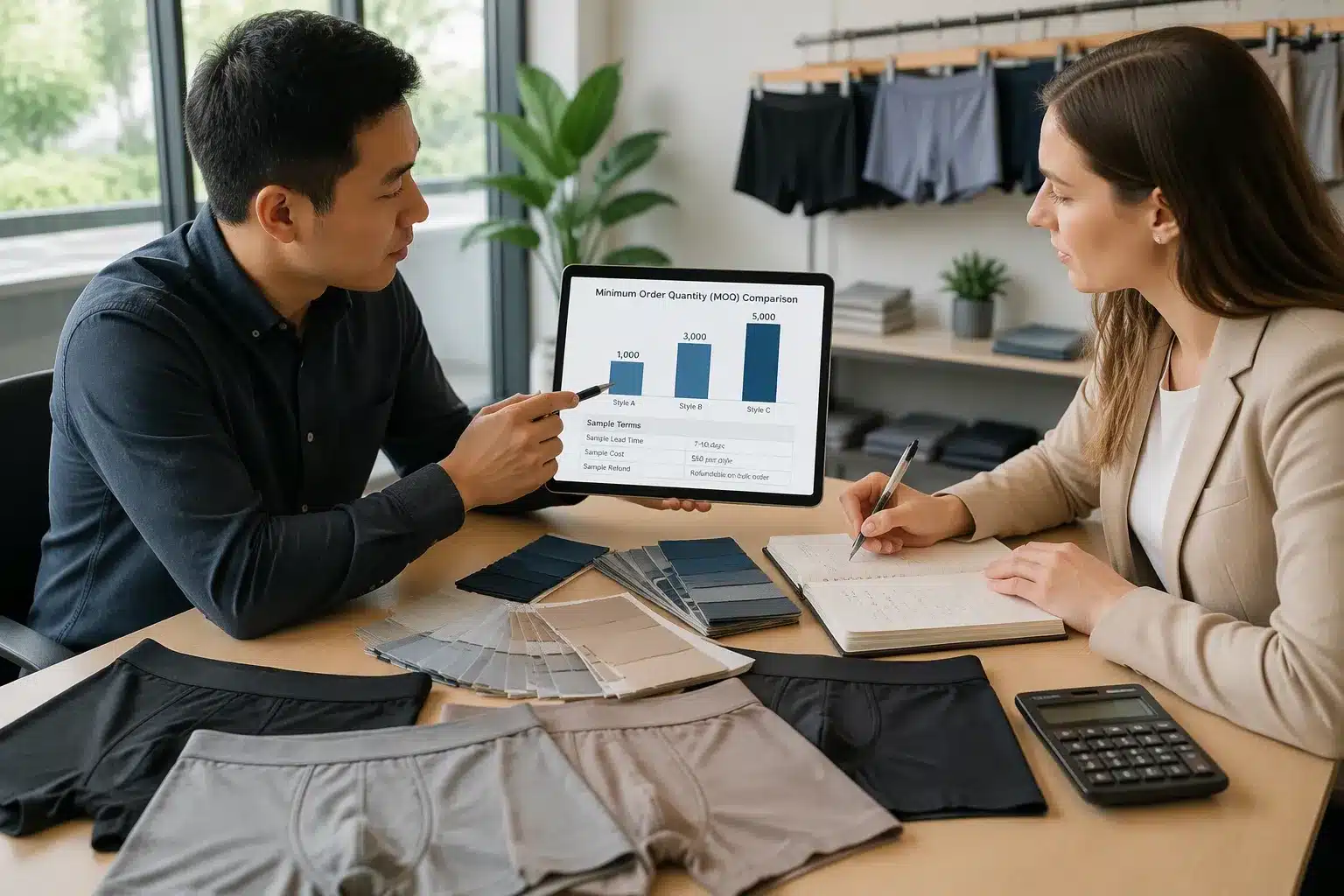
Minimums differ a lot between private label underwear manufacturers, so a brand should compare them before choosing a partner. One quoted number rarely covers every style, color, or trim. The same factory may quote one number for a stock style and a much higher number for a custom waistband. Treat every quote as a starting point for comparison, not a universal benchmark.
MOQ and Sample Fee Ranges
The minimum order quantity follows the capability tier. Label-only work on stock styles sits at the low end, and light customization starts near 30 units per style and color at some suppliers. Full OEM carries the highest floor, and some custom programs still offer 50 pieces per style with fast sample development. A brand ordering 300 pieces per color clears the label-only and light customization tiers with room to spare. The same order quantity sits tight against full OEM minimums.
Sample fees follow a similar pattern. Sampling costs usually run 2–5x the bulk unit price, and most suppliers credit that fee back when the bulk order is placed. A brand should confirm the credit terms in writing. Ask how many revision rounds the fee covers. Extra rounds often carry an added charge, and that charge rarely appears in the first quote.
Logo waistbands deserve a separate question. A custom jacquard or woven waistband often carries its own component minimum, and that minimum can exceed the garment minimum. Confirm both numbers before comparing moqs and prices across suppliers. A low moq on the garment means little if the waistband requires a much larger run. This is where moq flexibility matters most: a supplier who can source a stock waistband in the brand’s color keeps the total minimum low, while a fully custom band resets it.
Pattern Ownership and IP Terms
Pattern ownership changes with the source of the block. A stock block stays with the factory, and the brand owns only its brand assets. A custom pattern is different. The brand pays for development, so the contract should state that graded files and digitized markers transfer on final payment. Three terms belong in writing: file transfer format, reuse rights if the brand leaves, and a clause stopping the factory from selling the same custom pattern to another buyer.
The moq meaning shifts here as well. A higher minimum often reflects development work rather than unit count alone. A brand that pays for a custom pattern should confirm who holds the rights before the first sample ships. A clear minimum order with unclear IP terms is a worse deal than a higher minimum with clean ownership.
Standard and Rush Lead Times
Lead times grow with customization depth. Label-only orders move fastest because the style and fabric already exist. Light customization adds fabric selection and waistband sourcing, which extends the front end of the schedule. Full OEM adds pattern development and fit rounds, and that work pushes the timeline out by weeks rather than days.
Sampling lead times vary by supplier and by style complexity. A stock-style sample usually returns faster than a custom prototype, and fast sample development shortens the cycle at some factories. A brand should ask for a sample timeline in writing and compare it against the production window. Rush production is often available at a premium, and the premium should be quoted before the order is placed.
Option | Typical Minimum | Sample Fee Basis | Lead Time Pattern |
|---|---|---|---|
Label-only | Lowest tier | 2–5x unit price, usually credited | Shortest |
Light customization | From about 30 units per style/color | 2–5x unit price, credited on bulk | Moderate |
Full OEM | Highest tier, some at 50 pieces per style | 2–5x unit price, credited on bulk | Longest |
A brand should compare pricing across at least three quotes at the same tier. Ask each private label underwear manufacturer usa on the shortlist for the sample fee, the credit terms, and the production window in one document. A private label underwear manufacturer usa that answers all three clearly is easier to plan around. Confirm the minimum order and the rush option together with any underwear manufacturer usa before signing, and check that the underwear manufacturer usa can hold the quoted window across repeat orders.
Finding and Vetting Underwear Manufacturers in the USA
Discovery Platforms and Directories
A good shortlist begins with the right directory. Maker’s Row focuses on American factories and lets a brand filter by product type and location. Sewport, Foursource, and Common Objective list checked apparel manufacturers by category, location, and moq. Each platform shows a different part of the market, so a brand should search two or three instead of just one.
Compare the results by how deep the filters go, not by how many listings there are. A directory that shows moq and specialty upfront saves weeks of email. A directory that hides those details behind a contact form slows the search down. Cross-check every candidate against its own website before adding it to the shortlist.
Credentials and Capacity Benchmarks
Experience and capacity are the two fastest filters. A factory with 27 years in business has survived fabric shortages, demand swings, and retail shifts. A factory with 100,000+ units monthly capacity can handle growth without a line change. Use both figures as reference points when comparing candidates.
Ask for proof, not claims. Request the certification documents, the production calendar, and two client references. A domestic underwear manufacturer usa that answers all three quickly is easier to trust. A cut and sew underwear manufacturer usa should also show its sewing floor and its QC checkpoints. Verify that the us underwear manufacturer holds the credentials it lists.
Specialty and Location Fit
Specialty and location decide whether a factory can build the product a brand needs. The table below maps the main factors.
Factor Category | Factor | Evidence / Example |
|---|---|---|
Specialty | Fabric and trim expertise | In-house or preferred sourcing for modal, Supima cotton, stretch mesh, and elasticated lace |
Specialty | Production method | Seamless knitting needs specialist machinery and higher MOQs; cut-and-sew offers more design flexibility |
Specialty | Embellishment capability | A NYC studio specializes in lace application, embroidery, and custom trim |
Specialty | Specialty factories often run 50–300 units per style; 500+ per colorway signals a volume-focused factory | |
Location | Trim district proximity | New York City access to the NY trim district for embellishment work |
Location | Regional hubs | South Carolina (seamless knit), Los Angeles (basics, fast turnaround), Miami (commercial basics) |
Location | Domestic benefits | Faster sampling, in-person QC, and made in usa branding for premium customers |
Match the hub to the product. American Knitting Mills in South Carolina handles seamless and circular-knit work at roughly 500 units, which reflects knitting setup costs. New York Embroidery Studio serves embellished intimate apparel at low minimums. Los Angeles Apparel runs vertically integrated basics with minimums as low as 12 pieces. American Dawn Inc. in Miami covers commercial-grade innerwear basics.
Evaluate moq, specialty, and location together. A brand launching an intimate line should confirm that us manufacturing and 100% usa manufacturing claims hold up in writing. Strong underwear manufacturing in the usa depends on that fit, and the right underwear manufacturers in the usa will state it plainly. Compare underwear manufacturers in the usa on all three factors before requesting quotes from any underwear manufacturer usa.
Requesting a Private Label Test Order
What to Include in Your Inquiry
A good inquiry gives the factory everything it needs to quote without a follow-up email. State the style, the fabric you prefer, the number of colors, and the target order quantity. Name the tier you want: label-only, light customization, or full OEM. When a factory knows the tier, it can quote the right moq instead of guessing.
Attach the tech pack or a stock style reference, the size range, and the logo waistband artwork. List your packaging needs, including hangtags and barcode data. Ask three questions in the same message: what is the minimum per color, what does sampling cost, and how long does a sample take. A shortlist of three factories that answer all three in one reply is easier to compare than ten partial responses.
Comparing Quotes Side by Side
Quotes rarely arrive in the same format. Normalize them before you compare. Put each quote into one table with the same rows, so a low unit price cannot hide a high setup fee or an uncapped waistband minimum.
Row | What to Record |
|---|---|
Minimum per style and color | Garment minimum plus waistband and label minimums |
Sample fee and credit terms | Fee amount, revision rounds covered, credit on bulk |
Unit pricing basis | Fabric, trims, sewing, packaging, logistics |
Lead time | Sample window and production window, standard and rush |
Compare pricing at the same tier and the same order quantity. A label-only quote against a full OEM quote tells a brand nothing. Confirm whether the quote covers every color, and ask who owns the pattern files. A factory that answers these points in writing is easier to plan around.
Next Steps After Samples
A sample is a test of the working relationship, not just the garment. Check fit, stretch recovery, and label placement against the tech pack. Then confirm the revision rounds left under the sample fee. More than two rounds usually signals an unclear tech pack, so fix the pack before booking production.
Before committing, verify credentials. Ask for the 6-stage quality control process, ISO certification, and two client references. A factory with 27 years in business and 100,000+ units monthly capacity can absorb growth. Book the production slot early, and confirm the moq and the window together with the underwear manufacturer usa you select. Start with a small test order, then scale once fit, quality, and communication hold.
Figure out your moq and budget first. Then match both to a capability tier: label-only for market tests, light customization for proven styles, full OEM for signature fits. Check the choice with samples and credentials before you commit.
The best partner is not the cheapest quote. It is the private label underwear manufacturers usa option whose minimums, pricing structure, and service scope fit your current stage. A low price with a mismatched tier costs more over time.
Ask your shortlist for quotes and start with a test order. Check fit, quality, and communication with one underwear manufacturer usa before you scale. Confirm the moq in writing, then grow the order as sell-through proves the fit.
FAQ
What does MOQ mean for an underwear order?
The moq meaning is the smallest amount a factory will make for one style and color. It pays for development work, not just the number of units. A stock style has a lower minimum than a custom pattern. Before you compare quotes, check whether the number covers every color.
Which tier fits a first run of 300 pieces per color?
Label-only and light customization both work at that volume. At some suppliers, light customization starts near 30 units per style and color. Full OEM is tight at 300 pieces. Start in the lower tier to test fit, then move up once sell-through shows demand.
How do sample fees work?
Sampling usually costs 2–5x the bulk unit price. Most suppliers credit the fee back when you place the bulk order. Ask how many revision rounds the fee covers. Extra rounds often cost more, and the first quote does not mention that charge.
What belongs in a tech pack for underwear?
A tech pack shows measurements, construction, stitch type, fabric, and color. Underwear needs graded sizing, so include every size in the range with tolerances. Add gusset layout and material direction. A complete pack cuts revision rounds and keeps the minimum predictable.
How long does production take?
Lead time grows with how much you customize. Label-only orders move fastest because the style and fabric already exist. Light customization adds fabric and waistband sourcing. Full OEM adds pattern development and fit rounds, which pushes the timeline out by weeks.
Which credentials should a brand verify?
Ask for the 6-stage quality control process and ISO certification, then request the documents instead of trusting claims. Two client references help too. Experience and capacity are good benchmarks: 27 years in business and 100,000+ units monthly show a factory that can handle growth.
Where can a brand find vetted factories?
Maker’s Row focuses on American factories. Sewport, Foursource, and Common Objective list checked apparel manufacturers by category, location, and minimum. Search two or three platforms, then cross-check each candidate against its own website before adding it to the shortlist.
When does exclusivity become available?
Exclusivity grows with volume. SKU-level non-compete eligibility starts at 5,000+ pieces per order. Category-level exclusivity needs 20,000+ pieces cumulative volume. Full territory exclusivity needs 100,000+ pieces annual volume. Confirm the terms in writing before you commit to a tier.
See Also
Selecting Low-MOQ UK Underwear Manufacturers for Your Brand Success
Low MOQ Underwear Production for Small Batch Boxer Briefs
Men’s Underwear OEM Checklist: MOQ, Samples, QC, and Lead Times
Five Key Comparisons for Wholesale Men’s Underwear Manufacturers