
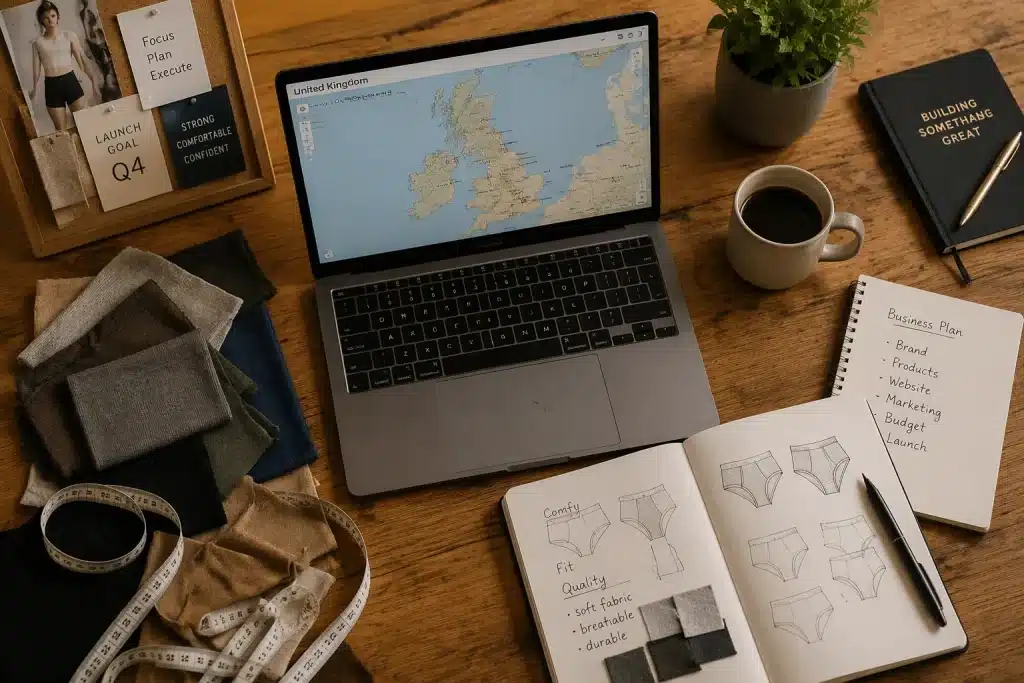
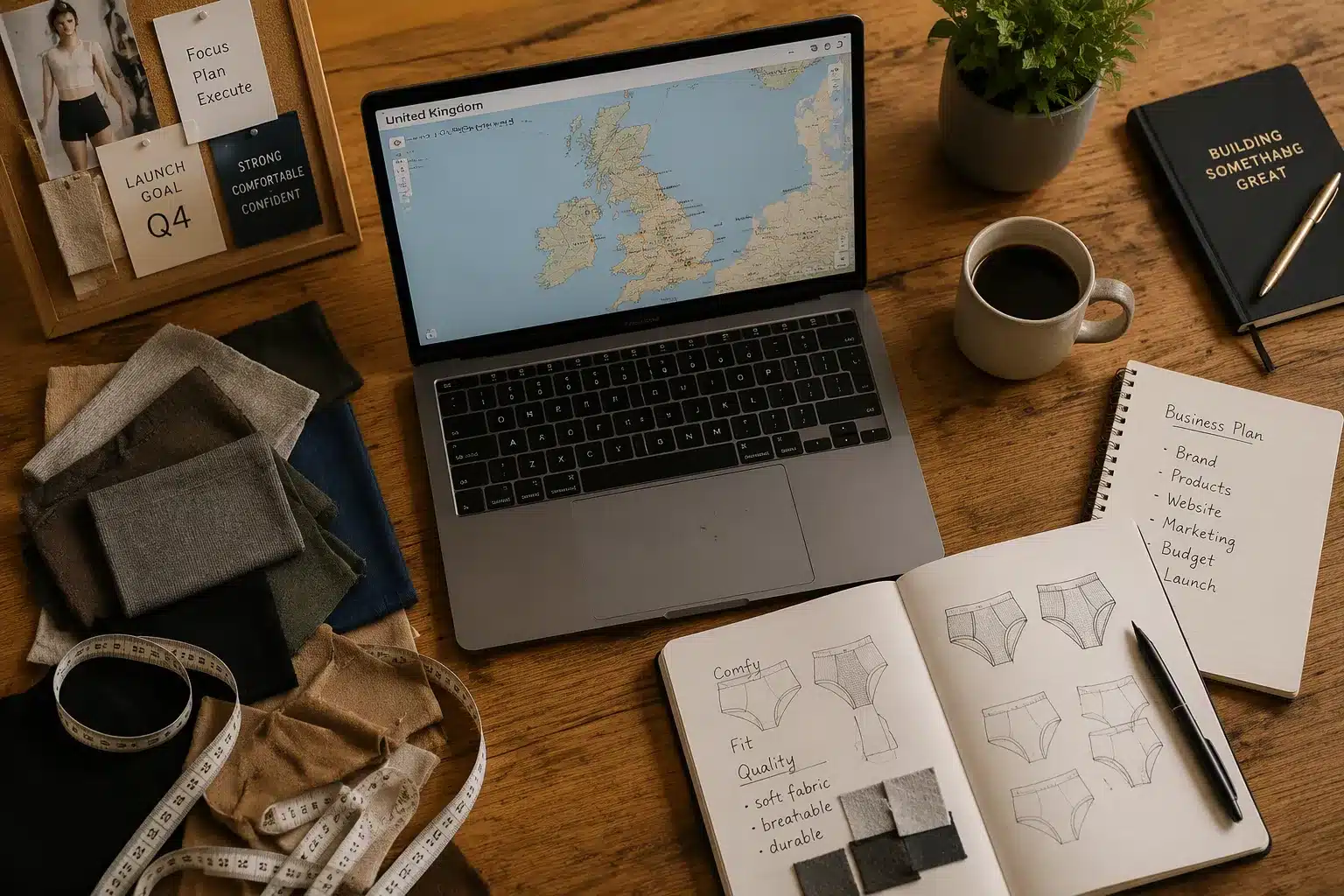
So you want to set up an underwear business? Here’s the short version. You’ll define your audience, write a plan, build your branding, research the market, design your line, pick fabrics, find manufacturers, understand costs, check compliance, then market and scale.
You can do this alone or with a small team. A clear plan matters more than a big budget. Expect a few months from first idea to first sale, and longer if you order custom stock overseas.
Follow the steps in order. Don’t jump straight to manufacturing. Get the early decisions right first, then talk to private label underwear manufacturers uk/ own brand mens underwear uk suppliers about samples.
Key Takeaways
Start by defining your target customer and your brand values. This will guide every decision you make later.
Write a clear business plan that sets out your goals, your budget and where the money will come from.
Make a strong brand name, logo and packaging that stand out.
Look at what other brands are selling and check if people want your product before you buy any stock.
Make a small underwear range that focuses on fit and comfort.
Pick comfy materials such as organic cotton for wearing every day.
Find manufacturers you can trust and agree sample plans in writing.
Know all the costs and begin with a small first order to lower your risk.
Define Your Audience and Values
Find Your Niche
Everyday, Performance or Premium
Start with one clear lane. Everyday underwear covers basic cotton-rich styles for daily wear. Performance styles focus on moisture-wicking fabric for gym and sport. Premium styles lean on finer materials and sharper design. Each lane needs a different price point and a different customer.
Pick the lane you can defend. A crowded market rewards a sharp angle. Ask yourself what you’d wear every day. Your answer often points to your niche.
Size Range and Fit
Decide your size range early. Most UK brands start with small to extra large. Wider ranges cost more to stock. They also win loyal customers who struggle to find a good fit.
Fit matters more than anything else. A pair that rides up or digs in loses a customer for good. Test your chosen fit on real bodies before you commit to production.
Set Your Brand Values
Comfort, Sustainability and Design
Your values shape every choice you make. Comfort comes first for underwear for men. Nobody buys a second pair that feels wrong. Sustainability can mean recycled yarns or durable construction. Design covers colour, cut and waistband detail.
Write three values down. Keep them short. Use them to judge every sample and every supplier quote.
Build a Customer Profile
Sketch one person who buys from you. Give them an age, a job and a reason to care. Maybe he’s a 32-year-old office worker who hates visible seams. Maybe he’s a runner who wants boxer briefs that stay put.
Now list where he shops and what he pays. This profile guides your pricing, your photos and your launch channels. It also tells you which men’s underwear brands you compete with.
A clear target audience makes every later decision easier. You’ll know which styles to sample and which to skip. You’ll also know what to ask manufacturers about logos, labels and sample plans when you get there.
Write Your Business Plan
A good plan keeps you honest. It turns a vague idea into something you can check against reality. Write it before you spend money on samples.
Your plan needs a few core parts. Work through them in order:
Business presentation: your name, legal structure (a private limited company registered in England and Wales is common), location, concept and founding team.
Market analysis: your target market and the competitors you’ve studied.
Commercial strategy: your product range, pricing and sales approach.
Operational plan: day-to-day operations, suppliers and processes.
Financial plan: profit and loss projections, cash flow forecasts and key performance indicators.
Add an executive summary, a management structure, marketing and sales strategies, and your funding requirements. That’s the full set.
Set Goals and Milestones
Give yourself dates. A launch date, a first restock date, a break-even target. Keep each one realistic and written down.
Milestones work better than vague ambitions. “Approve final samples by month three” beats “get samples sorted soon”. You can tick a milestone off. You can also see when you’re slipping.
Set product launch quantities here too. Decide how many units of each style you’ll order first. Small is fine. A tight first run tests demand without tying up your cash.
Choose a Revenue Model
Most new underwear brands sell direct through their own website. That gives you control over pricing, photos and customer data. Wholesale to shops brings volume but thinner margins. Some brands run both.
Think about your price point. Your model has to cover fabric, manufacturing, shipping, payment fees and marketing. If the numbers don’t work on paper, they won’t work in real life.
You might also plan a small overseas trial run. If so, say so in the plan. Note what you’ll need for it: samples, logo waistbands, care labels and compliance paperwork. Clear boundaries beat vague hopes.
Plan Your Budget and Funding
List every cost you expect before launch. Production, materials, packaging, website build, photography, ads and any legal setup fees. Add a buffer for the things you’ve forgotten, because you will forget something.
Then work out where the money comes from. Savings, a small loan, a grant, or pre-orders. Match your spending to your funding. Don’t commit to a big order before you know the cash is there.
Your financial plan should cover profit and loss, cash flow and your key numbers. Review it monthly once you launch. A plan you never open is just decoration.
Build Your Branding and Packaging
Name, Logo and Identity
Your name does a lot of work. It has to be easy to say, easy to spell and easy to find online. Check the Companies House register before you fall in love with a name. Then check the domain and the social handles. A great name you can’t secure is no use.
Your logo should look sharp on a waistband, which is tiny. Fine detail disappears at that size. Test your design at small scale before you approve it. Pick two or three brand colours and stick to them across your site, your packaging and your photos.
Think about the feeling you want. Calm and minimal? Bold and sporty? Your identity should match the values you wrote down earlier. A consistent look builds trust fast for a new underwear brand.
Design Your Packaging
Packaging is the first physical touchpoint your customer gets. A plain poly bag feels cheap. A well-designed box or mailer feels like a gift. You don’t need to spend a fortune, but you do need to be deliberate.
Decide how each pair ships. Will you fold it into a printed sleeve, a box or a compostable mailer? Add a swing ticket with your story and care guidance. Keep the outer mailer sturdy enough to survive the post.
Order packaging samples before you commit to a print run. Check the colours against your brand palette. Confirm the sizes fit your folded product. Small errors here get expensive at volume.
Meet UK Labelling Rules
UK law requires you to state the textiles a garment is made from. Every material must appear on the label. You must give an exact percentage for any material that makes up more than 15% of the product’s total weight.
Requirement | Detail |
|---|---|
Fibre content | List every textile used in the garment |
Percentage threshold | Exact percentage needed above 15% of total weight |
Protected terms | ‘100%’, ‘pure’ and ‘all’ only if one textile throughout |
Permitted tolerances | Up to 2% for natural wool impurities or anti-static treatments |
Non-textile parts | Elastic, buttons and badges don’t affect protected-term status |
Packaging option | Swing tickets or packaging can carry fibre composition |
A few other points are worth knowing. Country of origin isn’t legally required on clothing in the UK, but you must not mislead buyers about it. Size labels aren’t mandatory either, and no single sizing standard applies. Wash care labels aren’t required by law, yet leaving them out can leave you liable for damage from incorrect washing.
If you plan a small overseas trial run, settle labels and compliance documents with your manufacturer early. Ask what they provide for fibre content, care symbols and packaging artwork. Get it in writing before you pay a sample fee. That keeps your business on solid ground from the first order.
Research the Market
Study Competitors and Pricing
Spend a weekend studying the men’s underwear brands you already know. Buy a few pairs. Wear them. Wash them. Note what feels good and what annoys you after a day. That’s real market research, and it costs less than a focus group.
Now look at how they sell. Check their websites, their photos and their reviews. Read the one-star reviews closely. They tell you what customers hate: seams that itch, waistbands that roll, sizing that runs small. Your brand can win by fixing one of those problems well.
Pricing needs the same care. Build a simple pricing strategy around your costs and your position. Note what rivals charge for a three-pack, then work backwards to see if your numbers fit. Don’t copy a price blindly. A premium price needs premium fabric and sharp presentation behind it.
Validate Demand Early
Don’t build a full range on a hunch. Test the idea first. Set up a simple landing page with your concept and a email sign-up form. Run a small ad campaign. Count the sign-ups. A steady trickle of interest beats zero, and it tells you the idea has legs.
Talk to people too. Ask friends, gym mates and colleagues what they’d pay for a better pair of underwear. Listen for the moment they complain about something specific. That complaint is your opening.
If you’re weighing a small overseas trial run, plan it with clear boundaries. Decide the sample quantity, the logo waistband plan, the care labels and the compliance documents before you commit. Ask the factory what they supply and what you must arrange. Get it in writing. A tight trial order tests the supply chain without sinking your budget.
Gather Customer Feedback
Feedback is the cheapest product development you’ll ever get. Send early samples to a handful of people in your target audience. Ask three questions: how does it fit, how does it feel, and would you buy another pair? Keep the questions short and the group small.
Watch for patterns. One person disliking a waistband is taste. Five people mentioning it is a design flaw. Fix flaws before your first production run, not after.
The underwear industry rewards brands that listen. Log every comment in a simple spreadsheet. Sort them by style and by issue. Then take that list back to your manufacturer when you discuss the next sample round. Your customers will tell you what to build next, if you ask them properly.
Design Your Underwear Line
Choose Styles and Fits
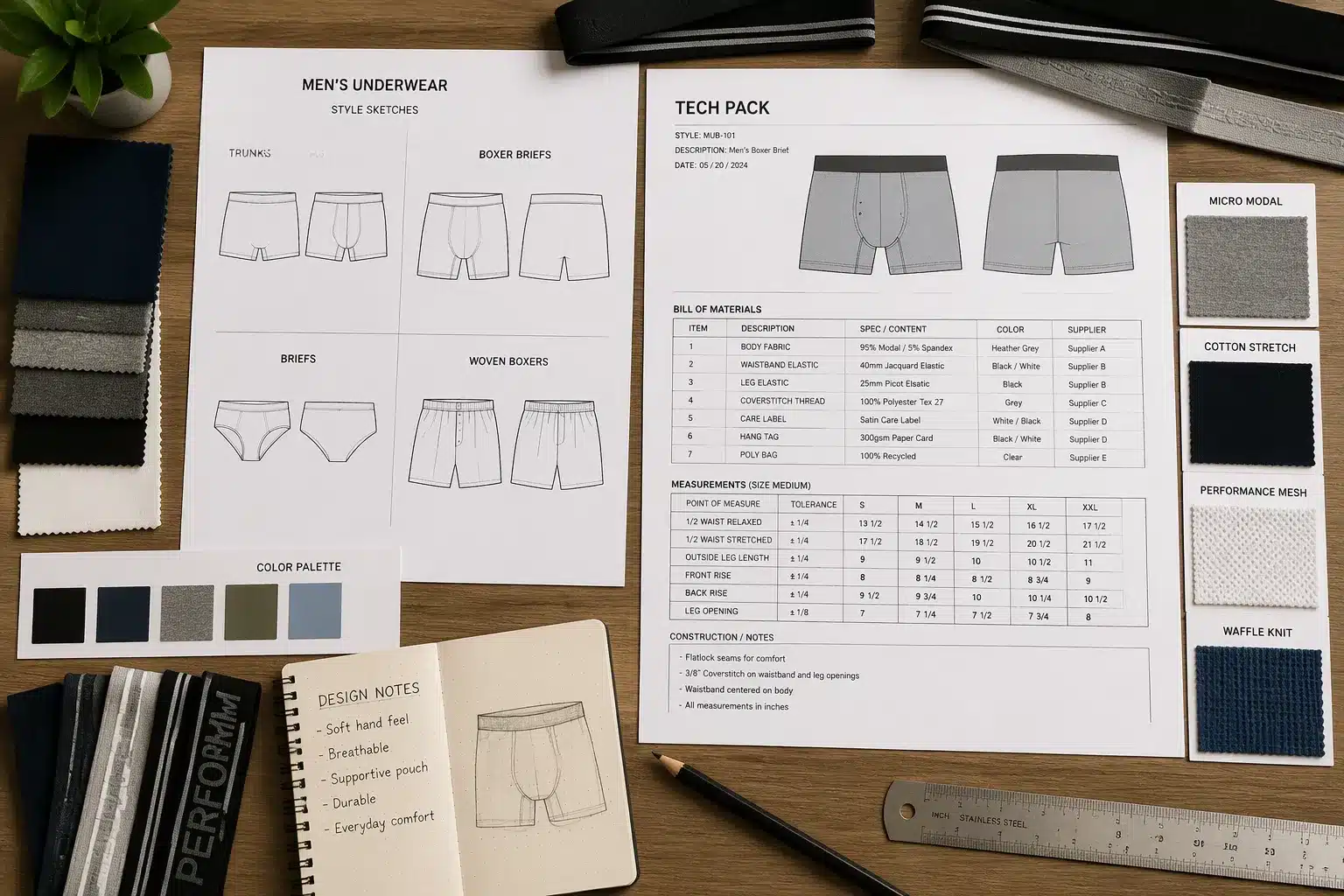
You’ve got your niche and your customer profile. Now it’s time to design the actual underwear line. Start with the styles. Most UK men keep more than one style in rotation, so pick a small range that covers the basics well.
Style | Fit | Leg Length | Feel | Best Use |
|---|---|---|---|---|
Trunks | Fitted | Short | Close and streamlined | Everyday wear, slim trousers |
Boxer Briefs | Fitted | Medium to long | Secure with more coverage | Everyday, work, active use |
Briefs | Fitted | No leg | Light and close fitting | Warm weather, slim clothing |
Woven Boxers | Loose | Medium | Relaxed and roomy | Lounging, sleeping, relaxed wear |
Trunks suit a modern, streamlined look. Boxer briefs give more thigh coverage with a fitted feel. Briefs skip the leg fabric entirely. Woven boxers stay loose and traditional.
Flattering cuts and comfort are your design priorities. A pair that looks sharp but rides up will not sell twice. Test every cut on real bodies before you commit.
Create Tech Packs
A tech pack is the document your factory builds from. Get it right and the sample comes back close to your vision. Get it wrong and you’ll burn weeks on revisions.
Your pack needs a cover page with front and back flats. Add your minimum order quantity and the size breakdown. List every fabric, trim and elastic in a bill of materials, with fibre percentages and fabric weight where you know it. Specify colours with Pantone references. Build a measurement spec with tolerances, graded across the size run. Add construction notes for seams, topstitching and bartacks. Include your label and swing tag designs with legal requirements. Finish with a checklist before you send it.
A tech pack includes a cover page and flats, bill of materials, measurement spec with tolerances, colourways with Pantone references, construction notes, and label and packaging specifications.
Pay extra attention to elastic application, seam placement and fabric stretch direction. These three details decide whether your boxer briefs feel right or wrong.
Plan Your Sampling Order
Here’s the sequence that saves you money. Follow it in order and you’ll avoid reworking the same sample five times.
Approve the base sample first. Check the cut, the seams and the feel.
Confirm sizing next. Sign off the size run and the grading.
Add logo waistbands once the fit is locked.
Approve care labels and fibre content labels after that.
Sign off packaging last, once the product is final.
This order matters most when you’re planning a small overseas trial run. Samples first, then size confirmation, then logo waistbands, then care labels, then packaging. Each step depends on the one before it. Changing a waistband before you’ve confirmed the fit wastes money.
Set clear trial boundaries too. Decide your sample quantity, your logo plan, your label requirements and your compliance documents before you commit. Ask the factory what they supply and what you must arrange. Get it in writing. That way you create your own underwear line without guessing, and nobody implies the product is made in Britain when it isn’t.
Budget time for sampling. Most cut-and-sew manufacturers deliver first samples in three to six weeks from an approved tech pack. Complex styles can take six to eight weeks. Plan for at least one revision round before you approve a final sample.
Aim for a tight first underwear collection. Two or three styles, each in a few colourways, beats a sprawling range. Your boxer briefs will likely carry the line, so give them the most attention. Get the fit and the fabric right on those, and the rest follows.
Quality shows in the details. A smooth waistband, flat seams and a soft fabric make the difference between a pair he wears once and a pair he buys again. Build your samples around that standard.
Select Fabrics and Materials
Compare Underwear Fabrics
Comfort comes first. Men’s underwear should feel smooth on the skin, pull sweat away and let air flow through. If you get this wrong, nothing else can fix the product.
The fabric you pick controls all three. Here is how the main options compare:
Fabric Type | Breathability & Comfort | Recommendation |
|---|---|---|
Synthetic (polyester, nylon, acrylic) | Holds sweat and moisture in, which causes rubbing, soreness and bacterial growth | Avoid for hot/summer conditions |
Organic cotton | Pulls moisture away naturally, lets air through, good for sensitive skin, made without pesticides or synthetic fertilizers | Top choice for men’s boxers and trunks |
Organic cotton wins for everyday wear. It breathes, it wicks and it suits sensitive skin. Synthetics have their place in performance styles, but they trap sweat in heat. Choose with your niche in mind.
Balance Comfort and Cost
Premium fabric costs more per unit. That’s fine if your price point carries it. Work out your fabric cost per pair before you agree to a supplier quote.
Don’t swap comfort for savings. A cheaper yarn that pills or loses shape will cost you repeat customers. Your boxer briefs should feel good on day one and day fifty.
Longer trunks made from breathable organic cotton offer more coverage and are noted to reduce chafing and irritation because they sit lower on the leg, staying in place without rolling up or bunching under trousers.
That’s the standard to aim for. Judge every fabric against it.
Source Fabrics and Trims
You’ll need fabric, elastic, thread and labels. Ask your manufacturer what they keep in stock and what you must supply. Many factories hold organic cotton in common weights, which keeps sampling quick.
Order fabric swatches before you approve a sample. Feel the stretch, check how it springs back and wash a piece to see how it behaves. Note the fibre percentages for your labels at the same time.
If you’re planning a small overseas trial run, set clear limits now. Decide your sample quantity, your logo waistband plan, your care labels and your compliance documents before you commit. Ask the factory what they supply and what you must arrange. Get it in writing. Nobody should suggest the product is made in Britain when it isn’t.
A proper restock of your underwear line starts with quality fabrics and flattering cuts. Lock both in early. Your fit, look, breathability, support and value for money all come back to this decision. Get the fit and fabric right on your boxer briefs, and the rest of the underwear line follows. That’s how you build underwear for men that earns a second order.
Find the Right Manufacturers
UK Versus Overseas Production
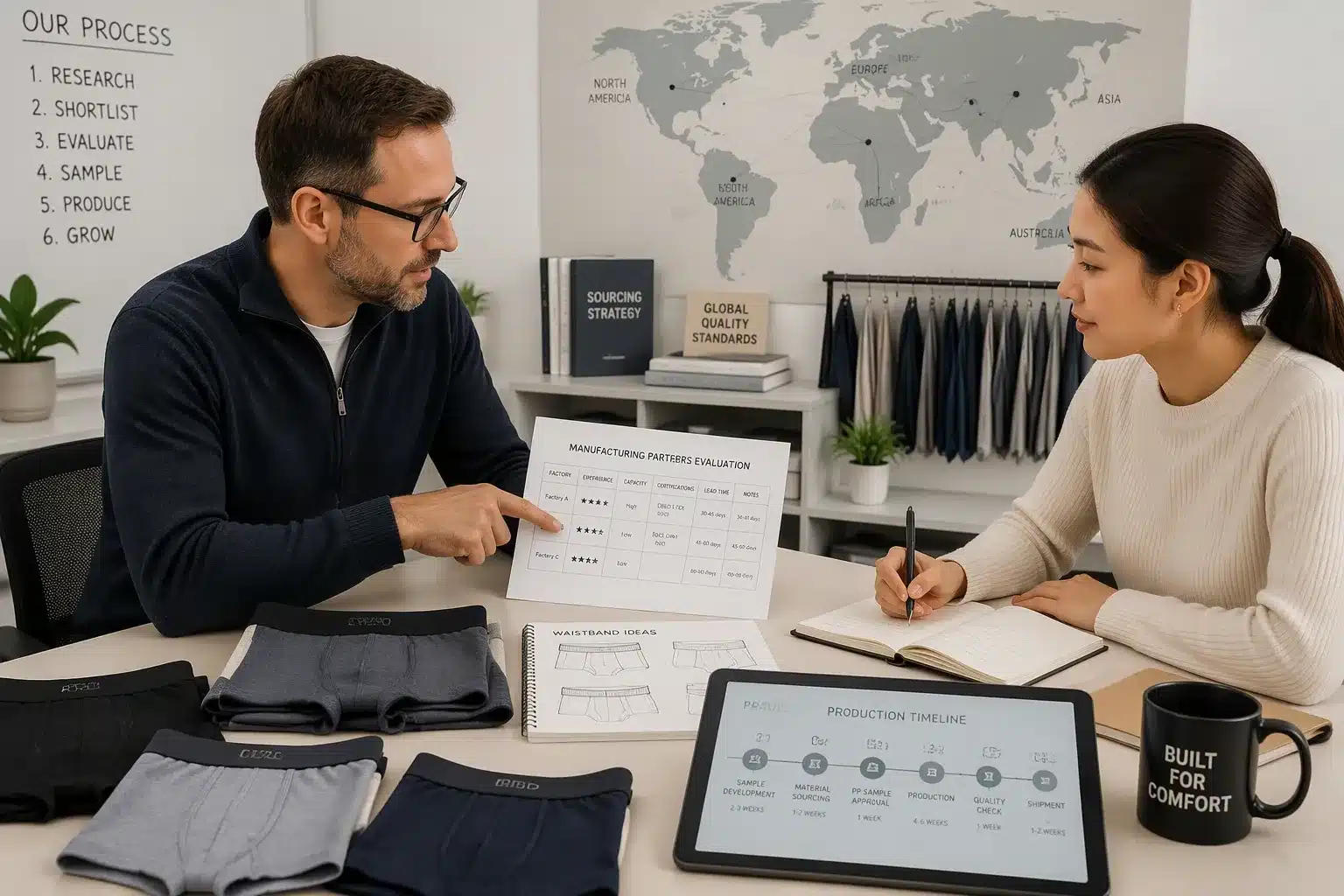
Where you make your underwear affects your costs, your lead times and how flexible you can be. UK production means short shipping times and easy factory visits. Overseas production often gives lower unit costs when you order in higher volumes. Neither option is better in every case. Your order size and your timeline should guide the choice.
Lots of founders ask whether overseas OEM can make small-batch private label men’s underwear. The honest answer is yes, within limits. Many factories will run a trial order, but they set a minimum. That minimum is usually higher than a UK supplier’s. Ask each factory directly what their smallest trial run looks like. Get the answer in writing before you plan anything.
Set clear trial boundaries from the start. Decide your sample quantity, your logo waistband plan, your care labels and your compliance documents before you commit. Ask the factory what they supply and what you must arrange. Nobody should suggest the product is made in Britain when it isn’t.
Three Production Paths
You’ve got three routes into production. Each one suits a different stage of your business.
Path | What It Involves | Where It Fits Best |
|---|---|---|
Small-batch trial | A short run of stock styles with light branding | Testing demand before you commit real money |
Light customisation | Stock blanks with your labels, waistband and packaging | Brands with a clear look but a tight budget |
Full customisation | Your own patterns, fabrics and construction | Founders ready to build a distinct product |
A small-batch trial keeps your risk low. You order a modest quantity, sell it, and learn what works. Light customisation lets you put your stamp on a proven product without paying for new patterns. Full customisation gives you a product nobody else sells, and it costs the most.
Private label underwear manufacturers uk/ own brand mens underwear uk suppliers sit across these paths. Some focus on light customisation and quick turnarounds. Others take on full custom builds. Match the supplier to the path you’ve chosen, not the other way round.
Vet and Shortlist Suppliers
Shortlist three to five manufacturers. Then check each one properly. Ask for references from brands they’ve worked with. Request their sample lead times and their minimum order quantities.
The MOQ picture varies widely. Wholesale HQ states that it imposes no minimum order quantity and no minimum order value, so you can order only what you need. That Designer Wholesale describes flexible minimum order quantities built for small independents and multi-location retailers alike, with orders starting from a few boxes and scaling to full container volumes. Hawthorn advertises the lowest MOQ in the UK for fully custom clothing, starting from 50 pieces per design, though specific colour and fabric choices may shift that figure.
Ask about quality control too. A good manufacturer welcomes the question. Check how they handle a failed sample and who pays for the rework. Confirm their communication style early. You’ll be talking to them for months.
When you create your own underwear line, the factory becomes your closest partner. Treat the shortlist like a hiring decision. A responsive supplier with a clear process beats a cheaper one who goes quiet for a week. Your boxer briefs will only be as good as the production behind them, so choose with care.
Understand Your Costs
Confirm First-Order Conditions
Before you pay a deposit, make the terms of your first order clear. Start with sample approval. You should approve the final sample in writing. That sample becomes the benchmark for the whole run.
Next, confirm the size breakdown. Agree the mix of small, medium, large and so on. Then lock your packaging sign-off. Approve the artwork, the colours and the folded sizes. Get all three confirmed before production begins.
If you’re running a small overseas trial, set the limits now. Decide your sample quantity, your logo waistband plan, your care labels and your compliance documents. Ask the factory what they supply and what you must sort out. Put it in writing. Nobody should suggest the product is made in Britain when it isn’t.
Unit Costs, MOQs and Lead Times
Ask for a full cost breakdown, not one single figure. You want the fabric cost, the cut-and-sew charge, the trims and the packaging, each listed on its own. That breakdown shows you where to cut and where not to.
Minimum order quantities vary a lot. Wholesale HQ states it sets no minimum order quantity and no minimum order value. Hawthorn advertises the lowest MOQ in the UK for fully custom clothing, starting from 50 pieces per design. Ask each supplier for their smallest trial run in writing.
Lead times need the same clarity. Most cut-and-sew factories deliver first samples in three to six weeks from an approved tech pack. Add time for one revision round. Then add production and shipping on top. Build that timeline into your launch date.
Write a Clear RFQ
A request for quotation gets you answers you can compare. Send the same document to every shortlisted supplier. Vague emails get vague replies, and vague replies hide real production costs.
RFQ Item | What to Specify |
|---|---|
Styles and quantities | Each style, colourway and size ratio |
MOQ | Your target first order and your ceiling |
Sample fees | Whether refundable, and against what order value |
Inspections | Who checks the goods, and at which stage |
Lead times | Sample, bulk production and delivery dates |
Labels and compliance | Fibre content, care labels, packaging artwork |
Add your logo waistband requirements and your packaging specs. Ask what the supplier provides for compliance documents. Then compare quotes side by side, not one at a time.
Good quality comes from clear briefs. A supplier who answers every line shows they’ll back you properly. That’s the partner your underwear business needs.
Check Compliance and Responsibility
Textile Labelling and Care
UK law sets the rules on fibre content. Every textile in the garment must appear on the label. You need an exact percentage for any material above 15% of the product’s total weight. Protected terms like “100%”, “pure” and “all” only apply when one textile runs throughout.
Working with an overseas OEM makes this step easier to get wrong. Ask your factory for the fibre composition in writing before you approve samples. Then check it against your own fabric records. Confirm who prints the care labels and who pays for a reprint if the wording is wrong. Wash care labels aren’t legally required in the UK, but leaving them out can leave you liable for damage from incorrect washing. Put care symbols on every pair anyway.
Product Safety Basics
Your underwear has to be safe for normal wear. Check that dyes and finishes suit skin contact. Ask your supplier for test reports on the materials they use. Keep the reports on file for each fabric and trim.
General product safety rules apply to clothing sold in the UK. You must not place unsafe goods on the market. Elastic, threads and waistbands all count as part of the product. Confirm your factory inspects each batch before it ships. A simple check at the sample stage catches most problems early.
Keep your approved sample as the reference standard for every later batch.
Keep Records in Order
Good records protect you if a customer or a trading standards officer asks questions. Build a simple folder for each style. Store the tech pack, the approved sample photos, the fibre composition, the test reports and the packaging artwork in one place.
Overseas production adds distance, so paperwork matters more. Ask your manufacturer which compliance documents they supply and which you must arrange. Get the answer in writing before you pay a deposit. Log every label version with a date. That way you can trace any pair back to its batch, and your records support the claims you make on your packaging.
Market and Scale Your Brand
Launch Channels and Early Sales
You’ve got stock. Now you need buyers. Start with your own website. It gives you full control of pricing, photos and customer data. Add one marketplace to widen the net. Plenty of shoppers discover new men’s underwear brands through search and social ads, so keep a small budget for both.
Launch with a clear offer. A single-style drop beats a scattered range. Push your boxer briefs first. They’re the easiest sell and the strongest hook. Set a simple goal for the first month, like a set number of orders or email sign-ups. Track it weekly and adjust as you go.
Don’t wait for perfect photos. Good light and a clean background beat an expensive studio. Ship fast and answer questions fast. Early sales come from trust, not polish.
Build a Community
People buy underwear from brands they trust. Trust grows from conversation, not ads. Share your design process. Post the sample that failed. Show the waistband you rejected. That honesty pulls your target audience closer.
Answer every comment and every email early on. Ask buyers what they’d change. Run a quick poll on the next colourway. Small gestures build real support over time. A customer who feels heard comes back, and he tells a friend.
Keep the tone human. Reply in your own voice. Skip the corporate script. Your community will spot the difference in a second.
Plan for Growth
Write your marketing plan before you scale. Decide which channel gets the next chunk of budget. Set a restock trigger, which is a stock level that tells you to reorder. Watch your repeat purchase rate. It tells you more about comfort and fit than any review.
If you’re weighing a small overseas trial, set the boundaries first. Fix your sample quantity, logo waistband plan, care labels and compliance documents before you commit. Ask the factory what they supply and what you must arrange. Get it in writing. Nobody should hint the product is made in Britain when it isn’t.
Growth also means widening the underwear line carefully. Add one style at a time. Test it on your existing customers first. A measured step protects your cash and your reputation. Every underwear brand faces that same choice: rush the range or build it slowly. Pick slowly. That’s how a young label turns a good first run of boxer briefs into a business that lasts.
Request a Private-Label Sample Plan
You’ve shortlisted your factories. Now ask each one for a private-label sample plan. This is a short written document. It sets out what they’ll make, what it costs and what you must supply. A good plan removes guesswork before you pay a penny.
What to Ask First
Send the same request to every supplier. Ask for the sample styles, the sample fee and whether that fee comes off a later bulk order. Request the sample lead time and the smallest trial run they’ll accept. Then ask who supplies the logo waistband, the care labels and the fibre content documents. Get every answer in writing.
This is where the overseas question usually lands. Plenty of founders ask whether an overseas OEM can run a small private-label batch. The answer is often yes, within limits. Ask each factory for their smallest trial quantity and their logo and label process. Set clear boundaries: sample quantity, waistband plan, care labels and compliance paperwork. Confirm what they provide and what you arrange. Nobody should imply the product is made in Britain when it isn’t.
Compare Sample Plans
Lay the replies side by side. A table keeps it honest and stops you comparing from memory.
What to Compare | Why It Matters |
|---|---|
Sample fee and refund terms | Shows the real cost of testing |
Smallest trial quantity | Tells you how much cash you risk |
Sample lead time | Sets your launch date |
Logo and label handling | Reveals who does the fiddly work |
Compliance documents | Shows what you must arrange yourself |
No single plan wins on every line. A low sample fee with a high trial quantity suits a founder with capital ready. A higher fee with a tiny trial run fits a cautious first drop. Private label underwear manufacturers uk/ own brand mens underwear uk suppliers sit across that range, so match the plan to your budget and your timeline.
Read each plan for clarity too. A supplier who answers every line will support you through production. Ask one follow-up question and watch how fast they reply. That tells you more than any brochure. Compare two or three underwear plans, pick the one that fits, and move to sampling with confidence.
Avoid Common Mistakes
Skipping Market Research
Plenty of founders fall in love with their idea and skip the boring bit. They order stock, build a site, then wonder why nobody buys. Don’t be that founder. Proper market research takes a weekend, not a month, and it saves you a fortune.
Buy a few pairs from rival brands. Wear them, wash them, and note what irritates you after a full day. Read the one-star reviews on their sites. Those reviews hand you a list of problems you can fix. Ask ten people in your target group what they’d pay for a better pair. Their answers will sharpen your pricing and your fit choices fast.
Underestimating Costs
New founders usually budget for the obvious things. Fabric, manufacturing, a website. Then the small costs arrive and eat the margin. Photography, ads, payment fees, packaging samples, reprint charges for a wrong care label. Each one looks tiny alone. Together they add up.
Build your budget from a full list, then add a buffer on top. Get a written quote that breaks out fabric, cut-and-sew, trims and packaging separately. That breakdown shows you where to trim and where cutting corners will hurt. If you plan a small overseas trial, fix your sample quantity, logo waistband plan, care labels and compliance documents before you commit. Ask the factory what they supply and what you arrange. Get it in writing, and never let anyone hint the product is made in Britain when it isn’t.
Overordering Stock
A big first order feels efficient. Lower unit costs, fewer reorders, a fuller-looking shop. It also ties up your cash in stock you haven’t sold yet. If a style flops, that money sits in a warehouse.
Start small and test demand. Order a modest first run of your underwear line, sell it, then restock what works. Watch your boxer briefs closely, since they usually carry the range. A tight trial protects your cash and your comfort with risk. It also gives you real feedback before you scale.
Treat your first order as a test, not a bet. Confirm sample approval, size breakdown and packaging sign-off before production starts. Then let sales tell you what to do next. That measured approach gives you the support you need to grow without gambling the business on one guess.
You’ve now got the full route map. Define your audience, write your plan, build your branding, research the market, design the line, choose fabrics, find manufacturers, understand costs, check compliance, then market and scale. That’s a lot of steps. Each one makes the next easier.
A measured approach keeps your risk low. You test demand before you order stock. You approve samples before you pay for production. That discipline builds a stronger underwear brand than any big launch budget.
So what’s next? Finish your business plan this week. Then send the same sample request to your shortlisted manufacturers. Compare the replies side by side, pick the plan that fits your budget, and start sampling. Your first pair of underwear is closer than you think.
FAQ
Can an overseas OEM make small-batch private-label men’s underwear?
Often yes, within limits. Ask each factory for their smallest trial quantity in writing. Many set a minimum higher than a UK supplier’s. Fix your sample quantity, logo waistband plan, care labels and compliance documents before you commit. Confirm what they supply and what you arrange.
What should I confirm before paying a sample fee?
Get the fee and its refund terms in writing. Ask whether it comes off a later bulk order. Confirm the sample lead time and who supplies the waistband, labels and fibre documents. A supplier who answers every line will support you through production.
How long does sampling take?
Most cut-and-sew factories deliver first samples in three to six weeks from an approved tech pack. Complex styles can take six to eight weeks. Plan for at least one revision round before you approve a final sample.
What order should I approve samples in?
Approve the base sample first. Confirm sizing next. Add logo waistbands once the fit is locked. Approve care and fibre labels after that. Sign off packaging last. Each step depends on the one before it, so changing a waistband early wastes money.
Do I need care labels on UK underwear?
Wash care labels aren’t legally required in the UK. Leaving them out can still leave you liable for damage from incorrect washing. Fibre content is different: you must list every textile and give an exact percentage above 15% of total weight. Put care symbols on every pair anyway.
How do I avoid implying my product is made in Britain?
Say plainly where each pair is made. Country of origin isn’t legally required on UK clothing, but you must not mislead buyers. Brief your factory and your packaging designer in writing. Check every label and listing before it goes live.
What is the biggest mistake new founders make?
Overordering. A big first run feels efficient and ties up your cash. Start with a modest trial, sell it, then restock what works. Watch your boxer briefs closely, since they usually carry the range. Let sales tell you what to do next.
How many styles should my first range include?
Two or three styles, each in a few colourways. A tight first collection beats a sprawling one. Give your boxer briefs the most attention, since they carry most underwear brand launches. Get the fit and fabric right there, and the rest follows.
See Also
Selecting The Best Private Label Men’s Underwear Manufacturer In The UK
A Complete Wholesale Guide To Men’s Underwear For UK Buyers
Choosing A Low-MOQ UK Underwear Manufacturer For Your Own Brand
How To Choose A Private Label Men’s Underwear Manufacturer In 2026
My Search For A Reliable Men’s Underwear Wholesale Supplier In The UK