


Wholesale underwear prices in the UK typically land at a few pounds per piece for basic briefs and multipacks, rising for lace, seamless and plus-size lines. Minimum order quantities vary widely, from mixed cartons to 100 pieces per style.
Online bulk platforms often sit around 20% below market price. Factory minimums commonly start at 100 pieces per style. Treat these figures as indicative and confirm them at quote stage.
This guide compares UK wholesalers, stock suppliers and overseas manufacturers on underwear wholesale UK prices and MOQs, showing where each fits best. It also sets out a practical framework for balancing cost against MOQ, including routes that offer no minimum order for wholesale underwear.
Key Takeaways
UK wholesale underwear prices start at a few pounds per piece for basic styles.
Factory-direct prices from China range from $2 to $5 per piece for thongs.
UK stock suppliers offer low MOQs, sometimes with no minimum order.
Overseas factories typically require 100 pieces per style as a minimum.
UK restocking is fast and low-risk, ideal for testing new ranges.
China OEM offers lower unit costs and customisation at higher volumes.
Always compare landed cost, not just unit price, when choosing a supplier.
Confirm MOQ and wholesale price in writing before placing any order.
Quick Answer: UK Restocking Versus China OEM
Here’s the short version. UK restocking means buying stock that already sits in a British warehouse. China OEM means commissioning production overseas to your own specification. They solve different problems, and the numbers below show why.
Price and MOQ Ranges at a Glance
Trade Prices by Product Type
Indicative trade bands, to be confirmed at quote stage:
Product type | Indicative trade price |
|---|---|
Basic briefs and multipacks (UK stock) | A few pounds per piece |
Lace, seamless and shaping lines (UK stock) | Higher, reflecting fabric and construction |
Factory-direct thongs (China OEM) | Typically $2–$5 per piece |
Online bulk platforms | Around 20% below market price |
MOQs by Supplier Type
UK wholesalers often work in mixed cartons, so a buyer can spread a small order quantity across colours and sizes. Some suppliers accept very small runs; others want bulk. Overseas factories commonly start at 100 pieces per style, and typical clothing minimums run from 50 to 500 pieces per style or colourway. Always confirm the minimum order quantity and wholesale price before purchasing.
When UK Restocking Fits Best
Low MOQs and Fast Replenishment
Need stock on the shelf this week? UK restocking wins. Goods are already in the country, so there’s no sea freight, no customs clearance and no import paperwork. Low MOQs let a small shop top up a bestseller without tying up cash. That speed matters when a style suddenly sells out.
Testers and Small Ranges
Testing a new range? UK stock is the low-risk route. A buyer can order a handful of styles, see what moves and reorder fast. Some platforms even offer no minimum order, which suits market stalls and pop-up shops. The trade-off is narrower choice and less control over design.
When China OEM Fits Best
Lower Unit Costs at Volume
Factory-direct pricing drops sharply once volumes rise. A thong at $2–$5 per piece looks cheap against UK trade prices, but that rate assumes a real order. Add freight, duty and clearance, and the landed cost climbs. At volume, though, the gap widens in OEM’s favour.
Private Label Scope
Want your own label, fabric and fit? China OEM delivers that. Factories handle pattern work, labelling and packaging to your brief. UK stock can’t match that customisation — you buy what’s on the shelf. Remember the origin point: OEM goods are made overseas, not held as UK stock, so plan lead times and import documents accordingly.
Wholesale Underwear Prices by Product Type
Not every line carries the same tag. Fabric, construction and pack format all move the number, so it pays to know where each style sits before you build a range.
Basics and Multipacks
Briefs, Thongs and Everyday Lines
Basic briefs and everyday knickers are the cheapest entry point in underwear wholesale UK catalogues. UK stock lines often land at a few pounds per piece, and that figure holds steady across colours because the construction is simple. Factory-direct thongs sit at roughly $2–$5 per piece, though that rate assumes an overseas order rather than goods already sitting in a British warehouse.
Three-Pack and Five-Pack Pricing
Multipacks change the maths. A three-pack or five-pack spreads packing, labelling and handling across several garments, so the price per garment drops against buying singles. Retailers also sell packs faster, which improves turnover. Ask suppliers for both single-unit and pack prices — the gap often surprises first-time buyers.
Everyday and Fashion Lines
Cotton, Modal and Microfibre Blends
Cotton sits at the affordable end. Modal and microfibre blends cost more because the yarn is dearer and the fabric needs gentler handling on the line. Expect prices to climb as the blend gets softer or more technical. None of this is dramatic per unit, but it adds up across a full size run.
Lace, Seamless and Shaping Styles
Lace, seamless and shaping styles carry the biggest premiums. Lace needs careful cutting and matching. Seamless pieces need specialist knitting machines. Shaping garments use panel construction and firmer fabrics. Each step adds labour and material, and pricing reflects that.
Specialist and Plus-Size Ranges
Sizing Extensions and Cost Impact
Plus-size ranges cost more to produce. Larger panels use more fabric, and grading across an extended size run takes extra pattern work. Some factories charge a supplement for sizes above a certain point. Buyers should confirm this before ordering, because the supplement rarely appears on the first quote.
Niche Fabric Premiums
Niche fabrics push prices higher again. Organic cotton, bamboo blends and recycled yarns cost more at the mill, and smaller dye lots add further cost. These premiums suit brands selling on fabric story rather than price alone.
Minimum Order Quantity by Supplier Type
Supplier type shapes the minimum order quantity more than any other factor. UK stock and overseas production run on different rules, and buyers feel that difference fast.
UK Wholesalers and Stock Suppliers
Per-Style and Per-Colour MOQs
UK wholesalers hold goods in British warehouses, so their minimums stay low. Some ask for 10 units per style. Others set a quantity per size and colour that suits a small shop. A few platforms offer no minimum order quantity at all, which helps market traders and pop-ups. Others want bulk, so check before you commit.
Mixed-Carton Options
Mixed cartons let buyers spread a small order quantity across colours and sizes. That flexibility keeps cash free and shelves full. Stock is already in the country, so replenishment takes days, not weeks. No customs paperwork, no freight bill.
Overseas Manufacturers and OEM Factories
Per-Style Minimums and Colour Surcharges
Overseas factories work differently. Typical clothing minimums run from 50 to 500 pieces per style or colourway. Some factories start at 100 pieces per style. Want a second colour? Expect a surcharge or a separate run. Higher MOQs apply to custom dye lots, and factories quote larger volumes to spread setup costs.
Sampling and Trial Thresholds
Sampling comes first. Factories usually charge for samples, then credit the cost against a confirmed order. Trial thresholds sit above sample level but below full production. Plan for sea freight, duty and import documents here — these goods are made overseas, not held as UK stock.
Stock, Trial Runs and Private Label
MOQ, Replenishment Speed and Risk
Stock means speed and low risk. Private label means control and higher minimum order quantities. A buyer weighing wholesale underwear options should match the route to the goal. Need stock this month? Stay with UK suppliers. Want your own label? Accept the longer lead time.
Matching Order Type to Business Stage
New brands suit low minimums and trial runs. Established brands can commit to bulk and win better unit prices. Either way, confirm the MOQ and wholesale price before purchasing. That single habit prevents most ordering surprises.
What Drives UK Clothing Production Costs and MOQs
Two things move together here: what a garment costs to make, and how many units a supplier will accept. Understand both, and quotes stop feeling like guesswork.
Cost Factors Behind the Price
Fabric, Construction and Trims
Fabric usually eats the biggest share of uk clothing production costs. A soft modal blend costs more at the mill than basic cotton. Construction adds labour — double stitching, gussets and reinforced seams all take time. Trims pile on top: elastic, labels, hooks and packaging each carry a price.
Picture a garment costing £15 to manufacture in the UK. Swap the fabric for a cheaper yarn and the number falls fast. Add lace panels and it climbs. Buyers should ask suppliers to break down prices for uk clothing production line by line.
Volume, Packaging and Incoterms
Volume changes production costs dramatically. Factories spread setup work across more units, so the per-piece figure drops as the order grows. Packaging matters too — a polybag and a swing tag cost little alone, but they multiply across thousands of units.
Incoterms decide who pays freight and where risk passes. An FOB quote looks cheaper than a delivered price, yet the buyer still covers shipping and duty. Compare like with like, or the cheapest quote may prove the dearest.
MOQ Factors Behind the Minimum
Fabric Minimums and Dye Lots
Mills sell fabric in fixed rolls, and dye lots have rules. A factory can’t buy a tiny length of a custom colour, so the minimum order quantity reflects what the mill will supply. Standard colours are easier — they often sit in stock.
Custom shades demand a full dye run. That pushes the moq up and lifts prices for uk clothing production. Ask whether a shade is stock-supported before falling in love with it.
Line Setup and Customisation
Every new style needs pattern work, marker making and a line setup. Factories quote larger volumes to spread those fixed costs across more units. That’s why MOQ and price move together — a bigger order quantity absorbs the same setup over more garments.
Labelling and customisation add another layer. Printed care labels, custom packaging and embroidered logos all need preparation. Note the origin point: these factors apply to made-to-order production, whether in the UK or overseas. Warehouse stock carries no such setup, but it offers no customisation either.
Comparing Suppliers: A Practical Framework
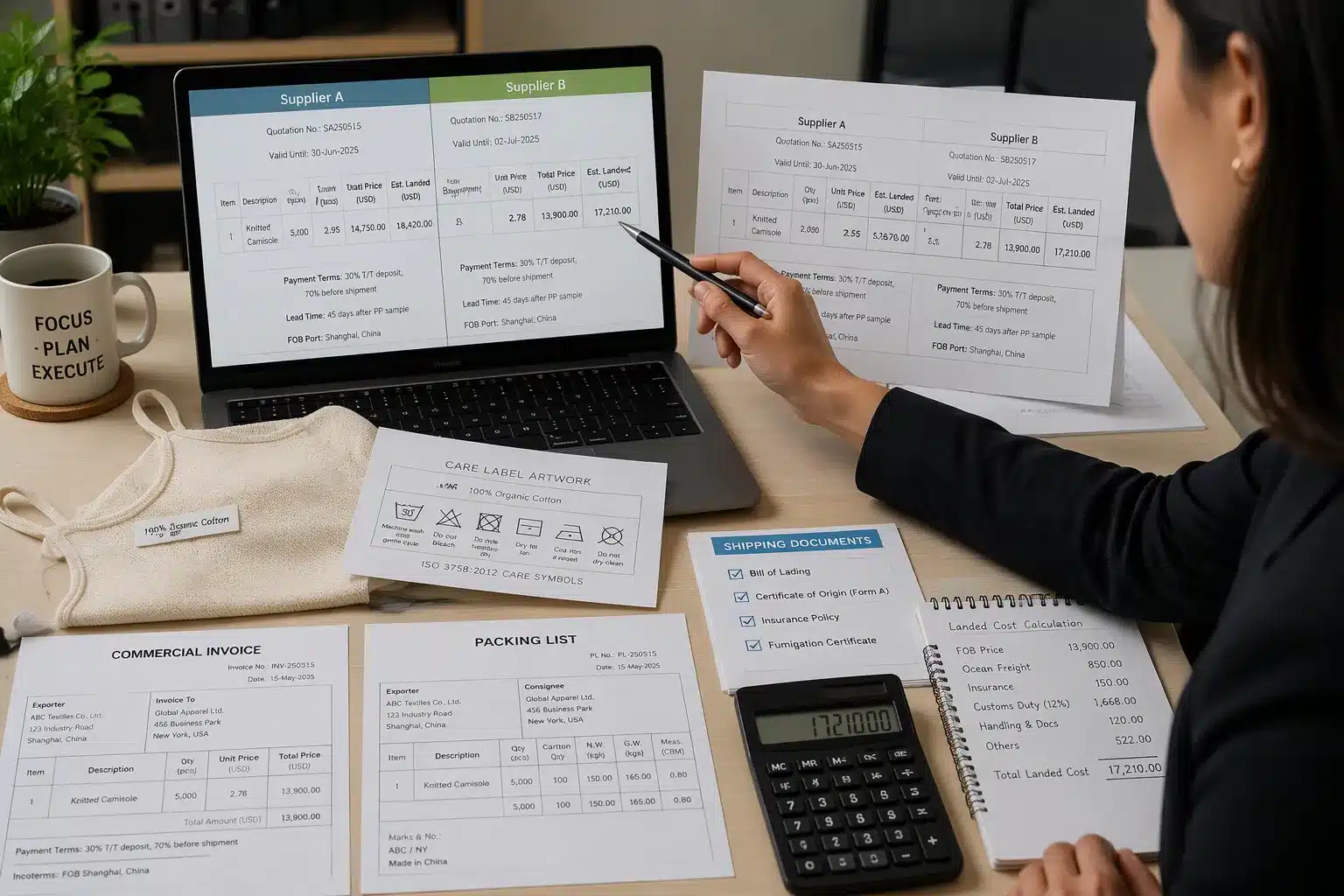
A fair supplier comparison starts with a level playing field. Two quotes only mean something when they cover the same garment, the same terms and the same extras. Otherwise, a buyer ends up comparing apples with swimwear.
Building a Like-for-Like Quote
The RFQ Checklist
A good request for quotation spells out what the price must cover. Ask each supplier to state whether the quote includes labels, packaging, decoration, sample development, inspection, export documentation and delivery. For international sourcing, require the applicable Incoterm and clarify who bears freight, insurance, duties, taxes, customs clearance and destination charges. A factory price alone never reflects the final cost of a sellable product.
Landed Cost Versus Unit Price
Unit pricing looks tidy on a spreadsheet. Landed cost tells the truth. Add freight, duty, clearance and delivery to the factory figure, and the gap between UK stock and overseas OEM often narrows. UK stock already sits in a British warehouse, so those extras mostly vanish. Overseas goods carry them in full. Compare the landed number, not the headline rate.
UK Textile Labelling and Import Checks
Composition, Care and Origin
Fibre composition is a mandatory legal requirement. A knitted camisole, for instance, needs a composition label declared clearly by weight percentage in English, such as “100% Organic Cotton” or “80% Cotton, 20% Polyester”. Care instructions using ISO 3758 symbols are voluntary, unless omission would mislead consumers. Country of origin text such as “Made in UK” follows the same rule. Verify wording on finished garments rather than trusting a supplier’s catalogue.
Documents to Request
Ask for test reports, composition records and care-label artwork before ordering. Overseas OEM shipments also need commercial invoices, packing lists and customs paperwork. UK stock needs none of that import documentation. Agree label placement as part of the product specification — the reverse of the centre-fold neck label or a dedicated satin side-seam label is recommended practice.
Supplier Vetting and Samples
Audit Questions and References
Ask direct questions. Where does production happen? Who handles quality checks? Can the supplier share references from similar buyers? A UK stockist and a Chinese factory will answer very differently, and that’s fine — the point is to know which model you’re buying into.
Sample Rounds and Sign-Off
Run a sample round before committing. Check fit, fabric hand-feel and label accuracy against the agreed spec. Sign off in writing, keep a sealed reference sample, and tie it to the order. That single habit settles most disputes later.
Balancing Cost Against MOQ

Price and minimums pull in opposite directions. Buyers want the lowest unit cost, yet the best rates sit behind bigger commitments. The trick is to grow the order as the evidence grows, not before.
Flexible Wholesale Buying Without Minimum Order Pressure
Test Orders and Mixed Packs
Flexible wholesale buying starts small. A buyer can test a handful of styles through mixed packs, spreading one order quantity across colours and sizes. UK stock makes this easy, because goods already sit in a British warehouse. No customs paperwork, no freight bill, no waiting weeks for a container.
Some platforms even offer no minimum order quantity, which suits market stalls and pop-ups. Others run sample development and very small runs for brands still finding their feet. That low-risk entry point lets a buyer learn what sells before committing real cash.
Negotiating Trial Quantities
Suppliers will often move on a first order. Ask for a trial quantity, then promise a reorder if it sells. A small production run of around 500 pieces can test real demand before scaling toward 50,000 units. That’s the sensible path — prove the style, then grow it.
New brands can start with low MOQs. Established brands place larger bulk orders and win better rates. Neither route is wrong. The right one depends on cash flow and confidence in the range.
Scaling Up Sensibly
Staged Reorders and Continuity Lines
Reorders beat big first orders. A buyer reinvests early profits into new products and advertising, then watches emerging trends before widening the range. Core continuity lines — the plain black brief, the bestselling three-pack — stay in stock and reorder on a rhythm.
Set higher MOQs specifically for reorders. That keeps small repeat orders cost-effective by balancing shipping, customs and logistics costs against volume. It matters most for international retailers with longer lead times.
Consolidating Styles for Price Breaks
Fewer variations mean lower costs. Cutting colourways or product variations lowers manufacturing costs, which helps small brands manage high minimums. Tier the MOQs by style, colour or value too — lower minimums for higher-priced items, higher minimums for cheaper collections.
Strategy | How it scales orders sensibly |
|---|---|
Higher MOQs for reorders | Balances shipping, customs and logistics against volume |
Tier MOQs by style or value | Lower minimums on premium items, higher on cheap lines |
Consolidate styles and colours | Fewer variations cut manufacturing costs |
Use sales history in negotiation | Historical data supports demand forecasts and bigger commitments |
Getting UK Market Quotes
What to Include in an RFQ
A tight request for quotation gets a tight answer. State the style, fabric, size range, colourways, labelling and packaging. Say whether you want UK stock or made-to-order production overseas. Ask each supplier to confirm the minimum order quantity and wholesale price in writing.
Comparing Responses Fairly
Compare landed cost, not headline rate. UK stock carries no import documentation and replenishes in days. Overseas OEM carries freight, duty and customs paperwork, plus longer lead times. Both can work — just weigh the trade-offs honestly.
So what’s the bottom line? UK stock prices sit at a few pounds per piece, factory-direct thongs run $2–$5, and MOQs stretch from mixed cartons to 100 pieces per style. UK restocking suits low minimums and fast turnaround. Overseas OEM suits volume and customisation.
Keep the framework simple: like-for-like quotes, landed cost, labelling checks and sample sign-off. Always confirm the moq and wholesale prices before purchasing.
New brands with tight cash flow should start small, perhaps with no minimum order quantity. Established brands can commit to bulk. Either way, production costs and minimums move together, so scale as demand proves itself.
FAQ
What do wholesale underwear prices look like in the UK?
Basic briefs and multipacks usually land at a few pounds per piece from UK stock. Lace, seamless and shaping lines cost more. Factory-direct thongs from China typically run $2–$5 per piece. Online bulk platforms often sit around 20% below market price. Treat every figure as indicative and confirm it at quote stage.
Can a small shop buy underwear with no minimum order?
Yes, in some cases. Several UK stock platforms offer no minimum order, which suits market stalls and pop-up shops. Others set small per-style minimums instead. A buyer can often start with no minimum order and scale up once a style proves itself. Always check the terms before committing.
How do UK stock and China OEM differ on lead times?
UK stock ships in days, because the goods already sit in a British warehouse. China OEM takes far longer — production, sea freight and customs clearance all add time. Buyers planning a launch should build that gap into their schedule. Speed favours UK restocking; volume favours overseas production.
What MOQs should a new brand expect?
New brands can start low. Some UK suppliers accept mixed cartons or no minimum order at all. Overseas factories commonly start at 100 pieces per style, and typical clothing minimums run from 50 to 500 pieces per style or colourway. A trial run of around 500 pieces can test real demand before scaling.
Do overseas orders need different labelling and paperwork?
Yes. UK stock arrives ready to sell. Goods made in China need composition labels, care information and origin marking checked against UK rules, plus commercial invoices, packing lists and customs documents. Buyers should request test reports and label artwork before ordering, not after.
Is there a way to test a range with no minimum order pressure?
Plenty of routes exist. Mixed packs spread one order across colours and sizes. Some platforms offer no minimum order, and factories will discuss trial quantities. A small run of around 500 pieces proves demand before a buyer commits to 50,000 units. Start small, then grow with evidence.
Which supplier type suits an established brand?
Established brands usually win better unit prices at volume. China OEM offers lower unit costs and full private label control — own fabric, fit and branding. UK stock still works for fast top-ups and continuity lines. Many brands run both: overseas bulk for core ranges, UK stock for quick replenishment.
What should a buyer confirm before placing any order?
Confirm the minimum order quantity and wholesale price in writing. Compare landed cost, not the headline rate. Check labelling and import documents for overseas goods. Run a sample round and sign off against a sealed reference. That habit prevents most ordering surprises, whatever the supplier type.
See Also
Essential Wholesale Guide to Men’s Underwear for UK Buyers
Five Key Comparisons of Wholesale Men’s Underwear Manufacturers
Choosing a Low-MOQ UK Underwear Manufacturer for Your Brand
Comparing USA Private Label Underwear Manufacturers on MOQ Pricing and Services
My Search for a Reliable UK Men’s Underwear Wholesale Supplier